
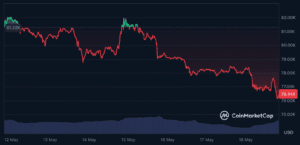
Bitcoin fell below $77,000 on Monday as ETF outflows, rising Treasury yields, oil-price pressure, and forced liquidations pushed the market into a deeper risk-off mood.
BTC is trading around $76,453, after touching an intraday low near $76,056 and failing to hold above the $78,000 area. The move pulled Bitcoin back to its weakest level in weeks and forced traders to refocus on the mid-$70,000 support zone.


The selloff followed a difficult week for spot Bitcoin ETFs, which recorded about $1 billion in net outflows and ended a six-week inflow streak. Crypto liquidations also accelerated, with market data cited in Monday updates placing total liquidations near $661 million over 24 hours as Bitcoin dropped to a two-week low around $76,700.
Bitcoin Loses the $77,000 Line
Bitcoin’s break below $77,000 matters because the market had already failed to build strength above $80,000.
For several sessions, BTC tried to stabilize near the upper-$70,000 range, but buyers could not turn that area into a stronger base. Once the price slipped below $77,000, leveraged traders started facing more pressure, and the market moved quickly toward the next support zone.
The latest price action shows a market that is still looking for a firm floor. Bitcoin has not collapsed into a full trend breakdown, but it has lost short-term momentum. Traders are now watching whether the $75,000 to $76,000 area attracts spot buyers or whether the selling pressure continues into a deeper test.
This is why the current move feels different from a normal intraday dip. Bitcoin is not only reacting to one headline. It is dealing with a mix of macro pressure, ETF weakness, and leverage unwinding at the same time.
ETF Outflows Remove a Key Support
Spot Bitcoin ETFs have been one of the most important demand channels in this cycle, so a sharp outflow week changes the market mood.
U.S. spot Bitcoin ETFs recorded close to $1 billion in weekly net outflows, ending six straight weeks of inflows. That matters because ETF buying had helped support Bitcoin during earlier pullbacks. When that flow turns negative, traders lose one of the strongest signs of institutional demand.
The problem is not only the size of the outflows. It is the timing. Bitcoin was already struggling to reclaim $80,000, and the ETF reversal arrived while yields and oil prices were rising. That combination made the market more fragile because both crypto-native demand and macro conditions weakened together.
If ETF flows stabilize quickly, the outflow week may look like a temporary reset after a strong inflow streak. If outflows continue, Bitcoin may have a harder time building a recovery because spot buyers will need to absorb more selling without the same ETF support.
Rising Yields Make Risk Assets Harder to Hold
Bitcoin is also being pressured by the bond market.
Higher Treasury yields make safer assets more attractive because investors can earn more from government debt without taking Bitcoin-level volatility. When yields rise quickly, traders often reduce exposure to risk assets, especially assets that had already rallied hard or were sitting near key resistance levels.
Recent market updates tied Bitcoin’s move lower to rising Treasury yields, higher oil prices, and renewed inflation concerns. The 10-year U.S. Treasury yield was cited near 4.6%, while the 30-year yield moved above 5%, adding pressure across risk markets.
This matters because Bitcoin is still trading like a high-liquidity risk asset during macro shocks. Long-term supporters may view BTC as scarce digital money, but short-term traders still respond to bond yields, inflation expectations, ETF flows, and Federal Reserve pricing.
That is why a strong on-chain supply story is not enough by itself. Bitcoin still needs fresh demand to overcome a tougher macro backdrop.
Liquidations Turn the Drop Into a Faster Move
Liquidations made the Bitcoin dump sharper than it might have been with spot selling alone.
When traders use leverage, their positions can be closed automatically if the market moves too far against them. That forced selling can add pressure after a key level breaks, especially when many traders are positioned in the same direction.
Monday’s selloff triggered roughly $661 million in crypto liquidations over 24 hours, with more than 107,000 traders affected in some market updates. Bitcoin accounted for a large share of the damage as BTC fell to its lowest level in about two weeks.
This is one reason Bitcoin can move so violently around support levels. A drop below $77,000 does not only trigger human selling. It can also trigger exchange-driven liquidations that close leveraged long positions automatically. That process can push price lower, which then creates more liquidation risk.
The good news is that liquidation flushes can sometimes clear excess leverage and help markets reset. The bad news is that they can also expose weak spot demand if buyers do not step in after the forced selling slows.
Oil and Geopolitics Add Another Layer of Stress
Bitcoin’s dump also happened while energy and geopolitical risks were adding pressure to global markets.
Oil-price strength can feed inflation fears because higher energy costs raise pressure on consumers and businesses. That makes traders more cautious about Federal Reserve policy and can reduce appetite for speculative assets. Several market updates linked Bitcoin’s weakness to higher oil prices, rising yields, and renewed geopolitical tension around Iran.
For Bitcoin, the issue is not only whether a geopolitical headline is directly about crypto. The issue is how those headlines affect liquidity and risk appetite. When oil jumps, yields rise, and equity futures soften, crypto traders often cut risk first and ask questions later.
That is why Bitcoin’s current support test is happening in a difficult environment. Bulls need more than a technical bounce. They need signs that macro pressure is cooling and that ETF demand is not continuing to drain liquidity.
What Traders Should Watch Next
The first level to watch is the $75,000 to $76,000 zone.
If Bitcoin holds that area and liquidations slow, traders may start looking for a bounce back toward $78,000. A stronger recovery would need BTC to reclaim $80,000 with better spot volume, because that level has become an important confidence marker after the latest rejection.
The second signal is ETF flow. A return to inflows would help repair sentiment, while another heavy outflow day could make the market more defensive. ETF demand is not the only force in Bitcoin, but it has become too large to ignore.
The third signal is Treasury yields. If yields cool, risk assets may get room to stabilize. If yields keep rising, Bitcoin rallies may stay weak because investors will have less reason to chase volatile assets.
The fourth signal is whether stablecoin liquidity turns into spot buying. Cash on exchanges can support a rebound, but only if traders actually deploy it. If stablecoins sit idle while BTC keeps testing support, the market may remain nervous.
Key Takeaway
Bitcoin’s drop below $77,000 shows how quickly the market can weaken when ETF outflows, rising yields, oil pressure, and leverage all move against bulls.
The selloff does not mean Bitcoin’s long-term story is broken, but it does show that short-term demand has weakened. Bulls now need BTC to defend the mid-$70,000 range, ETF flows to stabilize, and Treasury yields to stop rising before the market can rebuild confidence.
Disclaimer: This article is for informational purposes only and does not constitute financial, investment, or legal advice. Always conduct your own research before making any investment decisions.