

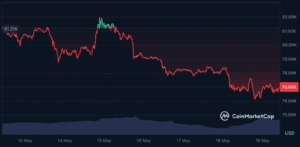
Bitcoin is back near $76,000 as US-Iran tensions, rising oil prices, and a global bond rout push traders away from risk assets.
BTC is trading around $76,937, after touching an intraday low near $76,056 and failing to rebuild momentum above the upper-$70,000 range. That keeps Bitcoin in a fragile short-term setup where buyers need to defend the mid-$70,000 zone before the market can regain confidence.


The pressure is coming from more than crypto-native selling. Oil prices climbed as Middle East tensions fed inflation fears, while U.S. Treasury yields pushed higher. The U.S. 10-year yield recently peaked near 4.631%, and the 30-year yield climbed above 5.1%, creating a difficult backdrop for Bitcoin and other risk assets.
Bitcoin Is Trading Like a Risk Asset Again
Bitcoin’s move toward $76,000 shows that traders are still treating BTC as a high-volatility risk asset during macro stress.
That matters because Bitcoin is often discussed as a hedge against political instability, inflation, or financial-system risk. In practice, short-term price action can look very different. When bond yields rise quickly and oil prices add to inflation fears, many investors reduce exposure to volatile assets first. Bitcoin can get sold alongside tech stocks, smaller altcoins, and other speculative markets.
The latest drop fits that pattern. Traders are not only reacting to one crypto headline. They are responding to a wider macro shock where war risk, energy prices, bond yields, and central bank expectations are all moving at the same time.
The Bond Rout Is Making Bitcoin Harder to Hold
The bond market is one of the biggest reasons Bitcoin is under pressure.
When Treasury yields rise, investors can earn more from government debt. That makes risky assets less attractive, especially when the 30-year U.S. Treasury yield is sitting above 5%. A higher long-term yield gives large investors a stronger reason to demand better returns before taking Bitcoin-level volatility.
Global bond markets have been hit by fears that rising energy prices could keep inflation high and force central banks to stay tighter for longer. Reuters coverage of the bond selloff described rising energy prices from the Iran conflict as a key factor behind the global rout, with investors also watching possible rate hikes from major central banks.
For Bitcoin, that creates a simple problem. BTC does not pay yield. When safe yields rise, the opportunity cost of holding Bitcoin rises too. That does not destroy Bitcoin’s long-term thesis, but it can pressure price in the short term when traders are already nervous.
US-Iran Tensions Add Oil and Inflation Pressure
The geopolitical side of the selloff is coming through oil.
Brent crude rose above $111 before easing, as markets reacted to renewed Middle East tensions and uncertainty around peace talks. Higher oil prices can feed inflation expectations because energy costs touch shipping, travel, production, food, and consumer spending. That makes bond investors demand higher yields and can make risk assets weaker.
This is why US-Iran headlines matter for Bitcoin even when the news is not directly about crypto. A geopolitical shock can raise oil prices, oil can raise inflation fears, inflation fears can push yields higher, and higher yields can reduce appetite for BTC.
The chain reaction is what traders are watching now. Bitcoin is not falling only because people dislike crypto this week. It is falling because the wider market is repricing risk.
The $76,000 Area Becomes the Immediate Test
Bitcoin’s next important test is whether buyers can defend the $75,000 to $76,000 area.
BTC has already touched an intraday low near $76,056, which puts the market close to that support band. If buyers step in and liquidations cool, Bitcoin could try to recover toward $78,000 and then the more important $80,000 level. A move back above $80,000 would help repair confidence because it would show that the latest macro shock did not break the broader range.
If the $75,000 to $76,000 area fails, traders may start looking for lower support. That could make the market more sensitive to forced selling, especially if leveraged longs are still crowded.
The current setup is fragile because support is being tested while macro conditions remain uncomfortable. Bulls need both price defense and calmer outside markets. Without that, even small bounces can fade quickly.
This Is Not the Same as a Pure Crypto Selloff
The important difference in this move is that Bitcoin is being hit from outside the crypto market.
A pure crypto selloff might come from exchange failures, protocol exploits, regulatory shocks, or whale selling. This decline is more macro-driven. Bond yields are rising, oil is elevated, global equities are under pressure, and traders are questioning whether central banks can ease policy if inflation risks stay high.
That context matters for traders because it changes what can fix the move. A crypto-only problem can sometimes stabilize when bad positioning clears. A macro problem may need yields to cool, oil to retreat, or geopolitical tension to ease before risk appetite improves.
Bitcoin can still rebound while macro pressure remains high, but it becomes harder. Traders may be more willing to sell rallies if they believe yields will keep climbing or energy prices will keep inflation sticky.
What Traders Should Watch Next
If the U.S. 10-year yield stays near the 4.6% area and the 30-year yield remains above 5%, Bitcoin may struggle to rebuild momentum. If yields cool, traders may become more comfortable adding risk again.
The second signal is oil. A move lower in crude prices could ease inflation concerns and help risk assets stabilize. If oil keeps rising because US-Iran tensions worsen, Bitcoin may stay under pressure even if crypto-native data improves.
The third signal is whether BTC holds $75,000 to $76,000. That zone is now the short-term line bulls need to protect. A clean defense would give the market room to breathe, while a break could bring more selling.
The fourth signal is spot demand. ETF flows, stablecoin buying, and exchange order books will show whether buyers are using this drop or waiting for deeper weakness.
FAQ
Why are US-Iran tensions affecting Bitcoin?
US-Iran tensions can lift oil prices and inflation fears. That can push bond yields higher, reduce risk appetite, and pressure Bitcoin because traders often treat BTC as a volatile risk asset during macro stress.
Why do higher bond yields hurt Bitcoin?
Higher yields make government debt more attractive compared with non-yielding assets like Bitcoin. When safe yields rise, investors often demand more reward before holding volatile assets.
What Bitcoin level matters now?
The key short-term area is $75,000 to $76,000. Bitcoin needs to defend that range to avoid a weaker setup and rebuild momentum toward $78,000 to $80,000.
Disclaimer: This article is for informational purposes only and does not constitute financial, investment, or legal advice. Always conduct your own research before making any investment decisions.