One day after SoFi became the first US bank to launch a stablecoin inside a banking app, the next domino fell. And it’s a much bigger one.
Block’s Cash App quietly began rolling out USDC stablecoin payments on Wednesday to its nearly 60 million monthly active users. The feature is currently live for about 25% of the user base, with full availability expected by the end of this week.


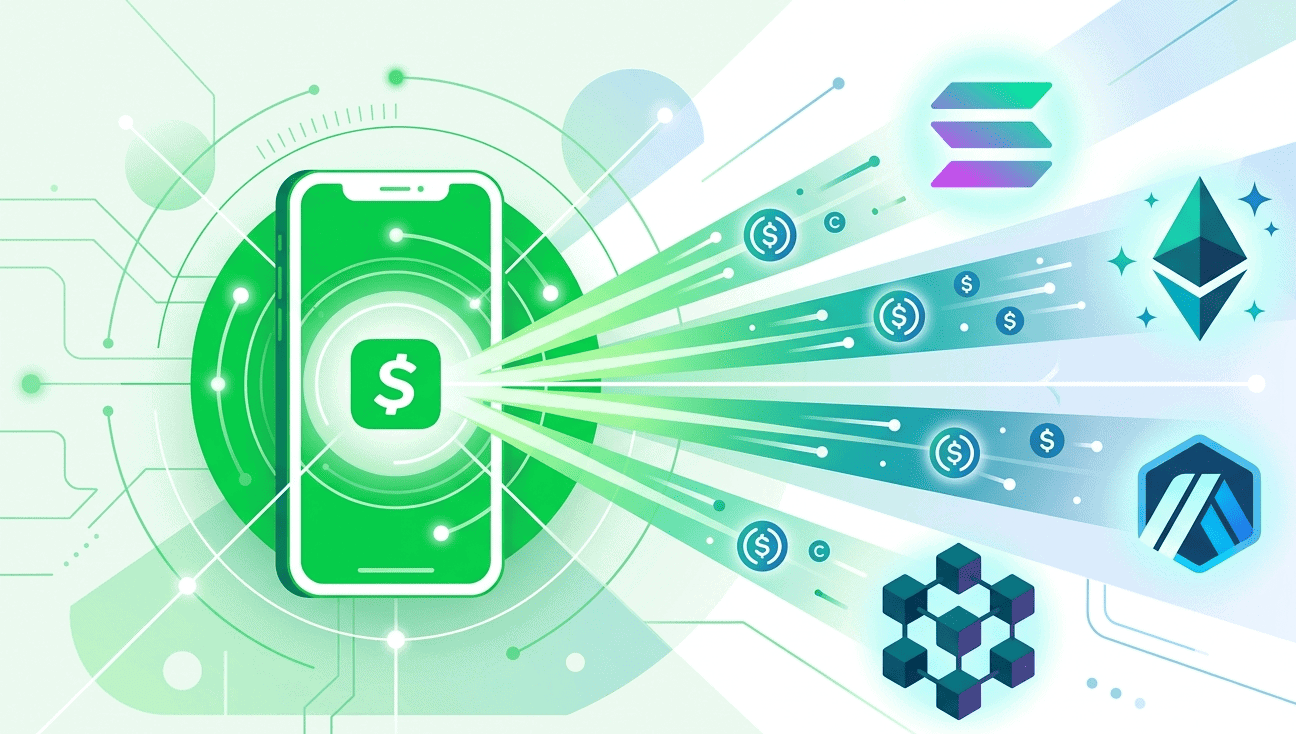
Users can send and receive USDC across four blockchain networks, Solana, Ethereum, Polygon, and Arbitrum, with zero transfer fees. Received USDC is automatically converted into a US dollar balance. No separate crypto wallet needed. No exchange account required. Just open Cash App and send stablecoins the same way you’d send dollars to a friend.
For a platform that 60 million Americans already use to split dinner bills, pay rent, and receive paychecks, adding stablecoin transfers is one of the most significant crypto distribution events in history. SoFi’s launch yesterday gave 15 million users a bank-issued stablecoin. Cash App just quadrupled that audience overnight.
The Bitcoin Maximalist Who Gave In to Customer Demand
The most fascinating part of this story is who made the decision.
Jack Dorsey has spent years positioning himself as one of the most committed Bitcoin maximalists in the tech industry. Block (formerly Square) has invested hundreds of millions in Bitcoin mining hardware. Dorsey personally advocated for a Bitcoin-only future and pushed back against altcoins, stablecoins, and everything else that wasn’t BTC.
That philosophy just collided with reality. In March, Dorsey acknowledged the shift publicly. “I don’t like that we’re going to support stablecoins but our customers want to use them,” he said. “I don’t think it’s wise to go from one gatekeeper to another.”
That candid admission tells you everything about what’s driving this rollout. It’s not ideology. It’s a demand. Cash App’s 60 million users asked for stablecoins, and Dorsey decided that refusing to give them what they wanted was worse than compromising his Bitcoin-only stance.
Block still views Bitcoin as its core crypto focus. Dorsey has described stablecoins as a bridge to Bitcoin adoption rather than a destination. But the practical effect is the same regardless of the philosophical framing: 60 million Americans now have access to USDC on four blockchains through an app they already use every day.
How It Works in Practice
The user experience is designed to feel like sending dollars, not interacting with a blockchain.
Cash App members with verified identities can send USDC to any external wallet address on Solana, Ethereum, Polygon, or Arbitrum directly from their app. They can also receive USDC from external wallets, including self-custody wallets, DeFi protocols, and other exchanges. When USDC arrives, Cash App automatically converts it to a dollar balance.
There are no transfer fees at launch. Cash App absorbs the blockchain network fees, making the experience genuinely free for users. That’s a significant advantage over traditional remittance services and even some crypto exchanges that charge withdrawal fees.
Transaction limits keep the feature within the consumer payment territory. Sending is capped at $2,000 per day and $5,000 per week. Receiving is capped at $10,000 per week. These limits position the feature as a payment tool rather than a trading instrument. You can send rent money, pay a freelancer, or receive a payment from overseas, but you’re not going to be moving institutional sums.
The multi-chain support is notable. Rather than restricting USDC to a single blockchain, Cash App lets users choose between Solana (fast and cheap), Ethereum (widely supported), Polygon (low-fee Ethereum scaling), and Arbitrum (another Ethereum Layer 2). That flexibility addresses one of the biggest pain points in crypto: different people use different networks, and a payment app needs to meet them where they are.
The feature is currently unavailable in New York due to state-specific regulatory requirements and is not available on sponsored accounts.
Two Stablecoin Launches in 24 Hours. That’s Not a Coincidence
SoFi launched SoFiUSD on Wednesday morning. Cash App began its USDC rollout on Wednesday afternoon. Two of the most widely used financial apps in America added stablecoin functionality on the same day.
That simultaneous timing reflects a market where the competitive pressure to offer stablecoin services has reached a tipping point. Neither company wants to be the one without it when the other has it.
The approaches are different but complementary. SoFi issued its own proprietary stablecoin (SoFiUSD) and is positioning it as an integrated banking product with plans for FDIC-insured tokenized deposits. Cash App chose to support the existing market leader (USDC) and is positioning it as a payment rail with zero fees and multi-chain support.
SoFi’s approach is more ambitious in the long term. Owning the stablecoin gives the bank control over issuance, reserves, and the economic relationship with its users. Cash App’s approach is more practical in the short term. Supporting USDC means instant compatibility with every DeFi protocol, exchange, and wallet that already accepts the world’s second-largest stablecoin.
Combined, these two launches put stablecoin functionality in front of approximately 75 million Americans in a single day. Add PayPal’s PYUSD (which reaches over 400 million accounts globally) and the stablecoin market has gone from crypto-native infrastructure to mainstream consumer product in the space of 18 months.
What This Means for the 60 Million People Who Use Cash App
For regular Cash App users, the USDC feature unlocks several practical use cases that weren’t available before.
Cross-border payments become dramatically cheaper. Sending $500 to a family member overseas via Western Union or a traditional bank wire costs $15 to $50 in fees and takes 1 to 3 business days. Sending $500 in USDC through Cash App incurs no transfer fees and settles in seconds on Solana or within minutes on Ethereum.
Freelancers and gig workers can now receive payments in USDC from clients who prefer to pay on-chain. A designer in Dallas who does work for a crypto-native company in Berlin can receive USDC directly to their Cash App, where it automatically converts to spendable dollars. No exchange account. No manual conversion. No waiting for international bank transfers.
Anyone who earns USDC through DeFi, staking, or other on-chain activities can now withdraw directly to Cash App and spend it like regular cash. That bridge between on-chain earning and real-world spending has been one of the biggest friction points in crypto. Cash App just eliminated it for 60 million people.
The risks are real and worth understanding. Blockchain transactions are irreversible. If you send USDC to the wrong address or select the wrong network, the funds are gone permanently. Cash App cannot reverse on-chain transactions. Users who are new to blockchain transfers should start with small amounts and double-check every address before confirming.
The Stablecoin Race Is Now a Sprint
Step back and look at what happened in a single week.
SoFi launched the first bank-issued stablecoin inside a consumer app. Cash App rolled out zero-fee USDC transfers to 60 million users. Circle minted $3.25 billion in fresh USDC on Solana. Mastercard secured a New York BitLicense for digital asset activities. Twenty banks remain queued to issue stablecoins through Anchorage Digital. And the GENIUS Act continues providing the regulatory foundation for all of it.
The stablecoin market has crossed $320 billion in total supply. USDC alone accounts for approximately $34 billion. And with Cash App, SoFi, PayPal, Visa, and Mastercard all integrating stablecoin functionality into products used by hundreds of millions of people, the growth trajectory is steepening rather than flattening.
For the crypto industry, the Cash App rollout is the kind of adoption event that changes the narrative permanently. When 60 million people can send and receive USDC through an app they already use for everyday payments, stablecoins stop being a crypto product and become a financial product. The distinction matters because financial products reach everyone. Crypto products reach crypto people.
Jack Dorsey didn’t want to support stablecoins. His customers made him do it. And that might be the most bullish signal of all, because when customer demand forces the hand of a Bitcoin maximalist, you know the trend is unstoppable.
FAQ
How many Cash App users can access USDC?
The feature is currently live for approximately 25% of Cash App’s nearly 60 million monthly active users, with full availability expected by the end of this week. Users need to verify their identity to access the feature. It is currently unavailable in New York and on sponsored accounts.
Are there fees for sending USDC on Cash App?
No. Cash App absorbs the blockchain network fees at launch, making USDC transfers free for users. Sending is capped at $2,000 daily ($5,000 weekly), and receiving is capped at $10,000 weekly. The feature supports USDC on Solana, Ethereum, Polygon, and Arbitrum.
How is this different from SoFi’s stablecoin launch?
SoFi issued its own proprietary stablecoin (SoFiUSD) through its national bank charter. Cash App supports USDC, the existing market-leading stablecoin issued by Circle. SoFi’s approach gives it control over issuance and reserves, with plans to offer FDIC-insured deposits. Cash App’s approach offers instant compatibility with the broader crypto ecosystem and zero transfer fees across four blockchain networks.
Disclaimer: This article is for informational purposes only and does not constitute financial advice. Cryptocurrency investments carry significant risk. Always conduct your own research before making any investment decisions.