
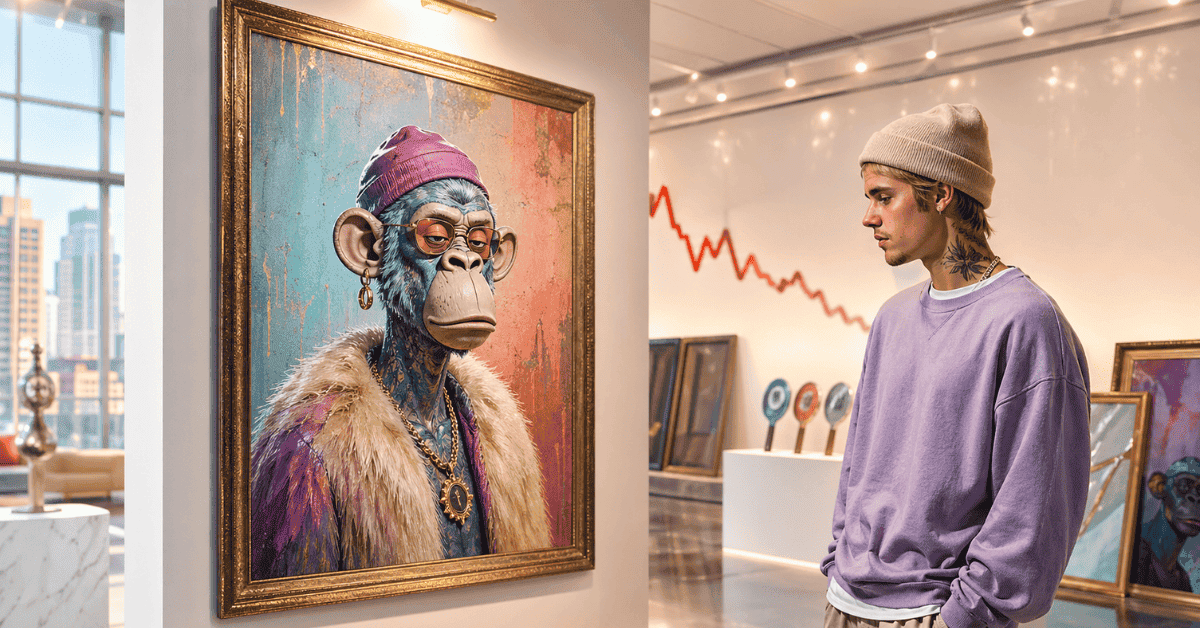
Justin Bieber’s once-famous Bored Ape Yacht Club purchase is back in the spotlight after reports estimated that the NFT he bought for about $1.3 million in 2022 is now worth roughly $12,000.
Bieber bought Bored Ape #3001 in January 2022 for 500 ETH, near the peak of celebrity-driven NFT mania. At the time, Bored Ape Yacht Club was one of the hottest collections in crypto, attracting musicians, athletes, influencers and traders who treated profile-picture NFTs as both status symbols and speculative assets.


Today, the same purchase looks very different. The estimated value of Bieber’s Ape has fallen by about 99% in dollar terms, turning it into one of the clearest examples of how brutally the NFT market has repriced since the last bull cycle.
Why Bieber Paid So Much
The NFT Boom Was About Status and Scarcity
In early 2022, NFTs were not only digital collectibles. They were cultural signals. Owning a Bored Ape meant joining an exclusive online club that had celebrity visibility, private events, token airdrops and a fast-rising floor price.
That atmosphere helped push prices far beyond what most traditional collectors would consider reasonable. Buyers were not simply paying for an image. They were paying for access, social status, future expectations and the belief that blue-chip NFT collections could become enduring digital brands.
Bieber’s purchase fit that moment perfectly. The market was hot, ETH was still relatively strong and celebrity wallets were being watched closely by NFT traders.
The Ape Was Not Especially Rare
The criticism at the time was that Bieber did not buy one of the rarest Apes. Bored Ape #3001 was widely described by NFT collectors as a “floor ape,” meaning it had relatively common traits and did not rank especially high on rarity lists.
That made the price stand out even more. Reports noted that Bieber paid far above the BAYC floor price at the time, meaning he spent significantly more than the cheapest available Bored Ape while not receiving an especially rare one.
In a rising market, overpaying can look harmless if the entire collection keeps climbing. In a falling market, it becomes painful quickly.
BAYC’s Floor Price Tells the Bigger Story
From Blue-Chip Status to Deep Repricing
Bored Ape Yacht Club remains one of the most recognizable NFT collections in the world, but its market has changed dramatically.
At its peak, BAYC represented the high end of Ethereum NFT culture. The collection’s floor price climbed into the hundreds of thousands of dollars during the 2022 mania, helped by Yuga Labs’ brand expansion, ApeCoin, Otherside metaverse hype and celebrity adoption.
Since then, prices have collapsed. Multiple market trackers and NFT reports show that BAYC floor prices have fallen sharply from peak levels, even though the collection still maintains more liquidity and recognition than most NFT projects.
That distinction matters. BAYC did not disappear. It simply stopped being priced like an unstoppable cultural asset.
Floor Price Is Only a Rough Valuation
The $12,000 estimate for Bieber’s NFT should be understood as a floor-based valuation, not a confirmed sale price.
NFTs are illiquid. A token is only truly worth what a buyer is willing to pay at the moment of sale. Because Bored Ape #3001 is not especially rare, analysts often estimate its value by looking at the BAYC floor price or comparable low-rarity sales.
That means Bieber may not have actually realized the loss unless he sells. Still, the mark-to-market decline is severe enough to show how much demand has faded from the NFT peak.
Celebrity NFT Hype Has Aged Poorly
The Star-Powered Cycle Broke Down
The Bieber example is part of a much larger pattern. During the NFT boom, celebrity purchases helped push collections into mainstream culture. Every major buy generated headlines, social media attention and a sense that NFTs were becoming the next big entertainment and fashion category.
But celebrity ownership did not protect prices once liquidity dried up. When crypto markets turned, NFT buyers became much more cautious. Thin markets, falling ETH prices, weak metaverse demand and regulatory questions all damaged confidence.
The result was a sharp unwind. Many celebrity-linked NFT purchases are now worth a fraction of their original prices, making them cautionary tales rather than endorsements.
The Market Learned a Hard Lesson About Liquidity
The NFT downturn also exposed a basic market problem: floor prices can fall quickly when there are not enough buyers.
Unlike major cryptocurrencies, individual NFTs do not trade in deep, continuous markets. Selling a high-profile NFT may require accepting a steep discount, especially if traders know the owner paid a much higher price.
That is why NFT losses can feel so dramatic. A collection’s floor can fall 80% or 90%, but a specific NFT may be even harder to sell if it lacks rare traits or fresh cultural demand.
What This Means for NFTs Now
Bieber’s Bored Ape loss does not mean NFTs are dead. It does show that the market has moved from hype-driven pricing toward a more selective phase.
Collectors are now asking harder questions. Does the NFT have real cultural value? Is there active community demand? Is the artwork historically important? Does ownership provide meaningful access, utility or status? Can the collection survive without constant celebrity attention?
Those questions are healthier than the 2021 and 2022 mindset, when many buyers assumed any major collection would keep rising.
The stronger NFT projects may still recover, especially if digital collectibles find better use cases in gaming, ticketing, loyalty programs, art, music or identity. But the era when celebrity buys alone could carry floor prices appears to be over.
What Comes Next
The next signal to watch is whether blue-chip Ethereum NFT floors continue recovering from their lows or whether recent rebounds fade again.
BAYC still has brand recognition, Yuga Labs support and a large holder base. But it also faces a very different market than the one that existed when Bieber bought in. Traders now care less about celebrity ownership and more about liquidity, execution and sustainable demand.
The second issue is whether NFT valuations become more trait-sensitive. If buyers become more selective, common pieces in famous collections may not recover as strongly as rare or historically important assets.
For now, Bieber’s $1.3 million Bored Ape is a reminder of how extreme the NFT boom became. At the top, digital status could command seven-figure prices. In today’s market, even one of the most famous celebrity-owned Apes is being valued closer to a used car than a luxury mansion.
Disclaimer: This article is for informational purposes only and does not constitute financial, investment, or legal advice. Always conduct your own research before making any investment decisions.