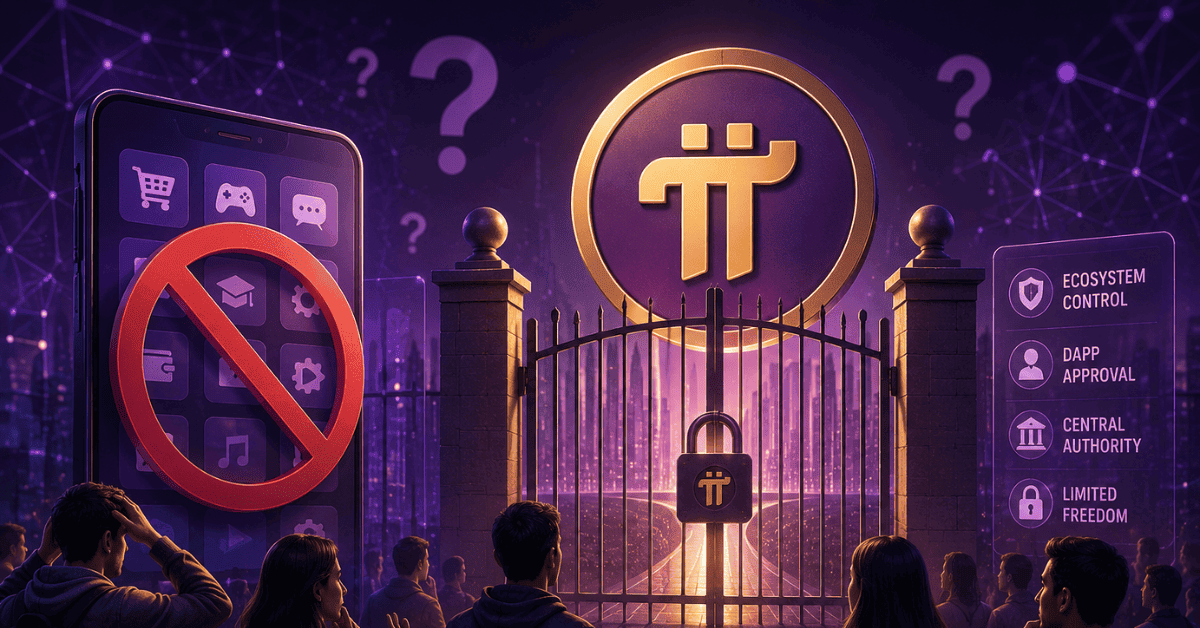
Pi Network DApp ban headlines are putting the project’s ecosystem governance back under scrutiny.
WorldBanksPi, reportedly one of the highest-ranked DApps inside the Pi Browser, was removed from the platform without warning despite having more than 140,000 users. The sudden removal has triggered debate across the Pi community because users and developers were not given a clear public explanation, appeal process or transition period.


For Pi supporters, the move may look like necessary cleanup. For critics, it is another sign that Pi Network remains heavily controlled by its core team.
Either way, the message is clear: if a DApp can disappear overnight, developers building inside the Pi ecosystem need to understand who really controls distribution.
What Happened to WorldBanksPi
WorldBanksPi had built a visible presence inside the Pi Browser.
According to recent reporting, the DApp had more than 140,000 users and ranked among the most prominent applications in the Pi ecosystem. Then it was removed. No gradual suspension. No public warning. No visible grace period.
The Pi Core Team reportedly made clear that the removal was part of a broader ecosystem cleanup, suggesting more enforcement actions could follow.
That creates two competing interpretations.
One interpretation is that Pi Network is trying to protect users by removing suspicious, low-quality or non-compliant applications. In a network where scams and unofficial Pi-related schemes have been a recurring concern, that argument has some weight.
The other interpretation is that developers are exposed to sudden platform risk. If a project can attract users and still be removed without a transparent process, builders may wonder whether Pi Browser is a stable place to launch serious applications.
Why This Matters for Pi’s Ecosystem
Pi Network has always depended heavily on community scale.
The project attracted millions of users with mobile mining, KYC onboarding and the promise of a broad app ecosystem where Pi could eventually be used in real commerce. But community size alone is not enough. A blockchain ecosystem needs useful applications, reliable developer tools and trust that builders will not be cut off arbitrarily.
That is why the WorldBanksPi removal matters beyond one DApp.
If Pi wants to become more than a token held by a large community, it needs developers to build services people actually use. Developers need rules, documentation, enforcement standards and appeal paths. If the rules are unclear, serious teams may hesitate.
A platform can clean up its ecosystem and still damage trust if enforcement feels opaque.
The Safety Argument Is Real
The Pi ecosystem has faced ongoing concerns about scams, fake apps, phishing, unauthorized listings and misleading promises.
That makes moderation important. A crypto ecosystem with millions of retail users cannot simply allow every project to operate freely if some apps may be abusing users, collecting sensitive data or creating unrealistic expectations.
In that sense, a strict enforcement move may be defensible. If the Pi Core Team believed WorldBanksPi violated platform rules or posed user risk, removing it could be the responsible action.
The problem is communication.
Even when an enforcement action is justified, users and developers need to understand the basic reason. Was the DApp removed for security issues? Misleading claims? Compliance concerns? Technical violations? User complaints? Something else?
Without an explanation, speculation fills the gap.
Centralized Control Remains the Core Debate
This story brings back one of the longest-running criticisms of Pi Network: centralization.
Many blockchains present themselves as open systems where developers can deploy applications without asking permission. Pi Browser, by contrast, appears to operate more like a curated platform. That can help with safety, but it also means the core team has significant power over what users can access.
That is not automatically bad. App stores, exchanges and payment platforms all moderate access. But it does mean Pi is not operating like a fully permissionless ecosystem in this area.
For users, the question is whether that control makes the environment safer.
For developers, the question is whether that control makes the environment too risky.
Both questions matter.
The Developer Trust Problem
Developers care about predictability.
If a team spends months building a DApp, acquiring users and integrating with Pi’s ecosystem, it needs confidence that access will not disappear overnight without clear due process. Otherwise, the platform risk becomes too high.
That does not mean Pi should never ban apps. Every serious ecosystem needs enforcement. But the strongest ecosystems usually combine enforcement with clarity.
Developers need to know what behavior triggers removal, how warnings are issued, whether appeals exist, and how users are protected if a DApp is taken down.
A sudden ban may solve one problem while creating another: fewer builders willing to take the risk.
What Pi Users Should Watch Next
The key thing to watch is whether the Pi Core Team explains the removal.
A clear explanation would help reduce uncertainty. It would also show whether the move was tied to a specific violation or part of a wider policy shift.
The second thing to watch is whether more DApps are removed. If this is the beginning of a broader cleanup, Pi users may see more sudden changes inside the Pi Browser.
The third thing to watch is developer reaction. If builders see the ban as necessary quality control, the ecosystem may benefit. If they see it as arbitrary control, it could weaken confidence.
The Bottom Line
Pi Network DApp ban coverage shows the tension at the heart of Pi’s ecosystem.
Removing WorldBanksPi may have been a safety measure, especially if the Pi Core Team saw risks that were not public. But banning a top DApp with more than 140,000 users without a clear warning or explanation also raises real questions about transparency and developer trust.
Crypto ecosystems need both safety and openness. Pi is leaning hard into control. The next test is whether it can explain that control well enough for users and builders to keep trusting the platform.
For now, WorldBanksPi’s removal sends a blunt message: inside Pi Browser, distribution is not guaranteed.
Disclaimer: This article is for informational purposes only and does not constitute financial, investment, or legal advice. Always conduct your own research before making any investment decisions.