The company behind the world’s most used stablecoin just posted one of the most impressive quarters in the history of finance. And it did it with roughly 150 employees.
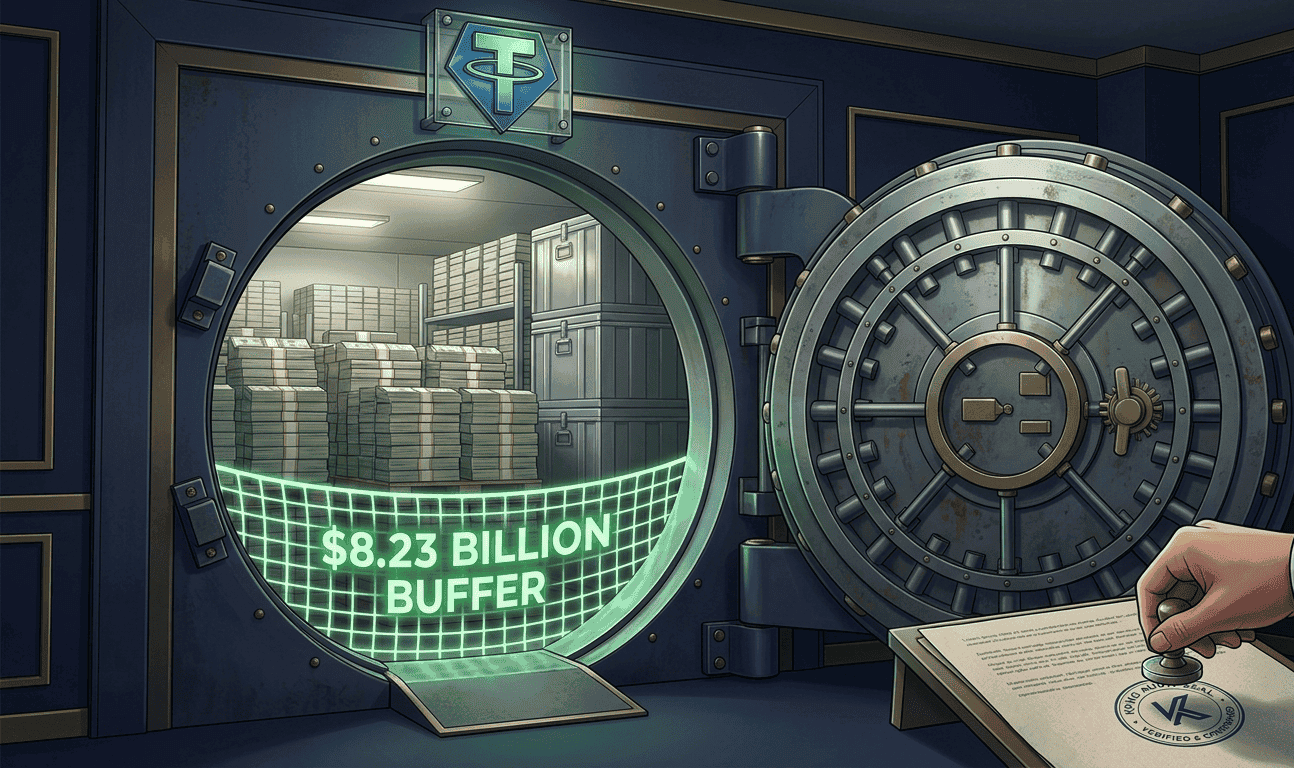
Tether earned $1.04 billion in net profit in the first three months of 2026. Its cash cushion, the amount of money it has over and above what it owes, grew to $8.23 billion. That is more spare cash than most mid-sized banks keep on hand. And USDT, its dollar-pegged stablecoin, reached a new all-time high of 570 million users worldwide.


CEO Paolo Ardoino kept it simple: “Our responsibility is to make sure USDT works without compromise. That means building a system that behaves the same way in any market condition.”
How Does Tether Make So Much Money?
The answer is surprisingly boring. Tether holds dollars. Those dollars earn interest. That interest is Tether’s profit.
When someone buys 1 USDT, they send Tether $1. Tether puts that dollar into safe, short-term investments, mostly US Treasury bills. Treasury bills currently pay over 4% per year. When you have $141 billion sitting in Treasuries, that 4% adds up to roughly $4 billion per year in interest income.
Tether does not share that interest with USDT holders. If you hold USDT in your wallet, you earn 0%. Tether keeps all the yield. That is the entire business model. It is basically a bank that does not pay interest on deposits.
On top of the Treasuries, Tether holds $20 billion in physical gold and $7 billion in Bitcoin. Those are not core to the business model. They are diversification plays. The gold and Bitcoin can go up or down, but the $141 billion in Treasuries generates predictable income every single quarter.
What Is the $8.23 Billion Reserve Buffer?
Think of it as a safety net. Tether has $191.77 billion in total assets. It owes $183.54 billion to USDT holders. The difference, $8.23 billion, is the buffer. That money belongs to Tether, not to USDT holders. It is profit that the company has kept on its balance sheet rather than distributing.
That buffer grew 47% in one year, from $5.6 billion in Q1 2025 to $8.23 billion in Q1 2026. It grew 30% from the $6.34 billion reported at the end of 2025. Every quarter, Tether earns about $1 billion and adds most of it to the buffer.
Why does the buffer matter? Because it protects USDT holders if something goes wrong. If Tether’s investments lose value, the buffer absorbs the loss before it affects the 1:1 backing. The $8.23 billion buffer represents about 4.5% of total liabilities. That is a thicker cushion than most traditional money market funds maintain.
To put it in context: the $8.23 billion buffer alone is larger than the total market cap of most stablecoins. It is bigger than the entire TUSD, FDUSD, and FRAX markets combined.
Is Tether Finally Getting Audited?
This is the question that has followed Tether for years. The company has never had a full audit from a Big Four accounting firm. Instead, it publishes quarterly “attestations” prepared by BDO, which verify that the numbers are accurate at a specific point in time but do not provide the deep forensic review that a full audit delivers.
That is changing. Tether said in its Q1 report that a formal KPMG audit “has formally commenced” as of March 2026. KPMG is one of the Big Four. If the audit is completed and published, it would be the first time Tether’s finances have been independently verified to the standard that regulators and institutional investors require.
The GENIUS Act, signed into law in July 2025, requires stablecoin issuers to maintain 1:1 reserves backed by cash or highly liquid instruments and to provide audit verification. The law takes full effect no later than January 18, 2027. Tether technically meets the reserve requirement based on its attestations, but the audit requirement is what it needs the KPMG engagement to satisfy.
If KPMG signs off, Tether’s credibility problem goes away overnight. If the audit reveals issues, the consequences would be massive for the entire crypto market.
How Big Is Tether Compared to Countries?
This is where the numbers get absurd. Tether is now the 17th-largest holder of US Treasuries on the planet. Not the 17th-largest fund. The 17th-largest holder, period. It has surpassed Taiwan, Israel, and the UAE. Only major sovereign nations and the largest central banks hold more American government debt than a company that did not exist 12 years ago.
Tether reported over $10 billion in profit for all of 2025. On an annualised basis, its Q1 2026 run rate projects roughly $4 billion for the year. That would make it more profitable per employee than almost any financial institution in history. Goldman Sachs earned $14 billion in 2025 with 45,000 employees. Tether earned $10 billion with about 150.
USDT in circulation stayed near $183 billion through Q1, with an additional $5 billion minted into early Q2. That brought total circulation to an all-time high. Tether said 570 million people now use USDT globally. Most of them are in emerging markets where USDT serves as a substitute for an unreliable local currency.
What Are the Risks?
Two big ones. The first is political. Senators Warren and Wyden opened their fourth investigation into ties between Tether and Commerce Secretary Lutnick’s family trust the day before this attestation was published. The timing was probably not a coincidence. If those investigations turn up evidence of improper relationships, Tether’s regulatory path in the US gets much harder.
The second is concentration. Tether’s reserves are heavily weighted toward US Treasuries, gold, and Bitcoin. If Bitcoin drops 30% in a single quarter, the $7 billion Bitcoin position could lose $2 billion, eating into the buffer. The Treasuries are safe, but the non-Treasury positions add volatility that a pure cash-and-Treasuries reserve would not have.
For now, the numbers speak for themselves. $1 billion in profit. $8.23 billion in buffer. $141 billion in Treasuries. 570 million users. A KPMG audit underway. Tether is either the most successful financial product of the decade or the most scrutinised. Probably both.
Frequently Asked Questions
How much profit did Tether make in Q1 2026?
Tether reported approximately $1.04 billion in net profit for Q1 2026. The company’s excess reserve buffer grew to a record $8.23 billion, up 47% from $5.6 billion a year earlier. Total assets reached $191.77 billion against $183.54 billion in liabilities.
How does Tether make money?
Tether earns interest on the reserves backing USDT. It holds approximately $141 billion in US Treasury bills, which at current rates above 4% generate roughly $4 billion per year in interest income. Tether does not share this interest with USDT holders.
Is Tether getting a Big Four audit?
Yes. Tether confirmed in its Q1 2026 attestation that a formal KPMG audit has “formally commenced.” If completed, it would be the first full Big Four audit of Tether’s finances. The GENIUS Act requires stablecoin issuers to provide audit verification by January 2027.
Disclaimer: This article is for informational purposes only and does not constitute financial, investment, or legal advice. Always conduct your own research before making any investment decisions.