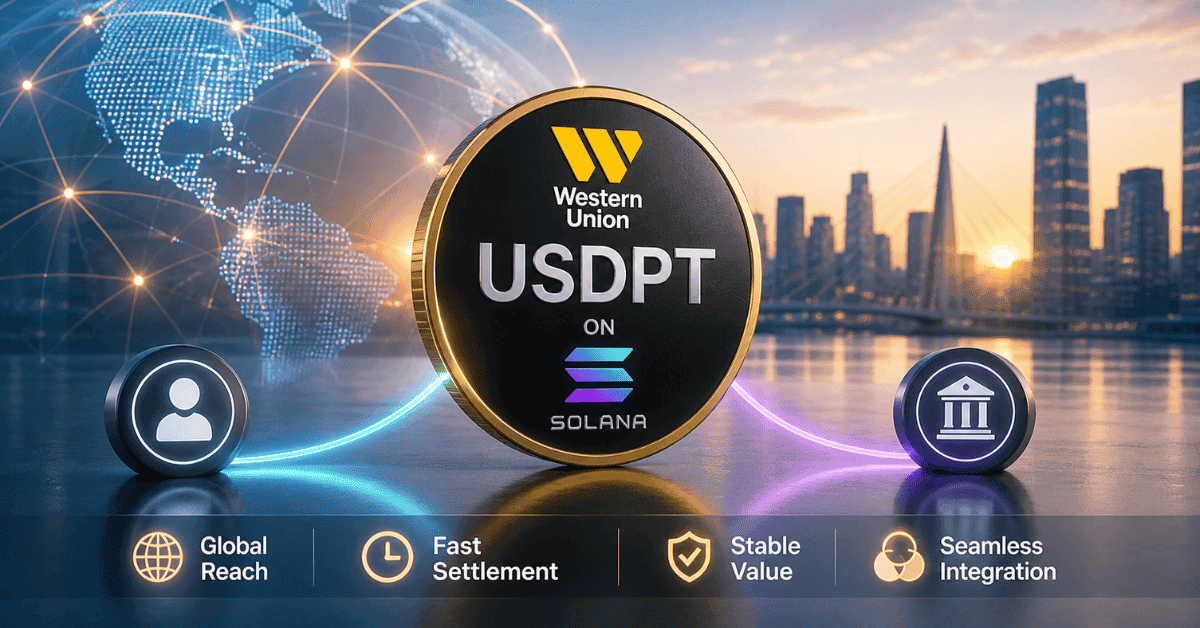
Western Union USDPT stablecoin has launched on Solana, giving one of the world’s best-known money transfer companies a regulated digital dollar for global settlement.
The token is designed to support faster blockchain-based payments and settlement across Western Union’s network. For a company historically built around cash transfers, agent locations and traditional payment rails, this is a major signal that stablecoins are moving from crypto trading into real financial infrastructure.


The interesting part is not just that Western Union is using a blockchain. It is that the company is using a public chain, Solana, for a dollar-backed payment token that can move value on-chain.
Why USDPT Matters
Stablecoins have already become one of crypto’s most useful products. Traders use them to move between assets, exchanges use them for liquidity and DeFi protocols use them as collateral.
Western Union is looking at the same technology from a different angle: settlement.
A remittance company does not need stablecoins because they are exciting. It needs them if they can move money faster, lower costs and reduce friction between markets. Cross-border payments still depend on banking relationships, time zones, fees and settlement delays. A tokenized dollar can simplify some of that.
That is why USDPT matters. It is not being launched as another speculative token. It is being positioned as payment infrastructure.
Solana Gets a Serious Payments Use Case
Solana has long pitched itself as a fast, low-cost blockchain suitable for payments, trading and consumer applications.
Western Union choosing Solana gives that pitch a stronger real-world example. A stablecoin linked to a global money transfer company is more meaningful than another short-lived token launch. It suggests that public blockchains are becoming part of how large payment companies think about settlement.
For Solana, the key benefit is credibility. If USDPT gains meaningful usage, it could strengthen the argument that Solana is not only a retail trading chain, but also a settlement layer for serious financial products.
The real test will be volume. A headline partnership is useful, but actual payment activity is what matters.
A Regulated Issuer Makes the Difference
USDPT is issued by Anchorage Digital Bank, which gives the product a more regulated structure than many offshore stablecoins.
That is important because payments companies cannot treat stablecoin compliance as an afterthought. They need clear rules around reserves, redemption, oversight and risk controls. A stablecoin used for global settlement has to be trusted by partners, regulators and users.
This is one reason the Western Union launch is notable. It combines three pieces that are becoming more common in serious stablecoin projects: a legacy payments brand, a regulated issuer and a public blockchain.
That combination is very different from the early stablecoin market, where many products were built mainly for crypto traders.
The Bigger Stablecoin Shift
Western Union’s move fits a larger trend.
Stablecoins are no longer only a crypto-native product. PayPal has PYUSD. Visa has tested stablecoin settlement. Banks and fintechs are studying tokenized deposits and regulated digital dollars. The direction is clear: stablecoins are becoming a payments battleground.
That does not mean every stablecoin will succeed. The market is already crowded, and USDT and USDC dominate crypto liquidity. A new stablecoin needs a strong reason to exist.
USDPT’s advantage is distribution. Western Union already has a global customer base, a payments network and deep experience in cross-border money movement. If USDPT becomes embedded inside that system, it could have a use case that goes beyond exchange trading.
What to Watch Next
The key thing to watch is whether USDPT becomes a real settlement tool or stays mostly symbolic.
If Western Union uses it across agents, partners and consumer products, the launch could become one of the more important stablecoin adoption stories of the year. If usage remains limited, it may be remembered as another corporate blockchain experiment.
Users should also watch how the product handles access, redemption, compliance and regional availability. Stablecoins only become useful when people and businesses can actually move in and out of them reliably.
For now, the launch shows that legacy payment companies are no longer sitting on the sidelines. They are starting to build directly with stablecoin rails.
The Bottom Line
Western Union USDPT stablecoin is a major sign that on-chain settlement is becoming part of mainstream payments.
The company is taking a regulated dollar-backed token, placing it on Solana and connecting it to a global money transfer strategy. That does not mean stablecoins are replacing traditional payments overnight, but it does show where the industry is heading.
Western Union spent more than a century moving money through traditional rails. Now it is testing what happens when those rails become programmable.
Disclaimer: This article is for informational purposes only and does not constitute financial, investment, or legal advice. Always conduct your own research before making any investment decisions.