
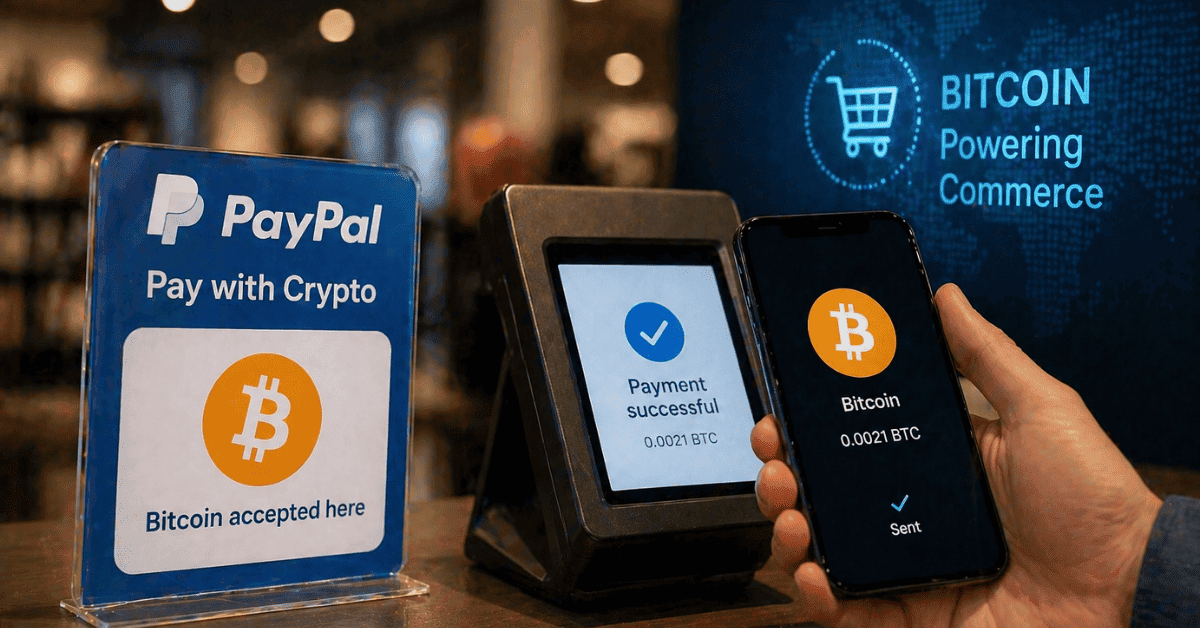
PayPal is putting crypto payments back near the center of its commerce strategy, and Bitcoin is one of the biggest names in the mix.
The payments giant has been expanding its crypto checkout tools for merchants, allowing U.S. businesses to accept more than 100 cryptocurrencies, including Bitcoin, Ethereum, USDT, USDC, Solana and XRP. PayPal says the feature is designed to help merchants reach global crypto users, reduce transaction costs and settle payments more efficiently.


That matters because PayPal is not a small crypto app. It is one of the largest consumer payments networks in the world. PayPal says it connects a global network of more than 400 million active consumer and merchant accounts, while its broader merchant reach is often discussed in the tens of millions.
The headline is simple: Bitcoin is getting another route into mainstream checkout.
PayPal’s Crypto Push Is Bigger Than Bitcoin Alone
This is not a Bitcoin-only product.
PayPal’s “Pay with Crypto” feature supports a wide range of digital assets and connects to external wallets including Coinbase, MetaMask, OKX, Phantom, Binance, Kraken and others. When a customer pays with crypto, PayPal can automatically convert the payment into fiat currency or PYUSD, its own dollar-backed stablecoin, for deposit into the merchant’s account.
That design is important. It lets merchants accept Bitcoin without necessarily holding Bitcoin.
For a small business, that can reduce the biggest concern around crypto payments: volatility. A merchant may want access to crypto buyers, but not want daily exposure to Bitcoin price swings. PayPal’s model gives them the payment option while handling conversion behind the scenes.
In other words, Bitcoin can function as global spending power for the customer, while the merchant can still receive a familiar settlement asset.
Why This Matters for Bitcoin Adoption
Bitcoin has long faced a practical adoption problem.
Many people hold it as a store of value, but far fewer spend it regularly. That is partly because Bitcoin is volatile, partly because tax rules can make spending complicated, and partly because not enough merchants accept it directly.
PayPal does not solve all of that. But it does make Bitcoin easier to plug into existing commerce.
Instead of asking millions of merchants to build crypto payment infrastructure from scratch, PayPal can add crypto acceptance to a payment network many businesses already understand. That lowers the friction for merchants and makes Bitcoin more visible as a payment option.
For Bitcoin supporters, this is the kind of infrastructure that matters. Price speculation gets the attention, but payment rails create utility.
The Real Business Case Is Lower Fees and Cross-Border Payments
PayPal is not pitching crypto payments only as a crypto-native feature. It is pitching them as a way to improve global commerce.
The company says crypto payments can reduce transaction costs, help merchants reach international customers and provide faster access to proceeds. PayPal has said its introductory crypto transaction fee is 0.99% for the first year, rising to 1.5% afterward, which it says can be meaningfully lower than many international card fees.
That cost angle is central. International payments are still expensive and slow for many businesses, especially smaller merchants selling across borders. Crypto payments, stablecoins and Bitcoin rails can offer a different settlement path.
Bitcoin may not be the cheapest or fastest option in every case, especially compared with stablecoins. But as the most recognized crypto asset, it gives PayPal’s crypto product immediate brand power.
PYUSD Is the Settlement Layer PayPal Controls
One of the more interesting parts of PayPal’s strategy is that Bitcoin is part of the front-end payment story, while PYUSD is central to the back-end settlement story.
PayPal’s stablecoin gives the company a native digital dollar inside its own ecosystem. Merchants can accept crypto and have proceeds settled in PYUSD, allowing PayPal to bridge volatile crypto assets with a more stable payment unit.
That makes the strategy broader than “PayPal likes Bitcoin.” The company appears to be building a system where Bitcoin, stablecoins and traditional currencies can all move through one payments interface.
For users, that means more ways to pay. For merchants, it means crypto access without needing to manage wallets, private keys or token volatility directly. For PayPal, it means the company can stay relevant as stablecoins and crypto payments become more competitive.
This Is Not Yet a Full Global Bitcoin Payment Revolution
The excitement around PayPal’s crypto push should be balanced with reality.
The merchant crypto checkout feature is initially focused on U.S. merchants, and availability depends on product rollout, regulation and supported wallets. PayPal’s own current wording refers to more than 400 million active consumer and merchant accounts worldwide, not a guaranteed 450 million active Bitcoin users.
That distinction matters. PayPal is not saying every user is suddenly paying with Bitcoin, and it is not saying every merchant will immediately accept Bitcoin. It is creating infrastructure that can make crypto acceptance easier.
Adoption will still depend on user demand, merchant incentives, fees, taxes and regulatory comfort.
Still, the direction is meaningful. Large payment companies do not add crypto infrastructure unless they believe there is a long-term commercial opportunity.
Bitcoin Is Becoming Part of the Payments Stack
The bigger story is that Bitcoin is moving from the edge of fintech into the payments stack of major financial platforms.
PayPal already helped normalize consumer crypto buying years ago. Now, its newer merchant tools are pushing crypto toward checkout, cross-border payments and business settlement.
That does not mean Bitcoin is replacing cards tomorrow. It does not mean merchants will abandon bank accounts. It does not mean stablecoins will not play a larger role in actual payment settlement.
But it does mean Bitcoin is gaining another path into real commerce.
For years, critics argued that Bitcoin was too speculative to be useful as money. PayPal’s latest crypto push does not fully settle that debate, but it makes the answer more complicated. If major payment platforms keep integrating Bitcoin, then Bitcoin’s role as global money becomes less theoretical.
The key test is whether people use it.
If customers pay, merchants accept and PayPal keeps expanding the product, Bitcoin’s commerce story could become much stronger. If usage stays low, the feature may remain more symbolic than transformational.
For now, PayPal’s message is clear: crypto payments are not going away, and Bitcoin is still one of the assets merchants cannot ignore.
Disclaimer: This article is for informational purposes only and does not constitute financial, investment, or legal advice. Always conduct your own research before making any investment decisions.