• About Us
  • Advertise
AltcoinReporter
  • Home
  • News
    • Bitcoin
    • Ethereum
    • Blockchain
    • Altcoins
    • DeFi
    • NFT
  • Press Releases
  • Reviews
    • Exchanges
    • NFT Marketplaces
    • Wallets
  • Market Analysis
  • Contact Us
No Result
View All Result
  • Home
  • News
    • Bitcoin
    • Ethereum
    • Blockchain
    • Altcoins
    • DeFi
    • NFT
  • Press Releases
  • Reviews
    • Exchanges
    • NFT Marketplaces
    • Wallets
  • Market Analysis
  • Contact Us
No Result
View All Result
AltcoinReporter
No Result
View All Result
Home Bitcoin

Bitcoin Has 32 Halvings, and Four Have Already Happened

Bitcoin’s supply schedule includes 32 halvings, with four already completed and the block reward now down to 3.125 BTC.

Dans Kramer by Dans Kramer
May 1, 2026
in Bitcoin
Bitcoin halving

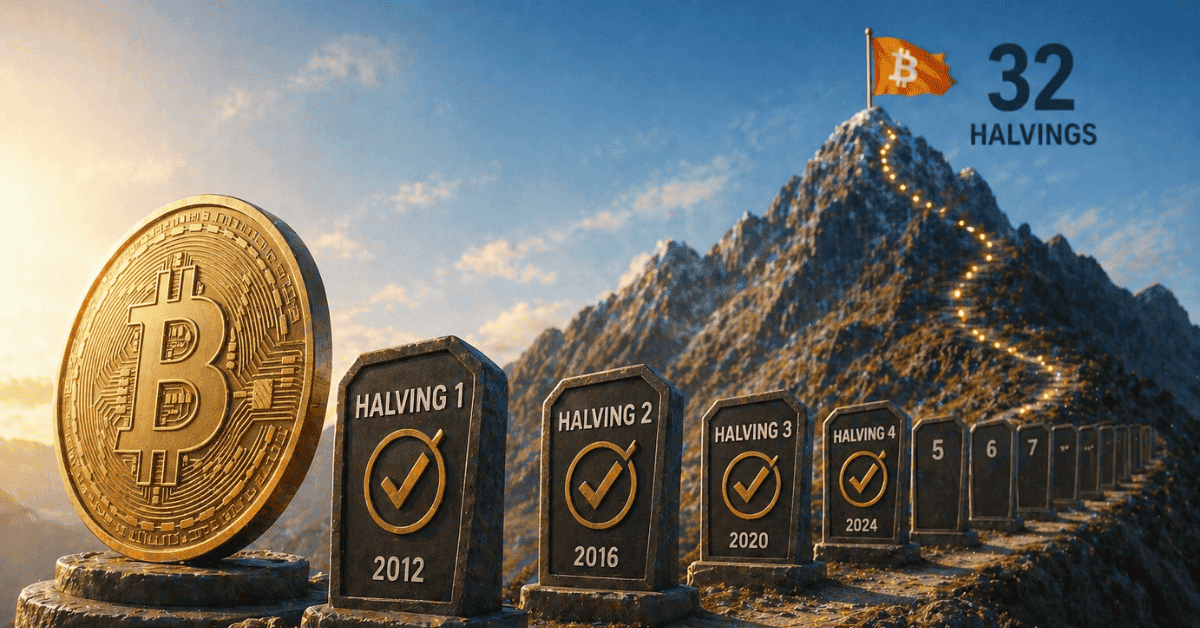
Bitcoin has 32 halvings built into its monetary design, and four of them have already happened.

That may sound like a small technical detail, but it is one of the most important facts about Bitcoin. The halving is the mechanism that gradually slows the creation of new BTC until the supply approaches its hard cap of 21 million coins.


Related articles

Bitcoin Crashes to $61,000 as $1.63 Billion Gets Liquidated in the Biggest Wipeout of 2026

Bitcoin Crashes to $61,000 as $1.63 Billion Gets Liquidated in the Biggest Wipeout of 2026

June 4, 2026
Europe’s Largest Bitcoin Treasury Seeks €5 Billion to Buy BTC While Strategy Sells

Europe’s Largest Bitcoin Treasury Seeks €5 Billion to Buy BTC While Strategy Sells

June 3, 2026

Bitcoin started with a block subsidy of 50 BTC per block in 2009. Roughly every 210,000 blocks, or about every four years, that subsidy is cut in half. After the fourth halving in April 2024, the reward fell from 6.25 BTC to 3.125 BTC per block.

This is why Bitcoin supporters often call it programmatic money. No central bank meeting is needed. No committee votes on issuance. The supply schedule is written into the network rules.

Four Bitcoin Halvings Have Already Happened

The first Bitcoin halving took place in November 2012, cutting the mining reward from 50 BTC to 25 BTC per block.

The second happened in July 2016, reducing the reward to 12.5 BTC. The third took place in May 2020, cutting it to 6.25 BTC. The fourth arrived in April 2024, bringing the reward down to 3.125 BTC.

Each halving reduces the amount of new Bitcoin entering circulation. It does not reduce the existing supply, and it does not directly change how many coins people already own. It simply slows future issuance.

That distinction matters. A halving is not a token burn. It is a supply growth reduction.

Why There Are 32 Halvings

Bitcoin’s smallest unit is one satoshi, equal to 0.00000001 BTC.

Because the block reward keeps being divided in half, the subsidy eventually becomes too small to continue in whole satoshis. After enough halvings, the block subsidy rounds down to zero. In Bitcoin’s design, that happens after 32 subsidy reductions.

That is why people often say Bitcoin has 32 halvings. The first four are already behind us, and the remaining halvings will continue approximately every four years until new BTC issuance effectively ends.

The final stages will not feel as dramatic as the early ones. Cutting the reward from 50 BTC to 25 BTC was a huge change in absolute terms. Cutting a tiny fraction of a bitcoin decades from now will matter much less to overall supply.

But the principle remains the same: Bitcoin’s new issuance keeps shrinking.

The Next Halving Is Expected Around 2028

The next Bitcoin halving is expected around 2028, though the exact date depends on block production speed.

Bitcoin targets an average block time of about 10 minutes. Since mining difficulty adjusts over time, the schedule stays roughly predictable, but not perfectly tied to the calendar.

At the next halving, the block subsidy will fall from 3.125 BTC to 1.5625 BTC. That means miners will receive half as much new Bitcoin for each valid block, not counting transaction fees.

This is why halvings are watched so closely by miners. Mining businesses must manage electricity costs, hardware efficiency and Bitcoin price volatility while their subsidy revenue periodically gets cut.

Halvings Matter Because They Change Miner Economics

For miners, the halving is not just a headline. It is a business model shock.

When the block subsidy falls, miners suddenly earn less BTC per block. If Bitcoin’s price does not rise enough to offset the reduction, less efficient miners can become unprofitable. That can force some miners to shut down older machines, sell reserves or consolidate with larger competitors.

This is why the halving often triggers discussion about mining difficulty, hash rate and miner capitulation.

However, Bitcoin’s security does not depend only on the subsidy. Transaction fees also reward miners. Over the long term, as the subsidy trends toward zero, Bitcoin’s security budget is expected to rely more heavily on fees.

That transition is one of the biggest long-term debates in Bitcoin.

Halvings Do Not Guarantee a Bull Market

Bitcoin halvings are often associated with bull markets, but they do not guarantee price increases.

The basic argument is simple: if new supply falls while demand stays the same or rises, price pressure can become positive. That is the scarcity story behind Bitcoin’s halving cycles.

But markets are more complicated than that. Liquidity, interest rates, ETF flows, regulation, miner selling, leverage and macro conditions all affect Bitcoin’s price. A halving is important, but it is not magic.

The cleaner way to think about it is this: halvings reduce Bitcoin’s new supply, but demand decides how much that scarcity matters.

Bitcoin’s Supply Story Is Getting Tighter

More than 19 million BTC have already been mined, which means most of Bitcoin’s total supply already exists.

The remaining coins will be released slowly over many decades. This gives Bitcoin a very different profile from fiat currencies, where supply can expand based on central bank decisions, government borrowing and financial system needs.

That does not automatically make Bitcoin risk-free. Bitcoin remains volatile, and its price can fall sharply. But its supply schedule is one of the few things about the asset that is highly predictable.

Investors can debate Bitcoin’s fair value. They can debate adoption. They can debate whether it is digital gold, a risk asset or something else entirely.

What they cannot easily debate is the issuance schedule.

The Bottom Line

Bitcoin has 32 halvings in its design, and four have already happened.

The block reward has fallen from 50 BTC in 2009 to 3.125 BTC today. The next halving is expected around 2028, when the reward will fall again to 1.5625 BTC.

That slow reduction is what makes Bitcoin’s monetary policy so different from traditional money. Bitcoin does not need anyone to promise scarcity. It enforces scarcity through code, block by block, halving by halving.

The most important takeaway is simple: Bitcoin’s supply is not controlled by mood, politics or central bank policy. It follows a schedule, and that schedule is still playing out.

Disclaimer: This article is for informational purposes only and does not constitute financial, investment, or legal advice. Always conduct your own research before making any investment decisions.


Dans Kramer

Dans Kramer Verified AltcoinReporter Author

Dans is a cryptocurrency writer at AltcoinReporter, focused on market analysis, trading strategies, and exchange reviews. He entered the crypto space in 2022, just after the bull run peak, and...

Read More
Tags: BitcoinBitcoin HalvingBitcoin SupplyBTCMining

Related Posts

Bitcoin Crashes to $61,000 as $1.63 Billion Gets Liquidated in the Biggest Wipeout of 2026

Bitcoin Crashes to $61,000 as $1.63 Billion Gets Liquidated in the Biggest Wipeout of 2026

by Salar Salek
June 4, 2026
0

Bitcoin opened Tuesday at $66,739. It briefly pushed to $67,477. Then the floor disappeared. By early Wednesday morning, BTC had...

Europe’s Largest Bitcoin Treasury Seeks €5 Billion to Buy BTC While Strategy Sells

Europe’s Largest Bitcoin Treasury Seeks €5 Billion to Buy BTC While Strategy Sells

by Salar Salek
June 3, 2026
0

Strategy just sold Bitcoin for the first time in four years. A French semiconductor company, Sequans Communications, announced it's liquidating...

BTC Falls Below $69,000 After Iran Kills Peace Talks and $766M Gets Liquidated

BTC Falls Below $69,000 After Iran Kills Peace Talks and $766M Gets Liquidated

by Salar Salek
June 3, 2026
0

Bitcoin dropped to $68,936 on Tuesday, breaking below $69,000 for the first time since April 7. The decline from an...

Strategy Breaks Its Four-Year Bitcoin Buying Streak With a Surprise Sale

Strategy Breaks Its Four-Year Bitcoin Buying Streak With a Surprise Sale

by Salar Salek
June 2, 2026
0

For five years, Strategy was the one constant in Bitcoin's chaotic universe. Markets crashed. Competitors folded. Regulators attacked. And through...

Bitcoin Bounces to $74K as Trump Hints at Lifting Hormuz Naval Blockade

Bitcoin Bounces to $74K as Trump Hints at Lifting Hormuz Naval Blockade

by Salar Salek
May 31, 2026
0

Bitcoin clawed back above $74,000 on Saturday after President Trump signaled that the US naval blockade of the Strait of...

Load More
  • Trending
  • Comments
  • Latest
Justin Sun vs WLFI: “See You in Court” as Backdoor Token Freeze Row Explodes

Justin Sun vs WLFI: “See You in Court” as Backdoor Token Freeze Row Explodes

April 13, 2026
Former UK Chancellor Kwarteng Leads Bitcoin Firm as Farage Backs BTC

Former UK Chancellor Kwarteng Leads Bitcoin Firm as Farage Backs BTC

April 16, 2026
Bitcoin Price Hits Highest Since January as Bulls Eye $85K

Bitcoin Price Hits Highest Since January as Bulls Eye $85K

May 7, 2026
Solana Alpenglow Upgrade 2026: Launch Date, Features, and What It Means for SOL

Solana Alpenglow Upgrade 2026: Launch Date, Features, and What It Means for SOL

April 18, 2026
North Korea’s Six-Month Con: How Hackers Stole $286M from Solana’s Drift Protocol

North Korea’s Six-Month Con: How Hackers Stole $286M from Solana’s Drift Protocol

0
Ethereum’s Glamsterdam Upgrade: What It Is and Why It Matters in 2026

Ethereum’s Glamsterdam Upgrade: What It Is and Why It Matters in 2026

0
Bitcoin’s Worst Q1 Since 2018: Can April Turn the Tide?

Bitcoin’s Worst Q1 Since 2018: Can April Turn the Tide?

0
Former UK Chancellor Kwarteng Leads Bitcoin Firm as Farage Backs BTC

Former UK Chancellor Kwarteng Leads Bitcoin Firm as Farage Backs BTC

0
Solana Tests Its Last Support at $65 as the Market Waits for Alpenglow

Solana Tests Its Last Support at $65 as the Market Waits for Alpenglow

June 6, 2026
XRP Drops to $1.11 as 60% of Holders Sit Underwater and the CLARITY Act Vote Looms

XRP Drops to $1.11 as 60% of Holders Sit Underwater and the CLARITY Act Vote Looms

June 6, 2026
Standard Chartered Names Three Conditions That Must Be Met Before Bitcoin Finds Its Bottom

Standard Chartered Names Three Conditions That Must Be Met Before Bitcoin Finds Its Bottom

June 5, 2026
JPMorgan Warns Time Is Running Out for the CLARITY Act as Banks Fight to Kill It

JPMorgan Warns Time Is Running Out for the CLARITY Act as Banks Fight to Kill It

June 5, 2026

About

AltcoinReporter

AltcoinReporter is an independent crypto news platform built to keep you ahead of the market. We cover everything from Bitcoin and altcoins to DeFi, NFTs, regulation, and emerging blockchain technology.


Our editorial team delivers accurate news, detailed market analysis, and expert insights, with every article written and reviewed by named contributors. We are committed to transparent, independent reporting our readers can trust.

News

  • Altcoins
  • Bitcoin
  • Blockchain
  • DeFi
  • Ethereum
  • NFT

Reviews

  • Exchanges
  • NFT Marketplaces
  • Wallets

Company

  • About Us
  • Advertise
  • Write for Us
  • Contact Us

Disclaimer: AltcoinReporter.com provides cryptocurrency news for informational purposes only, not financial, investment, or legal advice. Crypto markets carry significant risk. Always do your own research and consult a financial advisor before investing. We may earn compensation through affiliate links, ads, and sponsored content, which are clearly labelled. AltcoinReporter is not responsible for any financial losses resulting from information on this site.

  • Cookie Policy
  • Ethics
  • Corrections
  • Editorial Standards
  • Privacy Policy
  • Terms & Conditions

© 2026 AltcoinReporter. All rights reserved.

No Result
View All Result
  • Home
  • News
    • Altcoins
    • Bitcoin
    • Blockchain
    • DeFi
    • Ethereum
    • NFT
  • Press Releases
  • Reviews
    • Exchanges
    • NFT Marketplaces
    • Wallets
  • Market Analysis
  • Contact Us

© 2026 AltcoinReporter. All rights reserved.