
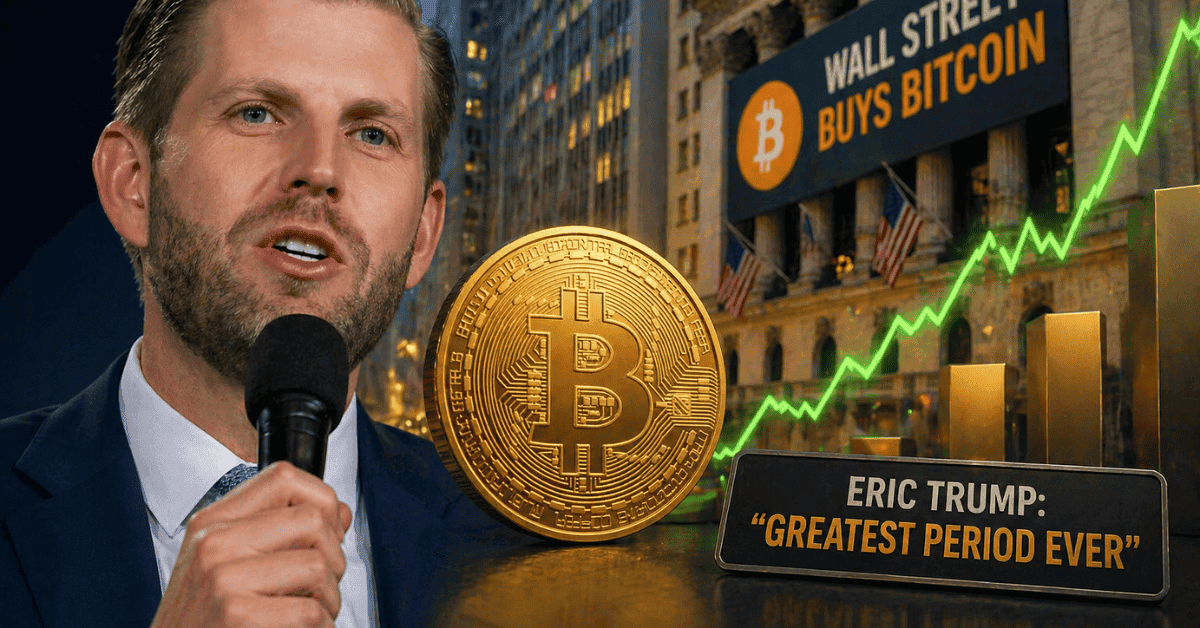
Eric Trump told the Bitcoin 2026 conference in Las Vegas that Bitcoin is in its “greatest period ever,” arguing that Wall Street’s shift toward BTC has changed the market’s long-term trajectory.
His comments came during a period when Bitcoin has become more deeply tied to traditional finance through spot ETFs, corporate treasury strategies, derivatives products and growing interest from major banks. For Trump, the message was simple: Bitcoin is no longer sitting outside the financial system. It is becoming part of it.


That argument is not new from Bitcoin bulls, but it carries more weight now because the market structure has changed. Investors no longer need a crypto exchange account or self-custody wallet to gain exposure. They can buy Bitcoin ETFs through familiar brokerage platforms, watch public companies hold BTC on their balance sheets and trade regulated products connected to the asset.
Wall Street Has Changed the Bitcoin Story
ETFs Opened the Door
The clearest sign of Wall Street’s arrival is the spot Bitcoin ETF market. Since U.S. ETFs launched, they have become one of Bitcoin’s most important demand channels, giving financial advisers, institutions and retail brokerage users an easier way to access BTC.
Eric Trump pointed to these products as evidence that Bitcoin has entered a new phase. ETF adoption has changed the conversation from whether institutions can access Bitcoin to how much exposure they want.
That matters because financial advisers and wealth platforms move slowly. Once products are approved, integrated and understood, allocations can build over time. Bitcoin does not need every institution to buy aggressively at once. It only needs a steady widening of access to change the demand base.
Banks Are No Longer Ignoring BTC
Trump also framed Wall Street’s shift as a cultural reversal. Large banks and financial firms that once dismissed Bitcoin are now building products around it, serving clients who want exposure or researching ways to integrate digital assets into their businesses.
This does not mean every bank is bullish on Bitcoin. Many still treat it as volatile, risky and sensitive to regulation. But the old wall between Bitcoin and traditional finance is clearly weaker than it used to be.
The result is a more professional market. Bitcoin now trades alongside macro assets, reacts to rate expectations and increasingly sits inside the same portfolio conversations as gold, equities and alternative investments.
Corporate Treasuries Add Another Layer
Strategy Changed the Playbook
Eric Trump’s comments also fit the broader corporate treasury trend. Strategy, formerly MicroStrategy, showed that a public company could build its entire financial identity around Bitcoin accumulation.
That model has inspired other companies to consider BTC as a treasury asset, although few have gone as far as Strategy. The idea is simple: if a company believes cash will lose purchasing power over time, Bitcoin can be framed as a long-term reserve asset.
The risk is also obvious. Bitcoin is volatile, and a treasury strategy built around BTC can expose shareholders to large swings. But the fact that companies are even having this conversation shows how far Bitcoin has moved from its early image as a fringe internet currency.
American Bitcoin Gives Trump a Direct Stake
Eric Trump’s own involvement in the sector also matters. He is tied to American Bitcoin, a Bitcoin mining and treasury-focused company that has made him one of the more visible political-family figures in the crypto industry.
That gives his comments additional attention, but it also means readers should understand the incentive. Trump is not a neutral outside observer. He is financially and publicly aligned with Bitcoin’s growth.
That does not make his argument automatically wrong. It does mean his bullish comments should be read as both market commentary and industry advocacy.
Why Bitcoin Bulls See This as a Turning Point
Bitcoin supporters argue that the current period is different from past cycles because the buyer base has matured.
Earlier Bitcoin rallies were often driven by crypto-native exchanges, retail speculation and offshore leverage. Today, BTC has access to ETF flows, corporate treasuries, public-market vehicles and regulated derivatives.
That deeper infrastructure may reduce some friction around ownership. It may also make Bitcoin more attractive to investors who previously avoided crypto because custody and compliance were too difficult.
The bullish case is that Bitcoin’s fixed supply is now meeting a much larger and more sophisticated demand channel. If that demand continues, long-term holders believe the asset can keep repricing upward over multiple cycles.
The Risks Have Not Disappeared
Institutional Adoption Cuts Both Ways
Wall Street’s arrival does not remove Bitcoin’s volatility. In some ways, it makes Bitcoin more connected to macro markets.
If investors are using Bitcoin ETFs as part of broader risk portfolios, BTC may react more strongly to interest rates, liquidity conditions and equity-market stress. That can help during risk-on periods, but it can also hurt during selloffs.
Institutional access also brings expectations. Large investors care about custody, regulation, tax treatment, liquidity and risk management. If any of those weaken, flows can reverse quickly.
Political Branding Can Complicate the Market
Eric Trump’s comments also highlight Bitcoin’s growing political visibility. The Trump family has become deeply involved in crypto, from mining ventures to token projects and public advocacy.
That attention can help crypto stay in the policy conversation, but it can also make Bitcoin more partisan in the eyes of some voters and regulators. Bitcoin’s strongest long-term argument has always been that it is neutral infrastructure. Too much political branding could make that harder to communicate.
For Bitcoin to keep broadening its institutional base, it may need to remain larger than any single political family, administration or market cycle.
What This Means for Bitcoin Investors
Trump’s “greatest period ever” claim captures the optimism many Bitcoin bulls feel right now. The asset has survived regulatory crackdowns, exchange failures, bear markets and repeated obituaries. Now, it is being packaged, traded and held through mainstream financial channels.
Still, investors should separate the long-term trend from short-term certainty. Bitcoin can be institutionally adopted and still experience sharp drawdowns. ETF inflows can be strong one month and weaker the next. Corporate buyers can add credibility, but they cannot eliminate market risk.
The more grounded takeaway is that Bitcoin’s market structure is stronger than it was in previous cycles. Whether that makes this its greatest period ever will depend on whether adoption continues after the excitement fades.
What Comes Next
The first signal to watch is ETF flow durability. If spot Bitcoin ETFs continue drawing capital across different market conditions, that would support Trump’s argument that Wall Street is becoming a consistent demand source.
The second signal is corporate balance-sheet adoption. More public companies adding BTC would show that Strategy’s model is influencing treasury policy beyond one firm.
The third signal is banking integration. If major banks expand custody, lending, trading or advisory services around Bitcoin, the asset’s role in traditional finance could deepen further.
For now, Eric Trump’s message reflects a broader shift already underway. Bitcoin is no longer trying to get Wall Street’s attention. Wall Street is already in the room, and the next question is how much bigger its role becomes.