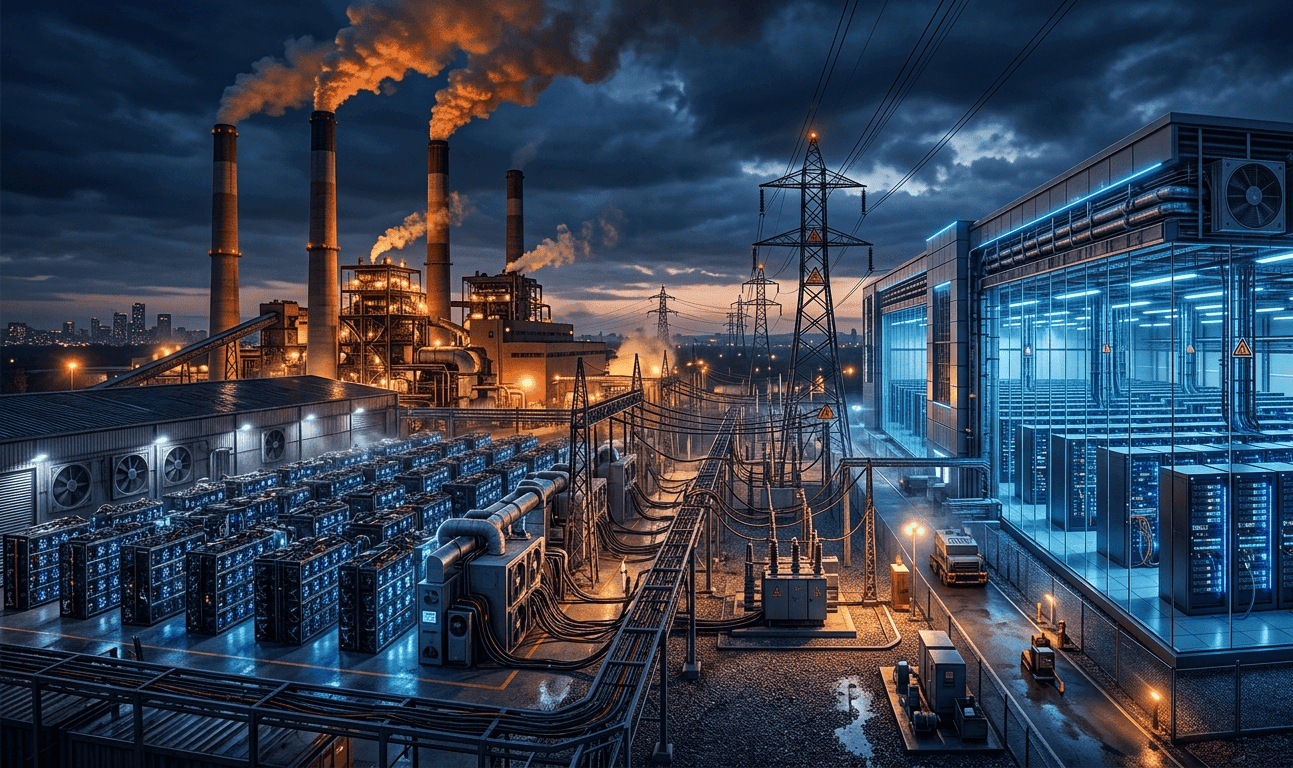
The biggest Bitcoin miner in America just spent $1.5 billion on something that has nothing to do with Bitcoin. Well, almost nothing.
MARA Holdings announced on Thursday that it will acquire Long Ridge Energy & Power from FTAI Infrastructure for approximately $1.5 billion, including at least $785 million in assumed debt. The deal gives MARA a 505 MW combined-cycle gas power plant in Hannibal, Ohio, plus 1,600 acres of land with water access, fibre links, fuel supply, and grid connections already in place.


MARA’s stock surged 13% on the news. Investors clearly liked what they saw. This is not a company buying more mining rigs. This is a Bitcoin miner transforming itself into an energy and AI infrastructure company.
What Did MARA Actually Buy?
A power plant. A big one. The Long Ridge facility runs a GE 7HA.02 combined-cycle gas turbine, one of the most efficient in the PJM power market. It generates electricity at less than $15 per megawatt-hour in all-in operating costs. That is cheap power in any market.
The site already hosts a 200 MW MARA data centre. The acquisition adds the power source, the land, and the development rights to expand. Total potential capacity at the site exceeds 1 GW. Combined with MARA’s other operations, the deal pushes the company’s total owned capacity to approximately 2.2 GW, a 65% increase.
The plant has been operating commercially since around 2021. It is hydrogen-blend capable. It comes with its own fuel supply of approximately 100 million cubic feet per day of natural gas. And roughly 76% of its power output is already hedged under financial swaps, meaning the revenue stream is locked in regardless of spot energy prices.
MARA expects the assets to add about $144 million in annualised adjusted EBITDA from day one. This deal pays for itself from the start.
Why Is a Bitcoin Miner Buying a Power Plant?
Because power is the new bottleneck. Not for Bitcoin. For AI.
The world needs enormous amounts of electricity to train and run AI models. Microsoft, Google, Amazon, and Meta are all scrambling to secure power for their data centres. The demand is so intense that energy has become the scarce resource, not chips, not software, not talent. Power.
MARA CEO Fred Thiel framed it directly: power is becoming the scarce input in AI, and Long Ridge is a rare platform that combines large-scale generation, land, water, fuel, and grid access in one location.
MARA is not the first Bitcoin miner to make this pivot. Core Scientific recently sold 1,900 BTC to fund its own AI transition. Riot Platforms has been exploring AI hosting. The entire mining industry realised that the infrastructure it built to mine Bitcoin, cheap power, cooling systems, massive facilities, is exactly what AI companies need. The pivot is logical. Bitcoin miners already know how to operate power-hungry data centres at scale. AI companies need exactly that.
Will MARA Stop Mining Bitcoin?
No. MARA plans to continue flexible Bitcoin mining and wholesale power sales at the site. The model is not “replace mining with AI.” It is “do both and let economics decide the split.”
When Bitcoin prices are high and mining is profitable, MARA directs more power to mining rigs. When AI hosting contracts offer better returns, it directs power to AI tenants. Owning the power plant gives MARA the flexibility to switch between the two based on which one pays better at any given moment.
That optionality is what investors are paying for. A pure Bitcoin miner lives and dies with the BTC price. A company that can sell power to AI tenants, mine Bitcoin, and trade wholesale electricity has three revenue streams instead of one. That diversification is why the stock jumped 13%.
MARA also sold 15,133 BTC last month to repurchase convertible notes, showing it is actively managing its balance sheet rather than just hoarding coins. This is a company that is thinking like an energy business, not a crypto cult.
What Comes Next?
MARA plans to begin constructing initial AI and critical IT capacity in the first half of 2027, targeting commercial service by mid-2028. The company says it has already received inbound interest from investment-grade AI and critical IT tenants for long-term leases at the Hannibal site.
Financing is backstopped by a 364-day senior secured bridge loan from Barclays. The equity portion comes from cash on hand and bitcoin-backed financing. The deal is expected to close in Q3 2026 pending regulatory approvals.
VanEck’s Matthew Sigel called the move a “smart non-dilutive pivot to infrastructure” but noted that tying executive incentives to megawatt milestones “raises the bar on not overpaying ahead of monetisation.”
The broader trend is clear. Bitcoin miners are becoming energy companies. Energy companies are becoming AI infrastructure providers. And AI companies are becoming the biggest electricity consumers on the planet. MARA just positioned itself at the intersection of all three. Whether that bet pays off depends on whether AI demand grows as fast as everyone expects. If it does, MARA is sitting on exactly the right asset. If it does not, they own a $1.5 billion power plant in Ohio.