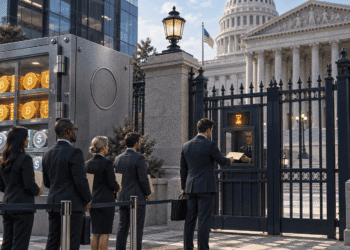


The most important legal battle in crypto isn’t happening in Congress or at the SEC. It’s heading to the highest court in the land.
Custodia Bank, the Wyoming-chartered digital asset bank founded by Caitlin Long, is preparing to file a petition asking the US Supreme Court to review the Federal Reserve’s denial of its master account application. Justice Neil Gorsuch granted the bank a 30-day extension on May 22, pushing the filing deadline to July 11, 2026.


The case sounds technical. It isn’t. At its core, it asks one of the most consequential questions in American financial regulation: does the Federal Reserve have unlimited, unreviewable power to decide which banks get access to the US payments system?
If the Supreme Court takes the case and rules in Custodia’s favour, it would fundamentally limit the Fed’s ability to block crypto-focused banks from the financial system. If the court declines to hear it, or rules against Custodia, it would confirm that the Fed can effectively override any state’s decision to charter a bank simply by refusing it access to the payment rails.
CEO Caitlin Long has called the denial a “death sentence” for the bank’s operations. She’s betting that nine justices will see it differently than every court that has ruled so far.
Five Years of Fighting for a Single Account
Custodia’s battle with the Federal Reserve stretches back half a decade.
The bank applied for a master account from the Kansas City Federal Reserve in October 2020. A master account gives a financial institution direct access to Fedwire, the Fed’s real-time gross settlement system, and the Automated Clearing House (ACH) network. Without one, a bank has to rely on intermediary institutions to process payments, adding cost, delay, and dependence on third parties that can cut off access at any time.
The Kansas City Fed acknowledged that Custodia was legally eligible for the account. It met every statutory requirement. It held a valid Wyoming Special Purpose Depository Institution charter. It was classified as a depository institution under federal law. On paper, it checked every box.
Then, in January 2023, the Fed formally denied the application. Officials cited “safety and soundness concerns” tied to Custodia’s crypto-focused business model. The denial came despite Wyoming’s state regulators having already approved the bank after their own thorough review.
Custodia had actually sued the Federal Reserve Board seven months earlier, in June 2022, arguing that the Fed lacked the legal authority to reject an application from a statutorily eligible institution. The lawsuit challenged not just the denial itself but the 28 months of unexplained delays that preceded it.
The district court ruled against Custodia in 2024. The 10th Circuit Court of Appeals affirmed that ruling in October 2025. And on March 13, 2026, the 10th Circuit denied Custodia’s petition for a full rehearing by a vote of 7-3.
Every court has sided with the Fed. Now Custodia is asking the only court left.
The Constitutional Question at the Heart of the Case
The legal argument Custodia plans to bring before the Supreme Court centres on the interpretation of two federal statutes: the Monetary Control Act of 1980 and the Federal Reserve Act.
Custodia’s position is straightforward. The Monetary Control Act states that Federal Reserve services “shall be available” to any depository institution that is eligible under the statute. Custodia is an eligible depository institution. Therefore, the Fed is legally required to provide it with services, including a master account. The word “shall” in the statute implies an obligation, not a discretion.
The Fed’s position is the opposite. It argues that the statute addresses pricing of services once they are provided, not entitlement to services in the first place. The Fed says it retains broad discretion to evaluate each applicant individually and deny access if it determines the institution poses risks to the payment system’s safety and soundness.
The lower courts accepted the Fed’s interpretation. But the 7-3 split at the 10th Circuit’s en banc rehearing suggests genuine disagreement about whether that reading is correct.
Judge Timothy Tymkovich, writing for the three dissenters, warned that the majority opinion “put the actions of Reserve Banks at odds with both statutory and constitutional requirements.” His dissent raised the “Major Questions Doctrine,” a legal principle that limits how much power unelected agencies can claim without explicit Congressional authorisation. Under that doctrine, the Fed’s assertion of unlimited discretion over master accounts, a power that effectively determines which banks can exist and which can’t, may require clearer legislative authority than the current statutes provide.
Three dissenting judges at the circuit level is notable. It signals that the legal question is genuinely contested, which increases the likelihood that the Supreme Court will agree to hear the case.
The Kraken Irony That Makes Custodia’s Case Worse and Better at the Same Time
Here’s the detail that makes this story almost unbearable for Caitlin Long.
On March 3, 2026, ten days before the 10th Circuit denied Custodia’s rehearing, the Kansas City Fed granted Kraken a limited “skinny” master account. The same regional Fed bank that denied Custodia access to the payments system turned around and gave a version of that access to Kraken.
The two companies are remarkably similar. Both are Wyoming-chartered. Both focus on digital assets. Both applied to the same Kansas City Fed. Custodia spent five years fighting and lost at every turn. Kraken received approval in months.
The difference is timing and politics. Custodia applied during an era when the Fed was actively hostile toward crypto-focused financial institutions. Kraken applied after the current administration took office and installed leadership that is publicly supportive of crypto integration. The rules didn’t change. The people interpreting them did.
For Custodia’s Supreme Court petition, the Kraken approval cuts both ways. On one hand, it weakens the urgency argument because an alternative pathway now exists. Custodia could theoretically abandon its full master account fight and reapply for the same kind of limited account Kraken received. On the other hand, it strengthens the legal argument. If the Fed has discretion to deny Custodia and approve Kraken under the same statutes, the decisions look arbitrary rather than principled, which is exactly the kind of unreviewable government power that courts are supposed to check.
Why This Case Matters for Every Crypto Company
Custodia’s fight is not just about one bank in Wyoming. It’s about whether the Federal Reserve has veto power over which types of financial institutions can participate in the American economy.
If the Fed can deny a master account to any legally chartered bank based on subjective “safety and soundness” concerns, it effectively controls which business models are allowed to exist in banking. A state can grant a charter. But without Fed access, that charter is worthless. The bank can’t process payments, can’t settle transactions, and can’t function as a real financial institution.
That dynamic creates what legal scholars call a “federal veto over state chartering authority.” Wyoming spent years building a regulatory framework specifically designed for crypto-focused financial institutions. The Fed overrode that framework by simply refusing to connect those institutions to the payments system.
For the dozens of crypto and fintech companies pursuing banking licences, OCC charters, and state trust company designations, the Custodia case determines whether those licences actually mean anything. If the Fed can block access regardless of what state or federal regulators approve, the entire licensing infrastructure becomes performative.
Trump’s executive order from May 19, which directed the Fed to evaluate crypto firms’ access to payment accounts, adds another dimension. The executive branch is pushing the Fed to open its doors. The judicial branch is being asked to force them open. If both efforts succeed, the Fed’s historic gatekeeping power over crypto banking would be fundamentally constrained from two directions simultaneously.
What Happens Next
The timeline is clear. Custodia has until July 11, 2026, to file its certiorari petition with the Supreme Court. The petition will argue that the 10th Circuit’s interpretation of the Federal Reserve Act is wrong and that the Fed does not have unlimited discretion to deny master accounts to eligible institutions.
Once filed, the Supreme Court will decide whether to grant certiorari, meaning whether to hear the case. That decision typically takes several months. If the court agrees to take it, oral arguments would likely occur during the October 2026 term, with a ruling expected in the first half of 2027.
If the court declines to hear the case, Custodia’s legal options are effectively exhausted. The bank would need to either reapply for a limited account through the pathway Kraken used, wait for Congressional legislation that forces the Fed’s hand, or wind down its operations.
Industry observers expect Custodia may pursue both tracks simultaneously, filing the Supreme Court petition while also exploring a limited account application as a practical backup. Fighting in court and negotiating with the Fed aren’t mutually exclusive, even if the optics are awkward.
The GENIUS Act and the FIRM Act, currently being merged in the Senate, include provisions that would force the Fed to process master account applications within 90 days and publish clear, objective criteria for approval or denial. If that legislation passes before the Supreme Court rules, the statutory question at the heart of Custodia’s case could be resolved by Congress rather than the courts.
Either way, the answer is coming. Whether it comes from nine justices, a hundred senators, or a combination of both, the question of who controls access to America’s payment system is about to be settled.
Disclaimer: This article is for informational purposes only and does not constitute financial advice. Cryptocurrency investments carry significant risk. Always conduct your own research before making any investment decisions.