
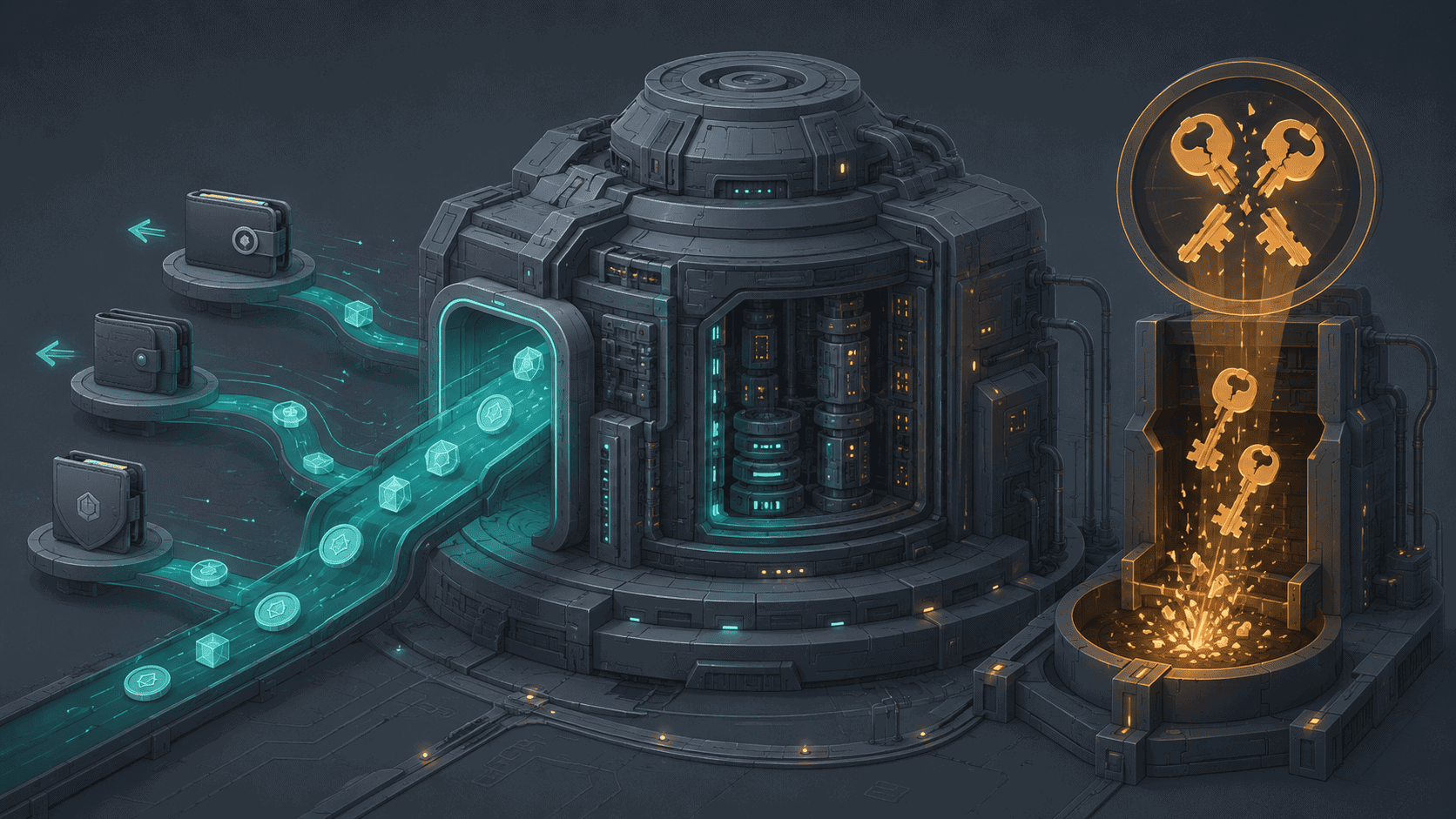
Seamless DAO is voting on a proposal to permanently wind down operations and revoke all administrative control, transitioning the protocol into a dormant, withdrawal-only state, according to CoinDesk’s governance roundup. Voting closes August 11.
If it passes, the protocol would stop operating as a going concern. Users could withdraw deposits, but no new activity would be possible and no party would retain the ability to upgrade contracts, adjust parameters or intervene.


Detailed public reporting on the proposal text remains limited, and the treasury disposition, timeline and withdrawal mechanics have not been widely covered.
Revoking control is the unusual part
Protocols wind down regularly. What distinguishes this proposal is the surrender of administrative keys.
Most DeFi shutdowns preserve some form of control. Teams retain upgrade authority to fix bugs, multisigs keep emergency pause capability, and governance stays technically live even after activity stops. That control is generally framed as user protection, since a protocol nobody can fix is a protocol nobody can rescue.
Revoking it removes both the risk and the remedy. No administrator can be compromised, coerced or subpoenaed, and no upgrade can be pushed. Equally, if a bug surfaces after the keys are gone, nothing can be done about it. Deposits sit in immutable contracts that behave exactly as written, correctly or otherwise.
For a sector where administrative keys have been a recurring attack surface, that trade-off has real appeal. Attackers seized upgrade authority over B² Network’s staking contract in July and drained roughly $3.86 million. A contract with no admin cannot be attacked that way.
Four DAOs restructuring in one week
The vote lands during an unusually busy stretch for DAO governance, and the direction is consistent.
GnosisDAO is voting through August 13 on separating powers between a leadership service provider and an independent supervisory board, while introducing a 5% voting weight cap to enforce decentralisation and comply with MiCA. Decentraland DAO is running a non-binding poll on term limits for council members, capped at two consecutive two-year terms, closing August 11. Lazy Summer DAO is voting on guardian roles and expiration parameters on HyperEVM to enable emergency pause capabilities.
Three of the four involve adding structure, formal boards, term limits, guardian roles, voting caps. Seamless is doing the opposite and removing it entirely. Both responses address the same underlying problem: token-weighted governance has not worked as advertised.
The pattern behind it
DAO participation has been deteriorating throughout 2026, and the euphemisms have become recognisable.
Velora, the cross-chain aggregator formerly known as ParaSwap, passed a proposal in April winding down its DAO and consolidating operations under Laita Labs, the development company that built the protocol. The DAO transferred its remaining $415,000 treasury, discontinued 20% protocol fee routing, retired staking with the exit lockup set to zero, and closed a futarchy governance pilot. Laita Labs framed it as alignment with existing reality: staking rewards and fee routing had been inactive for months, participation had declined, and the DAO functioned primarily as an off-chain signalling layer.
Jupiter suspended DAO voting entirely in April, with team member Kash Dhanda saying “the current DAO structure isn’t working as intended. We hear the complaints. We see the breakdown in trust.”
Analysts polled by ForkLog described a broader pattern of votes barely reaching quorum, forums emptying out, treasuries sitting idle and projects winding down, with the closures usually announced as “temporarily pausing governance” or “revisiting the model” rather than acknowledged as endings.
Voter participation across major DAOs frequently sits below 5%. That thin turnout is also what made the BONK DAO treasury attack possible in July, when an attacker spent roughly $4.4 million acquiring tokens to pass a malicious proposal and drained about $20 million. Only seven addresses voted.
What it means
Seamless winding down cleanly, with control revoked and withdrawals open, is arguably a better outcome than the alternatives available to a DAO with declining participation. The options in practice are handing operations to a development company, as Velora did, suspending governance indefinitely, as Jupiter did, or drifting until a low-turnout vote becomes an attack surface, as BONK discovered.
An explicit, voted shutdown that leaves users able to exit and removes every point of control is at least honest about what is happening.
It also raises a question the sector has largely avoided. DeFi has extensive frameworks for launching protocols and almost none for ending them. What happens to residual treasury funds, to users who never withdraw, to integrations that depend on a now-frozen contract, and to a governance token that no longer governs anything remains largely improvised each time.
The vote closes August 11.
FAQ
What is Seamless DAO voting on?
A proposal to permanently wind down protocol operations and revoke all administrative control, transitioning the protocol into a dormant, withdrawal-only state. Users would retain the ability to withdraw deposits, but no new activity would be possible and no party would keep the ability to upgrade contracts or adjust parameters. Voting closes August 11. Detailed public reporting on the proposal text, treasury disposition and withdrawal mechanics is currently limited.
Why does revoking administrative control matter?
Most protocol shutdowns preserve upgrade authority or emergency pause capability, framed as user protection. Revoking it eliminates a recurring attack surface, as seen when attackers seized upgrade authority over B² Network’s staking contract in July and drained roughly $3.86 million. The trade-off is that if a bug surfaces afterward, nobody can fix it. Deposits sit in immutable contracts that execute exactly as written.
Is this part of a wider trend?
Yes. Velora wound down its DAO in April and handed operations to Laita Labs, citing months of inactive fee routing and declining participation. Jupiter suspended DAO voting entirely, with a team member citing a “breakdown in trust.” Voter participation across major DAOs frequently sits below 5%, which also enabled the July BONK DAO attack where only seven addresses voted and roughly $20 million was drained. This week alone, GnosisDAO, Decentraland DAO and Lazy Summer DAO are all voting on governance restructuring.
Disclaimer: This article is for informational purposes only and does not constitute financial advice. Cryptocurrency investments carry significant risk. Always conduct your own research before making any investment decisions.