Solana is trading at approximately $65 on Thursday morning. The RSI on the daily chart reads 15.1. That’s not just oversold. That’s the most extreme oversold reading SOL has printed in all of 2026, and one of the lowest in the token’s entire history.
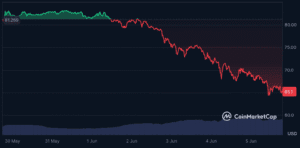
The decline from $85 on June 1 to $65 today represents a 23.5% drop in four days. The $69 level that served as support throughout late May broke on Wednesday and was retested from below. The retest failed, confirming that sellers are firmly in control and that former support has flipped to resistance.


SOL is now 74% below its all-time high. The token that was being discussed as an Ethereum competitor and a potential $500 candidate less than a year ago is fighting to hold a level it last visited in early 2025. The DeFi ecosystem that was flush with $3.25 billion in freshly minted USDC just two weeks ago is watching that liquidity sit idle while the price collapses underneath it.
The Alpenglow upgrade is the one catalyst that bulls are clinging to. Everything else has failed.
How $65 Became the Last Line of Defence
Solana’s chart has been deteriorating steadily since mid-May, but the collapse accelerated this week as Bitcoin crashed from $67,000 to $61,000 and dragged every major altcoin down with it.
The sequence of broken supports tells the story. The $85 level held briefly in late May before failing. The $80 to $82 zone, which analysts identified as critical support in the CoinDCX and CaptainAltcoin models, broke on June 2. The $76 resistance-turned-support gave way on June 3. And $69, which had been the floor of a four-month consolidation range, broke on Wednesday.
Each broken level produced accelerating selling as stop losses were triggered, leveraged positions were liquidated, and traders who had been defending those levels capitulated. The RSI at 15.1 reflects the cumulative impact of that selling pressure. It tells you that SOL has been sold harder, faster, and more aggressively than at any point this year.
The $65 zone represents the last cluster of meaningful buying interest on the chart. Below it, the next technical support sits at $61, and below that, $55 to $57, levels that haven’t been tested since mid-2024. A breakdown below $65 on volume would open a gap in the chart where very few historical transactions occurred, meaning limited natural support and the potential for a fast move lower.
The Alpenglow Catalyst
In a market where almost everything is going wrong for Solana, the Alpenglow upgrade is the one forward-looking catalyst that hasn’t been priced out.
Co-founder Anatoly Yakovenko confirmed at Consensus Miami that the upgrade could arrive as early as Q3 2026. Alpenglow would slash transaction finality from 12.8 seconds to approximately 150 milliseconds. That’s not an incremental improvement. It’s an order-of-magnitude leap that would make Solana faster than virtually every other blockchain and most traditional payment systems.
For context, Visa processes transactions in roughly 1 to 2 seconds. Ethereum’s finality takes approximately 12 minutes. Even after the Glamsterdam upgrade, Ethereum’s execution speed doesn’t approach what Alpenglow promises. If the upgrade delivers as described, Solana would have a speed advantage that no competing Layer 1 can match.
The upgrade also introduces a new Rust client and parallel execution improvements that target 20,000 transactions per second. Combined with the near-instant finality, these changes would position Solana as the clear infrastructure leader for high-frequency DeFi, real-time payments, and the kind of autonomous AI agent transactions that Amazon, Google, and JPMorgan are building toward.
The problem is timing. “As early as Q3” isn’t a confirmed date. It’s a best-case scenario from a co-founder at a conference. If the upgrade slips to Q4 or early 2027, the catalyst that bulls are counting on moves further away while the price pressure continues.
The Fundamentals Haven’t Broken
The gap between Solana’s network metrics and its token price is one of the widest in crypto right now.
The network processes over 4,000 transactions per second with near-perfect uptime. Daily transactions regularly exceed 30 million. Circle minted $3.25 billion in USDC on Solana in a single week in late May, the largest weekly stablecoin injection on any blockchain this year. Cash App chose Solana as one of four networks for its zero-fee USDC rollout to 60 million users. The Solana Foundation launched an initiative to support teams building fully on-chain perpetual futures to challenge Hyperliquid.
DeFi TVL has declined from its 2025 peaks but remains substantial. Developer activity continues growing. The Firedancer validator client from Jump Crypto is progressing toward launch. Institutional interest through ETF filings from Morgan Stanley (MSOL), VanEck, and others signals that Wall Street views Solana as a long-term infrastructure bet.
None of these fundamentals prevented a 23.5% price decline in four days. In a market where Bitcoin is crashing, ETFs are bleeding, and the Fear index reads 12, fundamentals take a back seat to liquidation cascades and correlated selling. SOL’s 87% bearish technical sentiment rating reflects a market that is trading on momentum and fear, not on network metrics.
The question is whether the fundamentals eventually reassert themselves or whether the token enters a prolonged period where strong usage coexists with a weak price, similar to what Ethereum has experienced throughout 2026.
The Competition That Won’t Let Up
Solana’s price pressure isn’t just about Bitcoin and macro. The competitive landscape has shifted against it over the past three months.
Hyperliquid flipped Solana by fully diluted valuation at $56 billion in May. The platform generates $620 million in annualised revenue from actual trading, a number that dwarfs what Solana’s native DeFi protocols produce. When the Solana Foundation announced its initiative to support on-chain perps, it was explicitly framed as a response to Hyperliquid’s dominance.
Stellar’s DTCC partnership positioned a smaller, cheaper, compliance-native blockchain as Wall Street’s first choice for tokenised securities. Ethereum’s Glamsterdam upgrade tripled its gas limit. Base, Coinbase’s Layer 2, continues siphoning developer attention and user activity. And the XRP Ledger completed its first institutional Treasury settlement with JPMorgan.
Solana remains one of the most capable blockchains in existence. But “most capable” doesn’t automatically mean “most valuable” in a market where capital is scarce and competition is intensifying. The Alpenglow upgrade needs to deliver a performance leap large enough to re-establish Solana’s technical moat against competitors that are closing the gap from every direction.
Where SOL Goes From Here
The immediate outlook depends entirely on whether $65 holds.
If $65 holds and SOL begins consolidating between $65 and $69, the oversold RSI at 15.1 creates conditions for a relief bounce. Historical precedent suggests that RSI readings this extreme produce at least a short-term recovery of 10-15%, which would target the $71 to $75 zone. Whether that bounce becomes a sustained recovery depends on whether Bitcoin stabilises and the broader market finds a floor.
If $65 breaks, the next support sits at $61, followed by $55 to $57. A decline to $55 would represent a 78% drawdown from the all-time high and would take SOL to its lowest level since mid-2024. That scenario becomes the base case if Bitcoin breaks below $60,000 and the broader crypto market enters a full capitulation phase.
On the upside, reclaiming $69 is the minimum signal that the immediate selling pressure has eased. Above that, $76 represents the level where the bearish breakdown originated. Reclaiming $76 on volume would shift the short-term trend from bearish to neutral and open a path toward $85.
The analyst consensus for year-end sits between $120 and $160, numbers that feel surreal at $65 but reflect the assumption that the Alpenglow upgrade, continued stablecoin growth, and an eventual Bitcoin recovery will lift SOL back into triple digits.
Getting from $65 to $120 requires a market environment that doesn’t currently exist. It requires Bitcoin above $80,000, ETF flows turning positive, the Fed signalling cuts, and the Alpenglow upgrade launching on time. Each of those conditions is possible. None of them is certain. And at $65 with an RSI of 15, the market is pricing in the possibility that none of them arrive on schedule.
FAQ
Why did Solana drop to $65?
SOL fell 23.5% in four days as Bitcoin crashed from $67,000 to $61,000 and dragged the entire altcoin market lower. The $69 support that held for four months broke on Wednesday and the retest failed, confirming sellers are in control. The RSI dropped to 15.1, the most oversold reading of 2026.
What is the Alpenglow upgrade?
Alpenglow is Solana’s next major network upgrade, targeting 150-millisecond transaction finality (down from 12.8 seconds) and 20,000 transactions per second through a new Rust client and parallel execution. Co-founder Yakovenko said it could arrive as early as Q3 2026. If delivered, it would make Solana faster than virtually every other blockchain and most traditional payment systems.
What are the key price levels for SOL?
Support sits at $65 (current level being tested), $61, and $55 to $57. Resistance sits at $69 (broken support now resistance), $76 (breakdown origin), and $85. The RSI at 15.1 suggests a relief bounce is statistically likely, but in the current macro environment oversold signals can persist longer than expected. Year-end analyst targets range from $120 to $160.
Disclaimer: This article is for informational purposes only and does not constitute financial advice. Cryptocurrency investments carry significant risk. Always conduct your own research before making any investment decisions.