There’s an old idea in investigative fiction about the significance of the dog that doesn’t bark. Sometimes the most revealing thing in a situation isn’t what happens, but what fails to happen. Applied to crypto right now, the story isn’t the war raging in the Middle East. It’s how little Bitcoin seems to care.
Over the weekend, US strikes on Iran entered their ninth consecutive night. CENTCOM launched a fresh wave of attacks aimed at degrading Iranian military capabilities used against commercial vessels in the Strait of Hormuz, the chokepoint through which roughly a fifth of the world’s oil once flowed and which has now been effectively closed for 136 days. This is a serious, sustained military conflict disrupting a critical artery of the global economy.


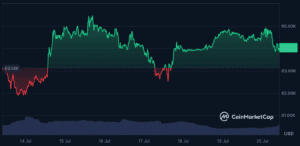
And Bitcoin? It barely flinched. The leading cryptocurrency moved sideways on Sunday, hovering between $64,000 and the low $65,000 range, down a negligible 0.03% over 24 hours even as trading volume surged 12%. Ether sat calmly in the $1,800 zone, up less than 1%. XRP and Dogecoin also drifted. For an asset class long mocked as the most volatile, panic-prone corner of finance, that composure in the face of nine nights of airstrikes is genuinely striking.
It’s tempting to see this as Bitcoin proving its “digital gold” thesis. The reality is more nuanced, and more interesting.
A Pattern, Not a Fluke
This week’s calm wasn’t a one-off. It’s the continuation of a pattern that has held throughout the entire Iran conflict, which makes it far more meaningful than any single day’s price action.
Rewind to earlier in July. When the US launched its third round of strikes in a single week and Tehran declared the Strait closed “until further notice,” Bitcoin held near $63,800, down just 0.3% over 24 hours and actually up 2% on the week. As one market update noted at the time, the absence of a flight to on-chain assets suggested a maturing market no longer easily spooked by headline conflict. That flatness, the analysis argued, was itself the signal.
Contrast this with how Bitcoin behaved during earlier Middle East flare-ups. When Israel struck Iranian nuclear facilities in June 2025, Bitcoin fell more than 7% over three days. In past episodes, a single Hormuz headline could trigger a sharp selloff. The reflexive “conflict equals sell crypto” reaction that defined earlier years has visibly weakened. Bitcoin is absorbing shocks that would once have sent it tumbling.
The behavioral shift comes down to who owns Bitcoin now. The market’s ownership base has increasingly shifted toward institutional holders and long-term investors who make decisions based on interest rates, liquidity, and multi-year theses rather than reacting to every geopolitical headline. Even through this weekend’s escalation, US spot Bitcoin ETFs recorded steady inflows, a sign that institutional money was calmly accumulating rather than fleeing. A market held by patient hands simply panics less.
Why the War Reaches Bitcoin Anyway
None of this means Bitcoin is immune to the conflict. The composure is real, but so is the underlying risk, and it travels through an indirect channel that’s worth understanding.
The danger isn’t the fighting itself. It’s what the fighting does to oil, and what oil does to inflation, and what inflation does to the Federal Reserve. With the Strait effectively closed for 136 days, crude prices have climbed and stayed elevated, recently pushing back above $80 a barrel. Sustained high oil prices feed directly into inflation through fuel, transport, and production costs. And persistent inflation gives the Fed every reason to keep interest rates high rather than cutting them.
That’s the transmission mechanism that actually matters for Bitcoin. Higher-for-longer interest rates raise the opportunity cost of holding a non-yielding asset like Bitcoin while making cash and bonds more attractive. So when Bitcoin does weaken on Iran news, as it did earlier in July when it slipped from near $65,500 to $64,000, it’s not because traders fear the war directly. It’s because they fear the war will keep the Fed hawkish. The conflict is a slow-burning inflation risk, not an immediate panic trigger.
This is the crucial nuance behind the composure. Bitcoin can stay calm through the headlines while still being genuinely exposed to the conflict’s second-order effects. A brief Strait closure that Tehran walks back is a threat the market can shrug off. A 136-day closure that keeps oil elevated and forces the Fed to hold rates is a real, grinding headwind, even if it never produces a dramatic single-day crash.
What the Composure Is Worth
For Bitcoin investors, the muted reaction carries a genuinely positive signal, but it should be read carefully rather than celebrated uncritically.
The positive read is that Bitcoin is maturing. An asset that can absorb nine nights of airstrikes and a closed oil chokepoint without cratering is behaving more like an established macro asset and less like a speculative plaything. This steadiness strengthens the case that skeptics have used against Bitcoin for years, namely that it’s too volatile to take seriously. Each episode of calm through crisis chips away at that objection and makes Bitcoin marginally easier for institutions to hold.
The cautious read is that calm during a conflict isn’t the same as strength. Bitcoin remains stuck below its previous cycle highs, trading around $64,000 versus its October 2025 record above $126,000. Its sideways movement reflects a market caught between competing forces: the improving sentiment from cooler inflation data on one side, and the persistent drag from the Iran conflict and a cautious Fed on the other. Composure in a range is not the same as a breakout.
Analysts are watching specific levels for the next real signal. Popular trader Ali Martinez noted that Bitcoin is trading below the previous cycle’s all-time high, and that reclaiming the $69,000 area and holding it as support has historically marked the transition from a bear market back into a sustained bull trend. Until Bitcoin can decisively break above that zone, its current calm is best understood as resilient consolidation rather than the start of the next major leg higher.
What It Means
The most useful takeaway from Bitcoin’s nine-night shrug is that the asset’s relationship with geopolitical risk has fundamentally changed. It no longer reacts to conflict headlines the way it once did. That’s a sign of a deeper, more institutional market, and it’s a meaningful evolution in how Bitcoin behaves.
But investors shouldn’t confuse this maturity with immunity. The Iran conflict is still reaching Bitcoin, just through the slower, more powerful channel of oil, inflation, and Fed policy rather than through panic selling. The Federal Reserve meets on July 28 and 29, and that meeting, far more than any strike on Iran, will likely determine Bitcoin’s next direction. If elevated oil keeps inflation sticky and the Fed signals continued caution, the grinding headwind persists regardless of how calm the price charts look.
Bitcoin’s composure through this crisis is a genuine milestone worth marking. The asset once defined by its chaos held steady while missiles flew and the world’s most important oil route stayed shut. That steadiness is the real story of the week. But the quiet on the surface hides a market still tethered to the same macro forces as everything else. The dog isn’t barking. That tells you Bitcoin has grown up. It doesn’t tell you the danger has passed.
FAQ
Why didn’t Bitcoin fall during the US strikes on Iran?
Bitcoin’s ownership base has shifted increasingly toward institutional and long-term holders who make decisions based on interest rates, liquidity, and multi-year theses rather than reacting to geopolitical headlines. This has made the market far less prone to panic selling than in earlier years, when a single Hormuz headline could trigger a sharp drop. During the ninth consecutive night of strikes, Bitcoin held between $64,000 and $65,000, and US spot Bitcoin ETFs even recorded steady inflows, showing institutions were calmly holding rather than fleeing.
Does this mean the Iran conflict doesn’t affect Bitcoin?
No. The conflict reaches Bitcoin indirectly. With the Strait of Hormuz effectively closed for 136 days, oil prices have stayed elevated above $80 a barrel, which feeds inflation and gives the Federal Reserve reason to keep interest rates high. Higher-for-longer rates raise the opportunity cost of holding non-yielding Bitcoin. So when Bitcoin weakens on Iran news, it’s because traders fear the war will keep the Fed hawkish, not because they fear the conflict directly. It’s a slow-burning inflation risk rather than a panic trigger.
What would signal Bitcoin’s next major move?
Analysts point to the $69,000 level as key. Popular trader Ali Martinez noted Bitcoin is trading below its previous cycle’s all-time high, and that reclaiming $69,000 and holding it as support has historically marked the transition from a bear market into a sustained bull trend. More immediately, the Federal Reserve’s July 28-29 meeting will likely determine Bitcoin’s direction more than any development in Iran, since Fed policy on interest rates is the dominant force acting on the asset right now.
Disclaimer: This article is for informational purposes only and does not constitute financial advice. Cryptocurrency investments carry significant risk. Always conduct your own research before making any investment decisions.