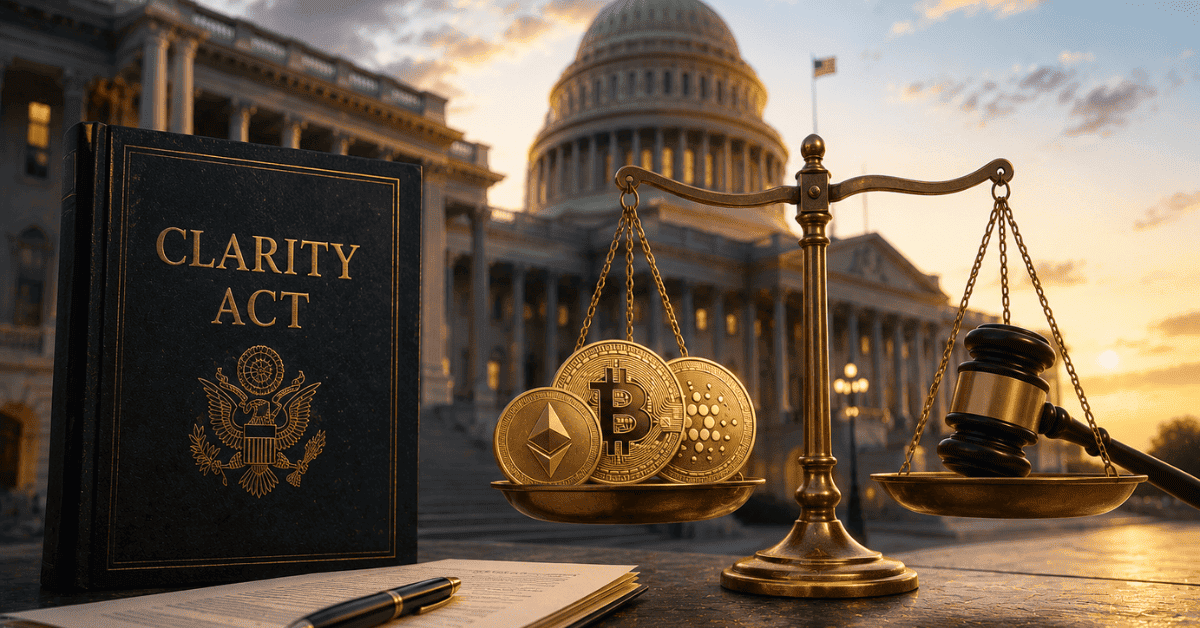
CLARITY Act is now closer to a full Senate vote than at any point since lawmakers first began debating a comprehensive framework for the U.S. crypto industry.
The legislation has already cleared the Senate Banking Committee and has been placed on the Senate Legislative Calendar, making it eligible for floor consideration. That does not mean a vote is guaranteed, but it does move the bill into the final phase of the legislative process before the Senate decides its future.


For the crypto industry, this is far more than another procedural update. The CLARITY Act has become the centerpiece of Washington’s attempt to answer one question that has frustrated exchanges, developers and investors for years: who actually regulates digital assets in the United States?
If lawmakers fail to answer that question this summer, the industry could remain stuck in the same legal uncertainty that has shaped the past several years.
The Bill Tries to End One of Crypto’s Biggest Problems
One of the industry’s longest-running complaints has never been that regulation exists. It has been that the rules often appeared inconsistent.
Some digital assets have been treated as securities. Others have been viewed more like commodities. Different agencies have claimed overlapping authority, leaving companies uncertain about which regulator they ultimately answer to.
The CLARITY Act attempts to draw clearer lines.
Under the proposed framework, the Commodity Futures Trading Commission would receive primary oversight of digital commodities and their spot markets, while the Securities and Exchange Commission would continue overseeing digital assets that qualify as investment contracts. The legislation also introduces a pathway for certain blockchain projects to transition away from securities regulation once they meet defined decentralization standards.
For many crypto businesses, that clarity could be just as valuable as any market rally.
Momentum Is Growing, But So Are the Challenges
Although the bill has made significant progress, its hardest test may still lie ahead.
Senate leaders must still decide when—or whether—to bring the legislation to the floor. Even then, supporters will need to secure enough votes to overcome the Senate’s procedural threshold, while unresolved negotiations continue behind closed doors.
Several issues remain under discussion, including ethics provisions related to public officials’ crypto interests, protections for decentralized finance developers and questions surrounding stablecoin yield products. None of these disagreements are directly about whether crypto should be regulated, but each has the potential to slow the legislation’s progress.
Time is also becoming a factor.
With Congress expected to enter its August recess in the coming weeks, supporters increasingly view the current legislative window as one of the best opportunities to advance comprehensive crypto legislation this year.
Why Investors Should Care
For many retail investors, regulatory legislation can seem disconnected from market prices.
In reality, the opposite is often true.
Large financial institutions generally avoid markets where legal responsibilities remain unclear. Exchanges hesitate to launch new products when they cannot confidently determine which regulator has jurisdiction. Startups often spend significant resources on legal advice before writing a single line of code.
Clearer legislation does not guarantee higher Bitcoin prices or another crypto bull market.
It can, however, reduce one of the biggest structural risks facing the industry.
A more predictable regulatory environment could encourage additional institutional participation, simplify compliance for exchanges and make it easier for blockchain companies to build products inside the United States rather than moving operations abroad.
That is why many executives view the CLARITY Act as more important than any single enforcement case.
The U.S. Is Catching Up With Global Regulation
The timing is also significant because the United States is no longer operating in isolation.
Europe has begun implementing MiCA, creating a unified regulatory framework for crypto businesses across the European Union. Stablecoin legislation continues advancing in multiple jurisdictions, while countries in Asia and the Middle East have spent recent years refining their own digital asset rules.
For much of the past decade, the United States has relied heavily on enforcement actions to shape the crypto market.
The CLARITY Act signals a different approach.
Rather than allowing court cases to define policy one lawsuit at a time, lawmakers are attempting to establish a legislative framework that businesses can understand before launching products.
Whether the final bill satisfies every part of the industry remains uncertain, but replacing ambiguity with published rules would represent a significant shift.
A Narrow Window With Long-Term Consequences
Despite the recent momentum, the CLARITY Act is not across the finish line.
The legislation still requires a successful Senate vote, possible reconciliation with previous versions and presidential approval before becoming law. Industry groups are actively lobbying lawmakers, while senators continue negotiating the remaining points of disagreement behind the scenes.
The coming weeks may therefore determine more than the future of a single bill.
They could shape how the world’s largest economy regulates digital assets for years to come.
For an industry that has spent much of the last decade asking Washington for clearer rules, the CLARITY Act represents its closest opportunity yet.
Now the question is no longer whether crypto regulation is coming.
It is whether Congress can finish writing it before the legislative clock runs out.
Disclaimer: This article is for informational purposes only and does not constitute financial, investment or legal advice. Always conduct your own research before making any investment decisions.