
The US Treasury issued a sectoral sanctions determination covering digital assets on Monday, one of five categories named in a campaign Treasury Secretary Scott Bessent announced as an effort to sever Iran’s remaining links to the global financial system.
Speaking at the Treasury Department in Washington, Bessent said the department had issued determinations against “five critical sectors — digital assets, technology, gold, aviation, and shipping — that the Iranian regime uses to try to prop up its failing economy.”


The determinations broaden the risk of secondary sanctions for foreign entities that continue doing business with Iran in those areas. The Office of Foreign Assets Control separately sanctioned nearly 60 entities, individuals and vessels accused of helping Iran procure nuclear and missile technology, conduct cyber operations or generate oil revenue.
“Any entity that facilitates money laundering on behalf of Iran will be removed from the U.S. dollar system,” Bessent said. “The clock just started ticking.”
The campaign, dubbed Operation Economic Outcast, arrives as the US-Iran war approaches its six-month mark. Markets showed little immediate reaction.
What a sectoral determination does
The mechanism is worth understanding because it operates differently from a standard designation.
Naming a sector does not sanction any specific company. It establishes the legal basis for OFAC to impose secondary sanctions on foreign entities operating in that sector if they are found to be materially assisting Iran. Secondary sanctions target non-US persons and typically cut them off from the US financial system rather than prosecuting them under US law.
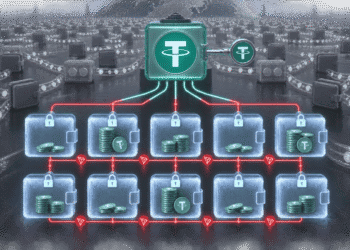
For digital assets, that means a foreign exchange, custodian, over-the-counter desk or payment processor found servicing Iranian entities now faces a defined pathway to losing dollar access, without OFAC needing to build a case under a narrower authority first.
Bessent was explicit that the categories were chosen because Iran uses them to generate revenue, evade sanctions or mitigate economic pressure.
Enforcement is deferred
The announcement contained an unusual amount of hedging about timing, which matters for how firms should read it.
Bessent said many of the secondary sanctions will not be immediate. “We are giving everyone the opportunity to remedy bad behavior,” he told reporters. “Why would I want to blow up the global financial system? We believe that it is important to level set and give people a cure period, but they should know that that will move very quickly and that we are serious.”
He described the announcement as “a warning shot and a level set of expectations” and declined to set a deadline: “I’m not going to set a timeline, but we do not have infinite patience here.”
The administration has not publicly named the countries or entities it is pressuring, nor disclosed their compliance deadlines. Bessent said President Trump is calling world leaders with specific requests to cease trading with Iran, and that he expects a major financial institution to be sanctioned by the end of this week.
Asked whether the campaign would encompass China, which has historically purchased roughly 90% of Iran’s oil, Bessent said only: “No one is above this.”
Why crypto made the list
The inclusion follows a documented pattern rather than arriving cold.
Chainalysis reported that sanctioned jurisdictions and entities received $15.8 billion in cryptocurrency during 2024, accounting for roughly 39% of all illicit crypto transactions, with Iran a significant contributor. The firm noted that as Western restrictions tighten, sanctioned nations turn to cryptocurrencies and alternative financial systems to sustain trade and access capital.
Iran has been explicit about the strategy. At a government-backed blockchain summit, parliamentary speaker Mohammed Bagher Ghalibaf said cryptocurrencies “provide new ways to do business and to pay for trade” and urged BRICS members to accept digital assets in trade with Iran.
Treasury has already acted twice in this area. In September 2025 it sanctioned two Iranian financiers and more than a dozen people and firms across Hong Kong and the UAE over roughly $100 million in cryptocurrency transfers derived from Iranian oil sales. In January 2026, OFAC sanctioned two UK-registered crypto exchanges linked to Iran’s financial system, the first time targeting digital asset platforms under the Iran sanctions programme.
Larger platforms have faced scrutiny too. In February, the Senate Permanent Subcommittee on Investigations wrote to Binance chief executive Richard Teng citing reports that the exchange had facilitated $1.7 billion in transfers to Iranian entities and that compliance staff had identified 2,000 accounts associated with Iran.
What it means for exchanges
The practical effect is a compliance obligation that arrives before any enforcement does.
Any exchange or service provider with meaningful non-US exposure now needs to establish whether counterparties, corridors or corporate customers touch Iranian entities, because the sectoral determination means dollar access is the stake. The named jurisdictions in Monday’s OFAC action, spanning the UAE, Hong Kong, China, Singapore, Switzerland and Europe, indicate where Treasury believes the networks sit.
The enforcement difficulty is genuine and worth stating plainly. Crypto’s appeal to sanctioned actors is that it routes around correspondent banking, which is where secondary sanctions bite hardest. Analysts have noted that cutting off individual intermediaries tends to push transactions toward new ones rather than stopping them, and Iran has spent years building alternative channels. Whether a sectoral determination changes that calculus depends on whether Treasury can identify service providers faster than they can be replaced.
There is also a structural tension. Bessent’s own reasoning for the cure period, that immediate enforcement risks disrupting the global financial system, applies less cleanly to crypto than to shipping or banking. Digital asset infrastructure is more fragmented and easier to reconstitute, which cuts both ways for enforcement.
Iran’s head of national security said Tehran would retaliate “in a seismic manner” and would treat any country supporting the sanctions as committing an act of war. Iran’s currency fell to a record low against the dollar. US officials indicated expanded secondary sanctions are expected to remain the primary course of action against Iran at least until after the midterm elections.
Disclaimer: This article is for informational purposes only and does not constitute financial or legal advice. Cryptocurrency investments carry significant risk. Always conduct your own research before making any investment decisions.