Tether had blacklisted 9,597 USDT addresses and frozen $5.69 billion in value as of 26 July 2026, according to BlockSec’s freeze tracker. Ten new addresses were added during a single 24-hour window.
The scale is not accidental. The ability to freeze has been built into USDT since the token’s earliest deployments, and it is exercised routinely, often several times a day. Individual freeze events regularly run into the millions of dollars.


That capability is the defining difference between a centralised stablecoin and an asset like bitcoin, and it is poorly understood by most of the people holding one. A lawsuit filed in New York on 31 August has now put the practice before a US court for the first time in a case where the holders dispute their inclusion.
What happens when an address is frozen
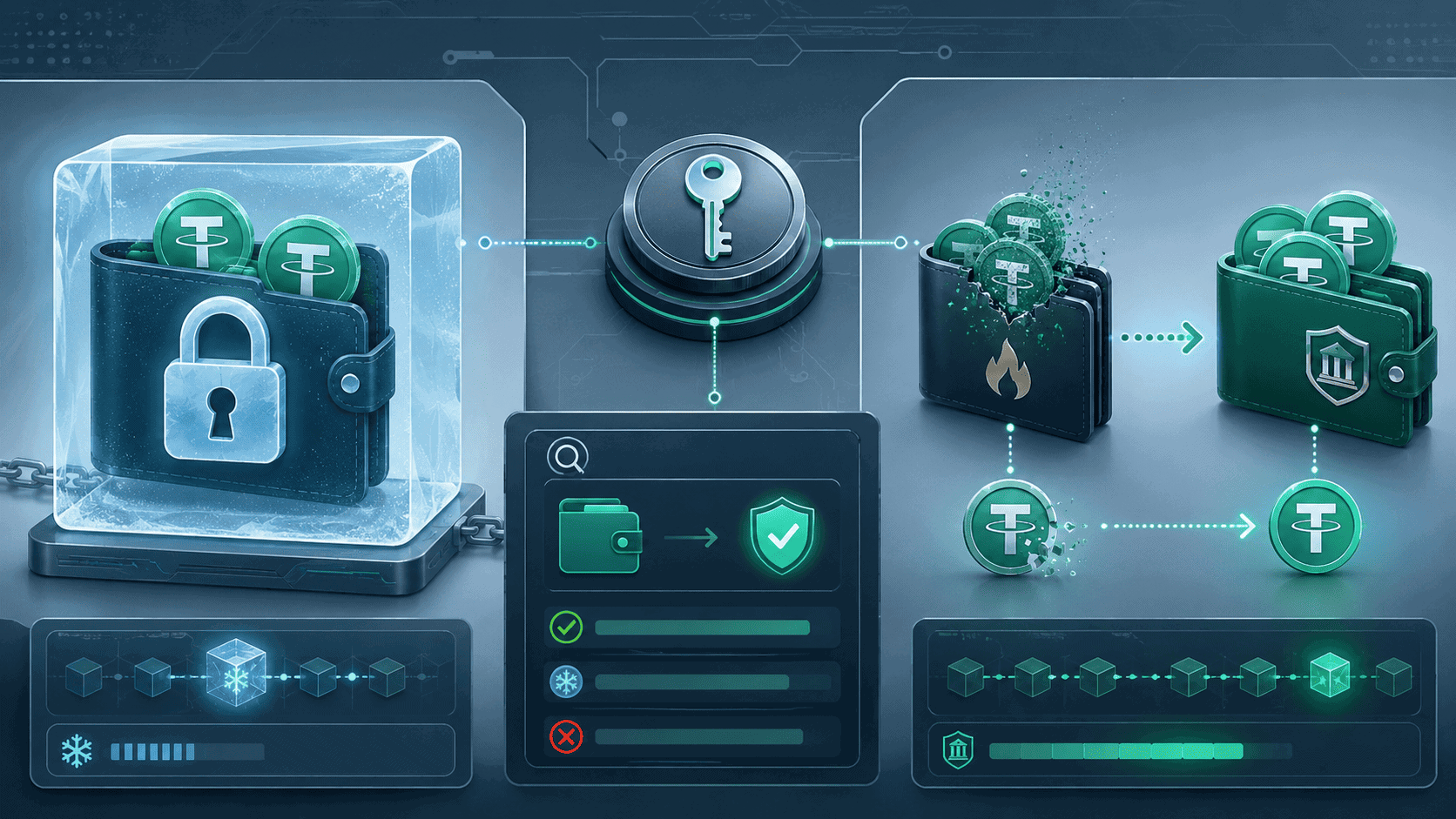
Tether maintains a list of blocked addresses within the software governing USDT. Adding an address requires a single instruction from Tether, and it takes effect the moment it confirms on the blockchain.
From that point, the system rejects any attempt to move USDT out of the address. It also rejects attempts to send USDT in. The balance remains visible in the holder’s wallet and on any blockchain explorer. It simply cannot be transferred.
There is no warning, no grace period and no appeal built into the process. Tether can reverse a freeze and restore transfers, though it rarely does.
Every freeze and reversal is recorded publicly, which means an address’s status can be independently verified by anyone.
One distinction is worth noting. A freeze applies to the token rather than the wallet. An address blacklisted for USDT on Tron can still move TRX and other tokens held at the same address. Only the USDT is locked.
USDT circulates on Ethereum, Tron, Solana, BNB Chain, Polygon, Arbitrum, Optimism, Base and Avalanche. Each version maintains a separate blocked list, and the safeguards differ slightly between them.
Freezing and seizing are different things
Two very different outcomes are commonly described using the same word.
A standard freeze leaves tokens in the original wallet, unmovable. Ownership on paper has not changed. In practice, many stay there indefinitely.
A seizure goes further. Tether destroys the tokens in the frozen wallet, removing them from circulation, then issues an equivalent amount to a different address, typically one controlled by law enforcement. The original balance drops to zero. This occurs when a court order directs it.
That second process is now being litigated. Two Thai businessmen sued Tether in the Southern District of New York over $42.4 million held across ten Ethereum addresses. Their wallets were blocked on 30 October 2025 following an informal request from Homeland Security Investigations. A seizure warrant instructing Tether to destroy and reissue the tokens did not arrive until 19 February 2026, nearly four months later.
The plaintiffs do not contest the underlying criminal allegations, which relate to a pig-butchering fraud investigation. They are challenging the sequence, and specifically whether the February warrant authorised destruction and reissuance at all.
What triggers a freeze
Blacklisting falls into two categories, only one of which involves an allegation against the holder.
Sanctions compliance accounts for the largest actions. When an address links to an entity on the US Treasury’s sanctions list, or to a sanctioned jurisdiction, Tether blocks it. The largest single freeze on record was $344 million in April 2026, tied to Iranian sovereign reserves, with cumulative Iran-linked seizures reaching roughly $1 billion. In July 2026, after the Treasury added four addresses to its Central Bank of Iran designation, Tether froze $131 million within hours.
Law enforcement requests form the second category. An agency serves a warrant, subpoena or international legal assistance request on Tether’s compliance department, and the address is blocked.
Neither category covers the situation most likely to affect an ordinary holder. Addresses are also frozen for indirect exposure, where a wallet received funds that originated several transfers earlier from a flagged address. Compliance analysts describe this as contagion risk, and it explains why merchants and trading desks screen incoming deposits rather than only outgoing payments.
Tether has additionally frozen addresses before any corresponding public sanctions designation appeared. Screening against published government lists alone can therefore clear a wallet that is already blocked.
Checking an address
Because freezes are recorded publicly, verification is straightforward and costs nothing.
BlockSec operates a public USDT freeze checker that queries Tether’s blocked list directly across supported networks and reports whether an address is currently frozen. Some tools additionally flag addresses that were frozen previously and later released, which functions as a risk signal when assessing a counterparty.
Comparable trackers exist for Circle’s USDC, Paxos’s USDP and First Digital’s FDUSD.
The practical advice is to check before accepting a substantial payment rather than afterwards.
Recovery is rare
The statistics on reversal receive little attention and are arguably the most consequential part of the subject.
During 2025, only 3.6% of blacklisted USDT addresses were unfrozen. Among that group, the median interval between freeze and release was 18.2 days. The overwhelming majority remained frozen.
Three routes exist for holders attempting recovery. Petitioning Tether’s compliance department directly, which resolves most legitimate cases that get resolved. Bringing a legal challenge in an appropriate jurisdiction. Or, where US federal forfeiture proceedings are underway, raising an innocent-owner defence.
None is quick and none carries any guarantee.
The trade-off behind the design
Stablecoins are frequently described as digital cash. The comparison fails at precisely this point.
Physical cash cannot be disabled by whoever printed it. Bitcoin cannot be frozen by any party, because no administrative override exists; a government seeking to stop a bitcoin transaction must obtain the private key. USDT operates on the opposite principle.
That control is why the asset functions inside a regulated financial system, and why Tether has become one of the more effective recovery mechanisms available to fraud victims, having frozen billions that would otherwise have disappeared.
David Schwartz, the former Ripple chief technology officer, defended the capability publicly on 2 September, arguing that requiring a court order before any freeze would allow stolen funds to be laundered before judicial process could intervene.
The counterargument carries equal weight. A private company acting on informal requests, over funds belonging to people who have not been charged with anything, exercises considerable discretion with limited external oversight.
Both positions describe the same feature. The freeze function recovers stolen money and exposes holders to unilateral action, and the New York case is the first serious test of where the boundary sits.
FAQ
Can Tether freeze USDT without a court order?
Yes. Its terms of service permit it and the capability is built into the token. Tether has acted on informal law enforcement requests before any warrant existed, which is the subject of ongoing litigation in New York.
What happens to frozen tokens?
They remain visible in the wallet but cannot be moved. In law enforcement seizures, Tether may destroy them and issue an equivalent amount to a government-controlled address, leaving the original balance at zero.
How can an address be checked?
Freezes are recorded publicly on the blockchain. Free tools including BlockSec’s USDT freeze checker query issuer blocked lists directly across supported networks and return an address’s current status.
Disclaimer: This article is for informational purposes only and does not constitute financial or legal advice. Cryptocurrency investments carry significant risk. Always conduct your own research before making any investment decisions.