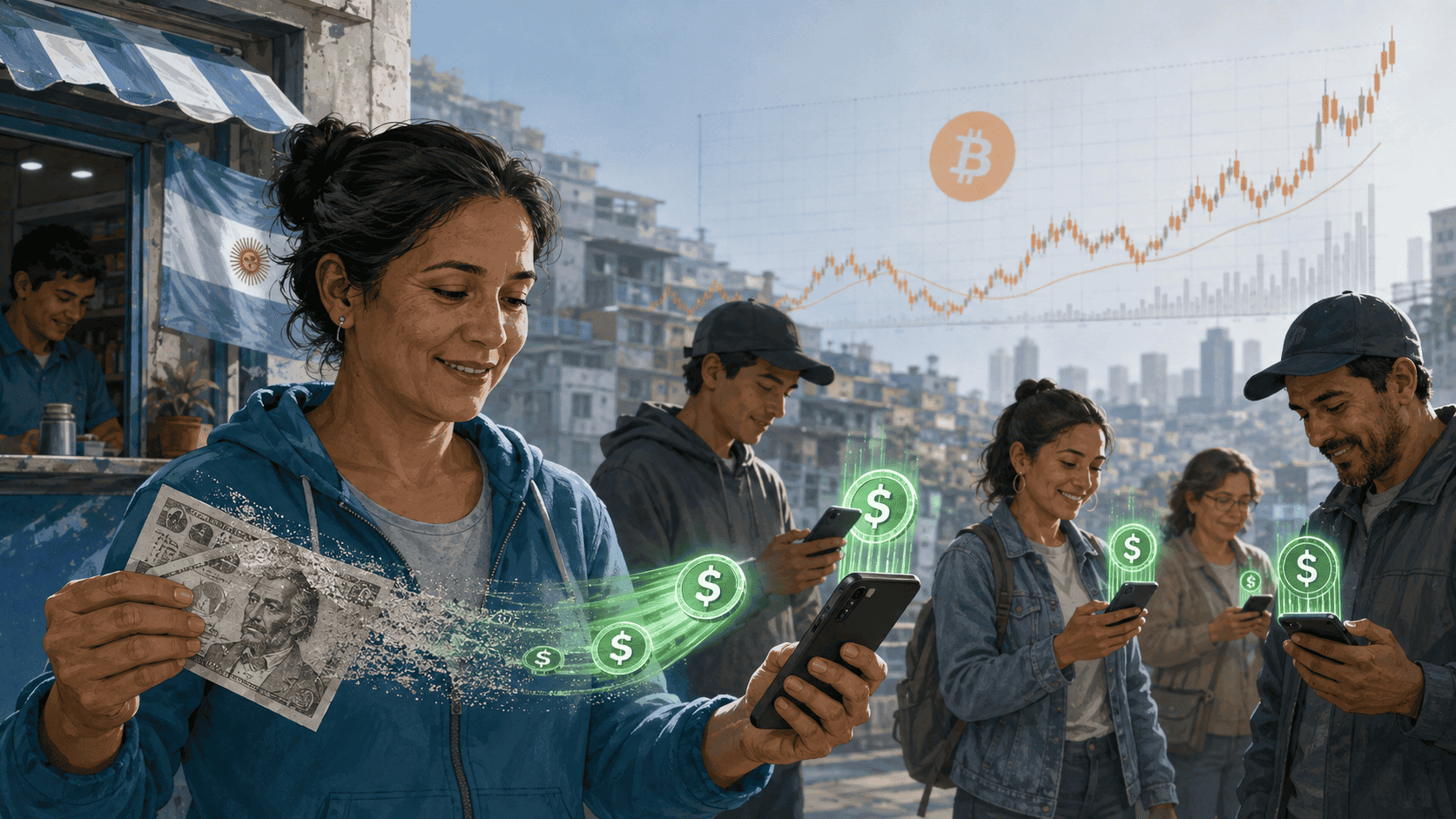
USDT and USDC account for more than 70% of all cryptocurrency bought on Bitso in Argentina, the exchange’s own data show, a ratio that has held through the sharpest bitcoin rally in three years.
Bitcoin crossed $80,000 on Tuesday for the first time since mid-May, touching $81,257 before slipping back to $78,996 on Wednesday. The move followed a US Treasury decision to double its long-term bond buyback programme, which pulled yields lower and triggered more than $4 billion in short liquidations.


None of that has altered what Argentines actually buy.
The figures come from Bitso’s 2025 Crypto Landscape in Latin America report, which analysed data from nearly 10 million customers across Argentina, Brazil, Colombia and Mexico. They describe last year’s behaviour rather than this week’s, which is precisely what makes the continuity notable.
Digital dollars overtook bitcoin regionally
Across Latin America, nearly 40% of all crypto purchases in 2025 involved dollar-pegged assets.
The breakdown by individual asset is the more revealing number. USDC accounted for 23% of purchases, ahead of bitcoin at 18% and USDT at 16%. Bitso read that as customers prioritising stability and liquidity over short-term positioning.
The pattern varies sharply by country. Argentina sits at 71%, the most dollarised market in the sample. Colombia comes in around 46%. Brazil is the most balanced at 34% stablecoins against 22% for bitcoin. Mexico shows its own profile shaped by remittance corridors.
Bitcoin has not disappeared from the region. It remains roughly 52% of investment portfolios. The distinction is between what people hold as an investment and what they buy as money, and the two have separated.
The peso explains most of it
Argentina’s position at the top of that range is not a preference for a particular technology.
Bitso’s data show transaction peaks in the days immediately following monthly salary payments. People convert pesos into stablecoins as soon as they receive them, because holding pesos carries a cost that compounds daily. The instinct is older than the rails: Argentines have bought physical dollars under capital controls for decades. Stablecoins move that behaviour onto a phone.
Payroll company Bitwage reports that around three in four workers in Argentina who are paid in crypto now request stablecoin salaries rather than volatile assets. A wage that does not shrink when the currency does is a straightforward proposition.
Bitso, which serves over nine million users across the region, pays roughly 4% APY on USDC and USDT holdings with weekly payouts and no lock-up. For a saver whose alternative is a depreciating local currency, that combination of stability and yield is the entire product.
Brazil is further along than the headline suggests
The Argentine figure looks less extreme when placed against its neighbour.
Brazil’s central bank reported that stablecoins made up more than 98% of $6.9 billion in crypto purchases during the first quarter of 2026, with total volume more than doubling year on year. The country’s tax authority, using a longer period and a wider definition, puts stablecoins at around 80% of all declared crypto volume.
First-half buying in Brazil reached $14.68 billion, up 135% from the same period in 2025.
Those numbers describe a market where dollar tokens are not a category within crypto. They are what crypto is used for.
Infrastructure is following the behaviour
Traditional payment companies have begun building for this pattern rather than waiting to see whether it persists.
Western Union launched its StableCard on 4 August across 37 markets, with expansion to more than 60 planned by year-end. MoneyGram became a Solana validator. Both are remittance businesses responding to customers who already move value in dollar tokens.
El Salvador provides a useful contrast for what has not worked. Digital-currency remittances reached $35.4 million in the first half of 2026, up 39.1% year on year, but still represent only 0.7% of total remittance flows. Bitcoin acceptance has been voluntary since the government’s 2025 agreement with the IMF, though the state continues buying one bitcoin a day for its reserve.
Legally mandated bitcoin adoption produced marginal usage. Voluntary stablecoin adoption produced 71% of purchases in Argentina and 98% in Brazil.
What could change it
Two regulatory developments sit between this behaviour and its continuation.
The first is cost. The GENIUS Act imposes compliance obligations on stablecoin issuers, and any expense that lands on the firms issuing dollar tokens will eventually appear in what a Latin American saver pays for one. That transmission is slow and indirect, but it is real.
The second is friction. Brazil’s central bank published Resolution 584 on 7 August, requiring exchanges from 1 January 2027 to delay transfers of $10,000 or more leaving the country by up to 24 hours, with smaller transfers subject to delay if flagged as risky. The stated purpose is fraud prevention. The practical effect is that moving dollar tokens out of the regulated Brazilian system becomes slower.
Russia’s digital asset law, effective 1 September, goes further by barring withdrawals from domestic digital depositories to personal wallets after a transition period.
Neither country has banned stablecoins. Both have decided that the frictionless bridge between a regulated financial system and self-custody is worth narrowing.
For the region’s savers, the more immediate question is whether dollar tokens remain cheap and accessible. On current evidence, the demand behind them has nothing to do with what bitcoin does in a given week.
FAQ
What share of Argentine crypto purchases are stablecoins?
More than 70%, specifically around 71%, according to Bitso’s 2025 Crypto Landscape in Latin America report covering nearly 10 million customers. That makes Argentina the most dollarised market in Bitso’s sample.
How does that compare regionally?
Stablecoins were nearly 40% of all Latin American crypto purchases in 2025, with USDC alone at 23%, ahead of bitcoin at 18%. Colombia sits near 46%, Brazil at 34% in Bitso’s data, though Brazil’s central bank reported stablecoins at over 98% of Q1 2026 purchases.
Why do Argentines buy stablecoins rather than bitcoin?
Bitso data show purchase peaks immediately after monthly salary payments, indicating people convert pesos as soon as they receive them to avoid currency depreciation. Bitwage reports around three in four crypto-paid workers in Argentina request stablecoin salaries.
Disclaimer: This article is for informational purposes only and does not constitute financial advice. Cryptocurrency investments carry significant risk. Always conduct your own research before making any investment decisions.