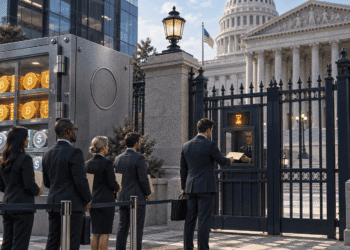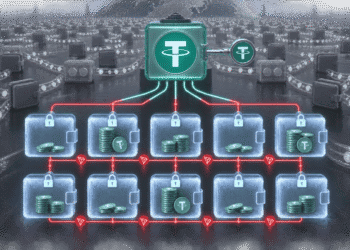

Nigeria has approved a national confiscation wallet for cryptocurrency seized by law enforcement, giving the state a single custody destination for assets it takes off criminals.
The Economic and Financial Crimes Commission disclosed the arrangement at a media session in Abuja, where chairman Ola Olukoyede described the problem it solves in plain terms.


“When you recover virtual assets, where do you put them? No accountability. That’s why we can’t continue like this,” he said. “Today, now we have a national confiscation wallet. So if I confiscate virtual assets now, it’s a national wallet that we put into those.”
The wallet was established with presidential approval and will be used by the EFCC and other law enforcement agencies.
The gap it closes is a real one
Seizing cryptocurrency is not the hard part. Holding it is.
When police confiscate cash, it goes into an evidence room with a chain of custody and an audit trail. When they seize a property, it sits where it is under a court order. Neither requires anyone to solve a technical problem.
Crypto has no equivalent default. Someone has to hold private keys, and whoever holds them controls the assets outright. Without a designated destination and clear custody rules, seized coins end up in wallets controlled by individual officers or ad hoc arrangements, and the accountability question Olukoyede raised becomes very difficult to answer.
The failure mode is not theoretical. The United States is currently prosecuting a contractor accused of stealing $46 million in seized crypto from US Marshals Service wallets he alone controlled, a case that surfaced only after an independent blockchain investigator spotted the funds. A White House review found the Marshals Service struggled to reconcile its digital asset holdings.
Nigeria is addressing the same problem earlier in its enforcement cycle, and the fact it is being addressed at all puts it ahead of several larger jurisdictions.
Freezes now happen in 72 hours
The wallet is one part of a broader operational shift the EFCC has been building.
The commission’s Fraud Risk Assessment and Control Department now monitors suspicious transactions and freezes funds within 72 hours of detecting unusual movement, before establishing where the money was going and why.
Olukoyede cited a case in which public funds moved from a local government account to a private company and then into cryptocurrency wallets. The commission froze the funds during the 72-hour window. He did not name the local government, company or state involved.
“Now we also have the capacity to trace cryptocurrency wallets, at least with those that are registered in Nigeria, and we are doing that,” he said.
That qualifier is important. Around 40 virtual asset platforms have been licensed in Nigeria, and the EFCC’s tracing capability is strongest where a wallet connects to one of them. Assets held in self-custody or routed through offshore platforms remain considerably harder to reach.
Civil forfeiture is the faster route
The legal strategy running alongside the wallet may matter more than the wallet itself.
The commission is using Section 17 of the Advance Fee Fraud Act to pursue civil asset forfeiture rather than waiting for criminal convictions.
“This is faster and quicker than criminal trial,” Olukoyede said. “We don’t have to wait 10, 15 years when witnesses die and assets are dissipated.”
Under the civil process, the commission files action against the asset directly. Anyone claiming ownership must appear and explain the source of the funds.
The efficiency argument is genuine, particularly for crypto, which can be moved and laundered in minutes while a criminal case takes years. It also inverts the usual burden. A claimant has to justify their ownership rather than the state proving a crime first, and that is a meaningful shift in who carries the risk of an error.
Nigerian courts have already applied the mechanism to digital assets, ordering interim forfeiture of wallets linked to a fraud syndicate involving 792 suspects in a 2025 case, with claimants given 14 days to contest.
What Nigeria has recovered
The EFCC reported recovering more than ₦1.23 trillion and $684.48 million between October 2023 and June 2026, alongside amounts in pounds and euros.
Virtual assets connected to the CBEX fraud are among the recoveries, and it was that case that exposed the custody gap the national wallet now addresses.
Olukoyede was direct about the limits of enforcement as a strategy. “The most effective system is not law enforcement. It is the policy regime, institutional reforms that close leakages,” he said, warning that the growing use of cryptocurrency to move illicit funds requires stronger technological capacity across financial and law enforcement institutions.
The unanswered questions
Several details have not been made public, and they determine how well this works.
Nobody has said who holds the keys, whether the wallet uses multi-signature controls requiring several independent approvals, or how holdings will be audited and reported. Those are precisely the mechanisms that separate a genuine accountability improvement from a single concentrated point of failure.
Nor is it clear what happens to assets afterwards. Whether Nigeria intends to sell seized crypto, hold it, or return it where forfeiture is overturned has not been addressed.
There is also the question of what a state wallet becomes once it is large enough. Governments holding significant crypto reserves face the same decisions any large holder does, and the United States, which holds an estimated 324,552 BTC, has spent two years arguing internally about custody and disposal.
Nigeria is one of the largest crypto markets in Africa, with high peer-to-peer volumes driven by currency pressure and remittances. That combination of heavy adoption and active enforcement makes it a useful test case, and other states building forfeiture frameworks will be watching how the custody arrangement holds up.
FAQ
What is the national confiscation wallet?
A single state-controlled wallet, approved by the Federal Government, where virtual assets seized by the EFCC and other law enforcement agencies are held. It replaces ad hoc arrangements that EFCC chairman Ola Olukoyede said left recovered crypto without accountability.
How does the EFCC freeze crypto?
Its Fraud Risk Assessment and Control Department monitors suspicious transactions and freezes funds within 72 hours of detecting unusual movement. Tracing capability is strongest for wallets connected to the roughly 40 virtual asset platforms licensed in Nigeria.
Why use civil forfeiture?
Section 17 of the Advance Fee Fraud Act allows the commission to file action against an asset directly rather than await a criminal conviction, which Olukoyede said avoids waiting 10 to 15 years while witnesses die and assets are dissipated. Claimants must explain the source of their funds.
Disclaimer: This article is for informational purposes only and does not constitute financial or legal advice. Cryptocurrency investments carry significant risk. Always conduct your own research before making any investment decisions.