
Ethereum trades around $2,484. Reaching $5,000 requires roughly 100%.
That is a doubling, and ETH has done it before. It has also spent the past three weeks unable to close above $2,550, a level that is 3% away.


The gap between those two facts is what this question comes down to. Here is what would actually need to happen.
Where ETH stands now
August produced the first genuine structural change in Ethereum’s chart for almost a year.
The token broke the descending trendline that had capped every rally since the August 2025 peak of $4,958, and printed a weekly candle worth more than 31%. That produced its first higher high of the current cycle, which is the technical detail that separates a real breakout from a bounce.
Since then, progress has stalled. ETH has oscillated between roughly $2,438 and $2,550, briefly touching $2,530 before being pushed back. It was quoted at $2,483.85 on Tuesday, down 0.26% over 24 hours.
The 0.618 Fibonacci retracement at $2,438.85 is acting as the floor, and holding it keeps the August structure alive.
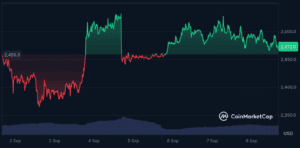
$2,550 has rejected it three times
The immediate obstacle is specific and has now held repeatedly.
Resistance sits between roughly $2,511 and $2,546, with the 50-week moving average at $2,542 reinforcing it. Analyst Ted Pillows identified $2,550 as the critical breakout level, and ETH has failed there on three separate attempts since the breakout.
A daily close above that zone would open $2,626, then $2,690. Zebpay’s technical read puts the decisive band at $2,550 to $2,600, with a confirmed breakout on volume opening $2,800 to $3,000 and a measured move potentially extending toward $3,050 to $3,250.
Even the optimistic technical case tops out around $3,250. That is 31% above current levels and still 35% below $5,000.
Nobody’s chart gets to $5,000 from here. It requires something the chart cannot show.
What the bulls are actually arguing
The case for a much larger move rests on institutional flows rather than technicals.
Ethereum ETFs posted record weekly inflows for a second consecutive week in late August, the highest of 2026, at a point when bitcoin funds were recording outflows. Exchange balances have been falling and whale accumulation has continued.
Fundstrat’s Tom Lee has said ETH could reach $6,000 if bitcoin hits $150,000, describing that as a conservative target. That framing is worth noting precisely: it is conditional on bitcoin roughly doubling from $78,500 first.
The structural argument is stronger than the price targets. Ethereum staking has reached a record 34.4% of supply, with more than 41 million ETH locked. Grayscale amended its Ethereum Staking Mini ETF to stake nearly all of its 839,556 ETH by default. Ethereum remains dominant in stablecoins, DeFi and tokenisation.
Three things stand in the way
The first is rates. The August CPI report lands on 11 September, and the Federal Reserve meets on 15 and 16 September. Strong August payrolls pushed hike expectations sharply higher, and ETH is a higher-beta asset than bitcoin. A hawkish outcome hits it harder.
The second is Ethereum’s own staking economics. EIP-8363, introduced in early August, would progressively burn validator rewards, taking net consensus-layer issuance to zero once staking reaches roughly 50% of supply. SharpLink chief executive Joseph Chalom publicly opposed it, arguing staking yield is the base rate underpinning DeFi and that removing it could push institutions to sell ETH as they unstake. Messari rates its chances of passing as low, but the debate itself removes a certainty institutional buyers had been relying on.
Validator rewards have already compressed to roughly 3% or below, a three-year low, as more ETH gets staked.
The third is delivery. The Glamsterdam upgrade has slipped to the fourth quarter, with a Sepolia testnet fork proposed for late September. There is no major Ethereum-specific catalyst inside the next quarter.
What a path to $5,000 requires
Four things, and they have to arrive together.
Bitcoin would need to move substantially higher first. Lee’s $6,000 target assumes $150,000 bitcoin, and ETH has not decoupled from that relationship. A Fed that holds and signals the tightening cycle is finished would be the precondition.
Ethereum ETF inflows would need to sustain their late-August pace across months rather than weeks, absorbing supply consistently.
ETH would need to clear $2,550 decisively and then hold $3,000, which is where February’s breakdown began and where genuine overhead supply sits.
And the staking issuance question would need to resolve without eliminating the yield that institutional holders are buying for.
The honest answer
Soon, no. Eventually, plausibly.
The most credible technical targets for the remainder of 2026 sit between $2,920 and $3,300. Getting to $5,000 requires bitcoin to lead, institutional flows to persist for months, and the staking economics debate to land favourably.
That is a 2027 proposition rather than a 2026 one, on current evidence.
The near-term levels are what actually matter. Holding $2,438 keeps the August breakout intact. Losing it opens $2,320, then $2,000. Clearing $2,550 on a daily close is the first genuine signal that this is a trend rather than a range.
Friday’s inflation print will decide which of those happens first.
FAQ
How far is ETH from $5,000?
Roughly 100%. ETH trades near $2,484, and it remains about 50% below its August 2025 all-time high of $4,958.
What is the key resistance?
The $2,511 to $2,550 zone, reinforced by the 50-week moving average at $2,542. ETH has failed there three times since its August breakout. A daily close above opens $2,626, then $2,800 to $3,000.
What are the main risks?
The Fed’s 16 September decision after strong August payrolls, EIP-8363’s proposal to burn validator rewards to zero at 50% staking, and the Glamsterdam upgrade slipping to the fourth quarter, leaving no near-term Ethereum-specific catalyst.
Disclaimer: This article is for informational purposes only and does not constitute financial advice. Cryptocurrency investments carry significant risk. Always conduct your own research before making any investment decisions.