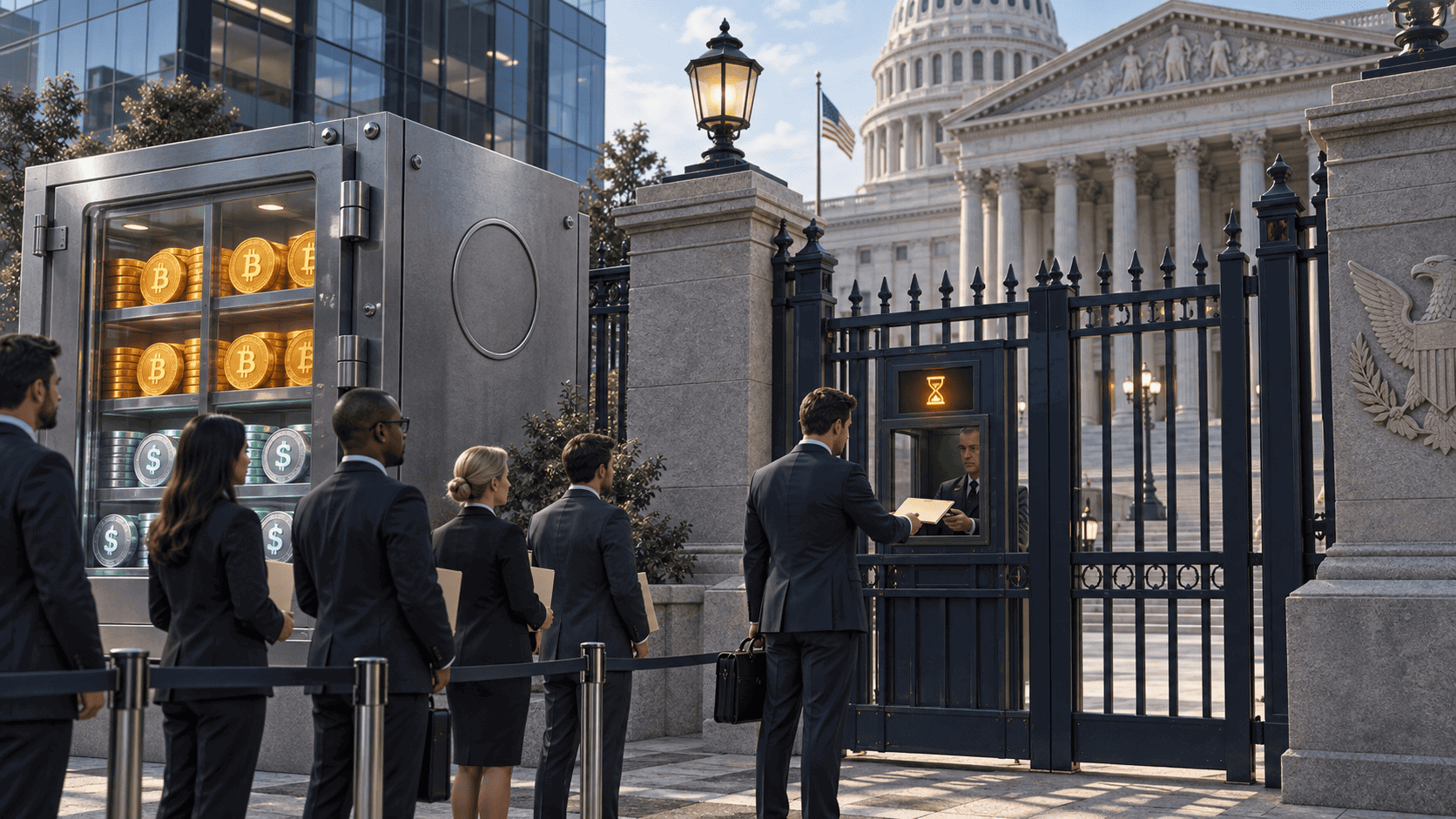
Block submitted an application to the Office of the Comptroller of the Currency on 8 September to establish Builders Bank & Trust, N.A., an uninsured national trust bank built to custody bitcoin and stablecoins.
If approved, the entity would operate under direct OCC supervision and provide custody and related fiduciary services. It would not accept deposits or issue loans, which is what separates a trust bank from a conventional lender.


Lee Woolley, Block’s digital asset strategy lead, is expected to serve as president and chief executive if the charter is granted.
Block said the charter would give its custody operations a consistent national framework as the business scales.
Bitcoin traded around $79,173 as the filing was reported, up 0.6% over 24 hours.
What a trust charter actually provides
The distinction matters more than the terminology suggests.
Most crypto custodians in the United States operate under state-level trust charters or arrangements with limited direct oversight. A national trust charter places the institution under a federal banking regulator with authority over national banks and trust companies.
That is the supervisory layer institutional allocators have been asking for. A pension fund or asset manager evaluating where to hold digital assets can point to federal supervision rather than a patchwork of state approvals.
The word “uninsured” is doing important work, though. Builders Bank would carry no FDIC backstop, because it takes no deposits. Federal supervision is not the same as federal insurance, and holdings would not be protected if the institution failed.
Block already offers custody services. The charter would move those activities into a federally supervised structure rather than create them from scratch.
The queue is now substantial
Block is joining a line that has formed rapidly.
Ripple, Circle, Paxos, BitGo and Fidelity Digital Assets all received conditional approvals in December 2025, with further applicants following through 2026. Circle received final approval in July for Circle National Trust. Sony Bank secured conditional approval for Connectia Trust. Revolut has won a conditional charter.
The OCC has been actively encouraging this. It said in August that it had received dozens of new charter applications over an 18-month period, having taken just 48 applications across the previous 14 years from 2011 through 2024, with no applications at all in three of those years.
“De novo chartering is a sign of a healthy banking system,” Comptroller Jonathan Gould said.
That is a deliberate policy shift, and crypto firms have been among its principal beneficiaries.
Warren has challenged the whole approach
The expansion is contested, and the objection is specific rather than rhetorical.
In a May 2026 letter to Gould, Senator Elizabeth Warren accused the OCC of approving at least nine national trust charters for crypto companies that may go beyond activities permitted under the National Bank Act. She also questioned whether some applicants were eligible in the first place.
Banking trade groups including the Bank Policy Institute have raised a parallel argument, contending that crypto firms gain bank-like credibility through these charters without meeting full banking requirements such as deposit insurance.
The industry’s counter is that the OCC’s chartering authority has long covered trust activities of this kind, and that federal supervision is preferable to the state-by-state alternative.
The dispute is unresolved and directly affects how quickly applications move.
Approval is neither quick nor certain
The review process carries no guarantee, and recent timelines illustrate the variability.
World Liberty Financial’s proposed World Liberty Trust Company received conditional approval on 14 August after roughly 220 days, the longest review among recent fintech and digital asset applications and about 100 days beyond the OCC’s stated 120-day target. That application faced additional scrutiny because of its ties to the Trump family.
Conditional approval also does not permit operations to begin. Applicants must still satisfy requirements covering capital, governance and compliance before opening.
Block’s filing starts a process that could take months and may not succeed.
What it signals
Block’s motivation is straightforward and worth stating plainly. The company already runs Cash App, holds bitcoin on its own balance sheet, and builds bitcoin hardware and mining infrastructure. Custody sits at the centre of all of it, and Dorsey has been among the more consistent bitcoin advocates in public technology.
Bringing that function in-house under federal supervision removes a dependency on third-party custodians and gives Block a regulatory position its competitors are also chasing.
The wider pattern is the more interesting part. Crypto custody is being absorbed into the federal banking perimeter, one charter at a time. That is what the industry spent years asking for, and it produces a market where the institutions holding digital assets look increasingly like the institutions holding everything else.
Whether that is maturation or capture depends on your view of what crypto was for. The practical effect is that a Fortune 500 payments company now wants a federal bank charter to hold bitcoin, and the regulator has been signalling it is open to the idea.
FAQ
What is Builders Bank & Trust?
An uninsured national trust bank Block has applied to establish, which would provide custody and fiduciary services for bitcoin, stablecoins and other digital assets under OCC supervision. It would not accept deposits or make loans.
Does the charter mean holdings are insured?
No. “Uninsured” means there is no FDIC backstop on holdings. The charter provides federal supervision of the institution, which is a different thing from federal insurance of the assets it holds.
How long will approval take?
The OCC targets 120 days, but recent digital asset applications have run longer. World Liberty Financial’s conditional approval took roughly 220 days. Conditional approval also does not permit operations to begin until capital, governance and compliance requirements are met.
Disclaimer: This article is for informational purposes only and does not constitute financial or legal advice. Cryptocurrency investments carry significant risk. Always conduct your own research before making any investment decisions.