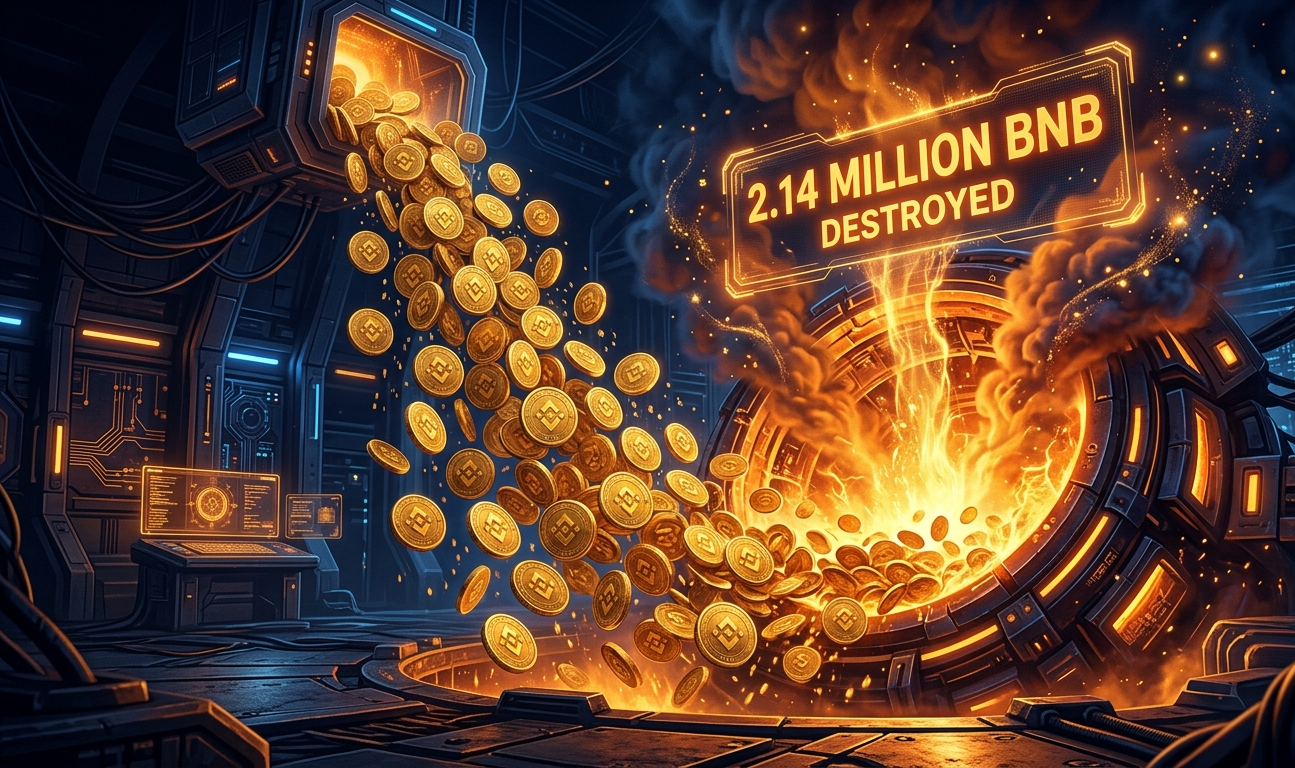
Every three months, Binance takes a chunk of BNB tokens and sends them to a dead wallet address where they can never be recovered. The tokens are gone forever. On April 15, the company did it for the 35th time, and this one was the largest dollar-value burn in the programme’s history.
Binance executed its 35th quarterly BNB burn on April 15, 2026, permanently removing approximately 2.14 million BNB, worth roughly $1.32 billion at prevailing prices, from circulation.


If you are new to crypto and wondering why a company would voluntarily destroy over a billion dollars worth of its own token, you are asking the right question. The answer is simple: fewer tokens in circulation means each remaining token represents a larger share of the total. It is the crypto equivalent of a stock buyback, except the shares are not repurchased and held. They are destroyed.
How the Burn Actually Works
BNB did not always burn tokens this way. In the early days, Binance would manually decide how many tokens to destroy based on its quarterly profits. That gave the company a lot of discretion, and critics argued it made the process opaque.
The burn was executed via Binance’s Auto-Burn mechanism, an on-chain formula that calculates destruction amounts based on BNB’s price and BSC block output, removing human discretion entirely.
Now it is automatic. The formula looks at two things: how much BNB is worth and how many blocks the BNB Smart Chain produced during the quarter. Higher price and more blocks mean more tokens get burned. Nobody at Binance decides the number. The blockchain does.
The tokens are sent to a “blackhole” address on the BNB Smart Chain: a wallet with no private key that nobody can access. Once they land there, they are permanently removed from existence. You can verify every burn on the blockchain yourself. That transparency is the whole point.
The Numbers So Far
With this burn, Binance has now eliminated over 62 million BNB, surpassing 30% of the original 200 million supply, as the protocol targets a hard cap of 100 million tokens.
Think about that for a moment. Nearly a third of all BNB that ever existed is already gone. The remaining supply sits at about 134.8 million tokens and continues to shrink every quarter. At the current pace, BNB will reach its target of 100 million tokens sometime around 2032.
BNB is currently trading around $622 with a market cap above $84 billion. It is the fourth-largest cryptocurrency by market cap, behind Bitcoin, Ethereum, and Tether’s USDT.
The Pioneer Burn Programme
There is a lesser-known part of the burn that deserves attention because it is genuinely clever.
The burn also included approximately 4,500 BNB from the Pioneer Burn Programme, an initiative designed to assist users who have lost their BNB through mistakes, such as sending tokens to unrecoverable addresses.
If you accidentally send BNB to a wrong address and lose your tokens, Binance will cover your loss and count those lost tokens toward the quarterly burn total. Your mistake becomes part of the deflationary event. You get your tokens back, and the total supply still shrinks. It is a small programme in the context of a $1.32 billion burn, but it turns what would normally be a painful user error into something that benefits the entire network.
Does the Burn Actually Move the Price?
This is the question everyone wants answered, and the honest answer is: not immediately, and not by itself. BNB is trading about 55% below its October 2025 all-time high of $1,370. The burn did not prevent that decline, and it did not cause a price spike when it happened on April 15.
What the burn does is create a structural tailwind. Every quarter, the supply gets smaller. If demand stays the same or grows, there are fewer tokens available to meet that demand. Over time, that pressure adds up. It is not a catalyst that moves the price in a single day. It is a slow, mechanical force that works in the background while everything else, from geopolitics to market sentiment to Bitcoin’s price action, determines the short-term direction.
The burn also signals something about Binance’s financial health. Destroying $1.32 billion in tokens only makes sense if the company believes BNB’s utility and ecosystem activity will continue to grow. A company in trouble does not voluntarily eliminate a billion dollars in assets. The burn is, in a sense, a quarterly statement of confidence.
What to Watch Going Forward
The next burn is scheduled for Q2 2026, with an estimated 1.64 million tokens set to be destroyed. BNB Chain has also been upgrading its infrastructure aggressively. The Fermi hard fork in January reduced block times to 0.45 seconds, and the network is targeting 20,000 transactions per second with sub-second finality by the end of the year.
For BNB holders, the maths is straightforward. The supply is shrinking on a fixed schedule. The network is getting faster. The ecosystem, which includes the world’s largest crypto exchange, continues to process billions in daily volume. Whether that translates into price appreciation depends on the broader market, but the structural foundation keeps getting stronger with every burn.
Thirty-five burns down. About 34.8 million tokens left to go before the 100 million target is reached. The bonfire is not slowing down.