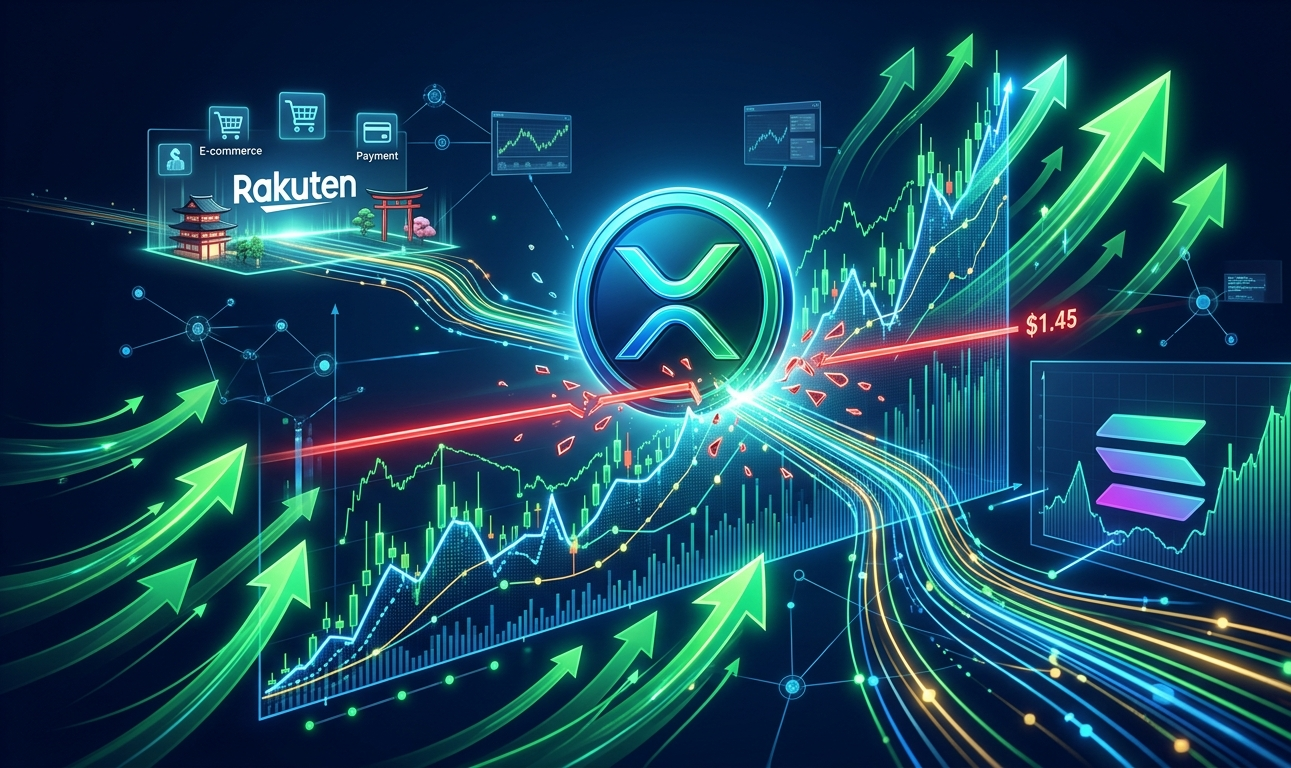
While Bitcoin’s breakout above $77,000 has dominated the headlines, XRP has quietly outperformed every major cryptocurrency this week. The token is up roughly 8% over the past seven days and 3% on the day, pushing past the $1.44 resistance level that had rejected it three times this year and breaking above $1.50 for the first time since February. Bitcoin gained 3.5% over the same period. Ethereum gained about 6%. XRP beat them both.
Traders are watching the $1.44 resistance and $1.40 support levels as XRP tests a major structural zone and trades above its 200-day EMA, with volume still too inconsistent to confirm a decisive breakout.


What makes this rally different from the previous three attempts at $1.45 is that multiple catalysts are hitting at the same time rather than arriving one at a time.
Wrapped XRP Just Launched on Solana
Wrapped XRP has launched on Solana via custodian Hex Trust and cross-chain protocol LayerZero, making XRP usable in Solana’s DeFi ecosystem for the first time. Each wXRP is backed 1:1 by native XRP held in segregated custody accounts and can be redeemed at any time, allowing holders to deploy capital on Solana without selling their underlying XRP.
This is significant because it connects two of crypto’s largest ecosystems that had no direct bridge before. XRP has always been a payments asset. Solana has always been a DeFi and trading powerhouse. Now XRP holders can access Jupiter, Phantom, Titan Exchange, and Meteora without ever leaving their XRP position. The wrapped token launched with over $100 million in total value locked from day one.
The Solana debut is part of a broader Hex Trust rollout to Ethereum, Optimism, and HyperEVM, reflecting a wider trend of tokens bridging across chains to chase yield and liquidity.
For a token that has historically sat on its own ledger doing cross-border payments and not much else in DeFi, this is a meaningful expansion of what XRP can actually be used for.
Rakuten Opened XRP to 44 Million Users
Earlier this week, Rakuten Wallet listed XRP for spot trading and payments on April 15. This is bigger than a normal exchange listing because 44 million Rakuten Pay users can now convert loyalty points into XRP and spend it at over 5 million merchant locations across Japan.
Rakuten is not a crypto company. It is Japan’s largest e-commerce platform, the operator of the country’s most widely used loyalty programme, and a financial services conglomerate with banking, insurance, and securities arms. When Rakuten adds a crypto asset to its payments ecosystem, it creates a distribution channel that no exchange listing can match.
Most of Rakuten’s 44 million users will never buy XRP. But even a fraction of that user base converting loyalty points creates steady buying pressure that did not exist before this week.
ETF Inflows Hit a Three-Month Record
XRP investment products pulled in $119.6 million in net inflows for the week ending April 11, with almost all of it coming from European investors through Swiss exchange-traded products while US institutions wait on the CLARITY Act markup expected in late April.
That $119.6 million figure accounted for more than half of all global crypto fund inflows for the week. European investors are positioning in XRP through regulated products at a pace that has not been seen since the spot XRP ETFs launched in late 2025. The demand is coming from institutional channels, not retail speculation, and it is concentrated enough to move the price.
The $1.45 Wall Finally Broke
Roughly 1.24 billion XRP sits in wallets at breakeven prices between $1.45 and $1.47, and every rally this year has failed at that wall of break-even sellers.
Previous attempts to push through $1.45 were driven by a single catalyst and ran into that wall of holders selling to break even. This time, the Hormuz reopening, the Solana integration, the Rakuten listing, and the ETF inflows all arrived in the same week. The combined buying pressure from institutional products, Japanese retail infrastructure, and DeFi liquidity was enough to absorb the sellers and push through.
XRP broke past $1.50 for the first time since February after Iran declared the Strait of Hormuz open and oil prices dropped over 10%. The Solana launch gave XRP an extra push on top of the broader rally. The 100-day EMA at $1.55 and the 200-day EMA at $1.80 are the next levels to watch.
What Comes Next
The CLARITY Act, the bill that would make XRP’s digital commodity classification permanent federal law, is expected to face its Senate markup in the final weeks of April. If it passes committee, XRP would be the only major altcoin with explicit, legislated commodity status in the United States. That would remove the last significant regulatory overhang that has kept some US institutions on the sidelines.
The ceasefire expires on April 22. If it holds and the broader market continues to rally, the $1.55 and $1.60 levels become realistic targets. If the ceasefire collapses and risk assets sell off, XRP’s relative strength will be tested against the same $1.45 level it just broke above.
For now, XRP is doing something it has not done consistently in 2026: outperforming Bitcoin on a weekly timeframe with genuine fundamental catalysts behind the move rather than just hype.