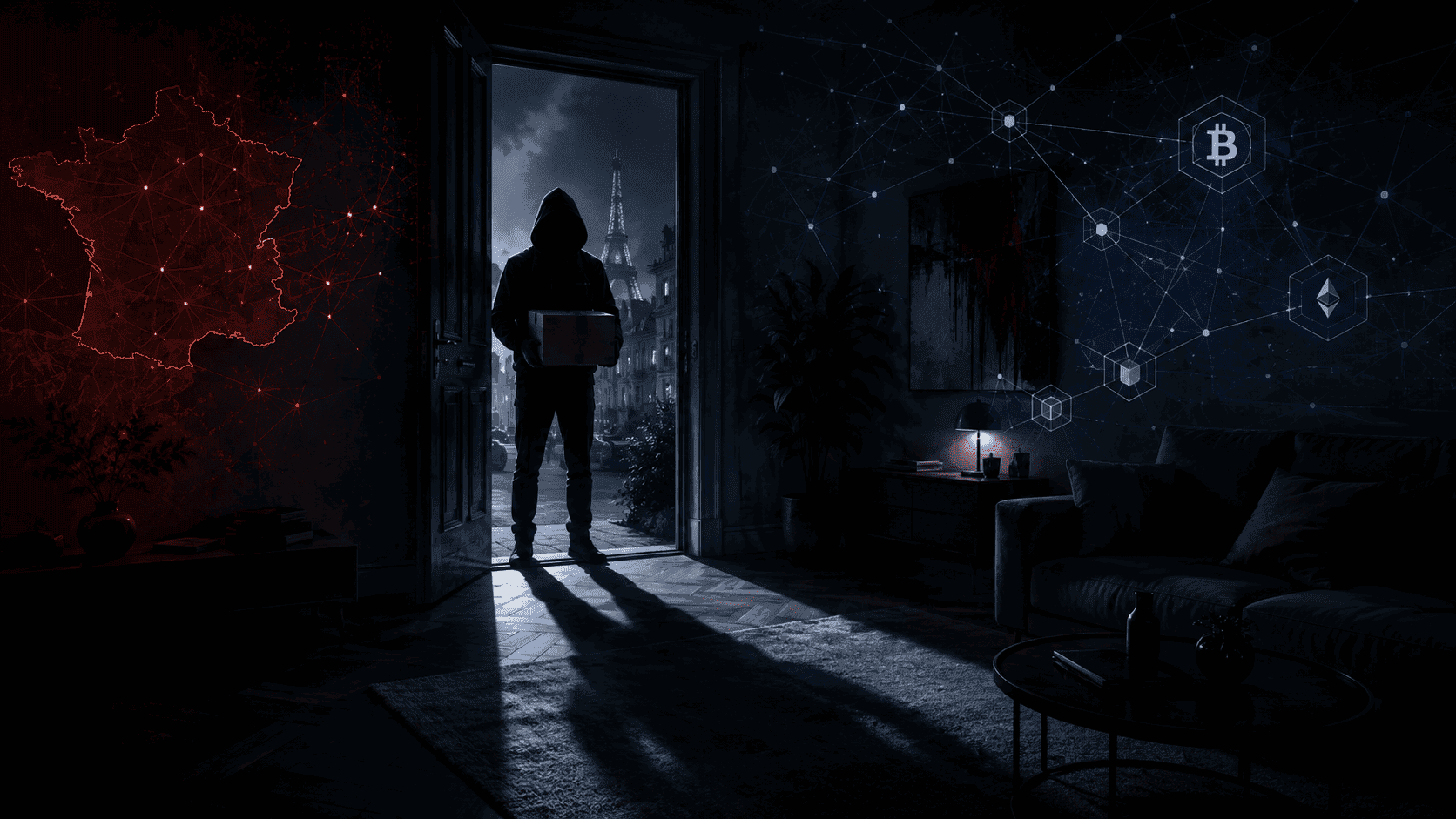
On the evening of May 20, a man walked up to a home in Villenoy, a quiet town east of Paris. He was carrying a cardboard box and wearing a branded delivery vest. He looked like any other courier making a late drop-off but he wasn’t.
When the homeowner opened the front gate, five masked accomplices rushed into the courtyard from their hiding positions. They grabbed the woman and tried to force her into a Citroën C3 parked on the street. She screamed. Neighbors heard the cries and intervened. The attackers scattered.


The woman was the wife of Sébastien Borget, co-founder and chief operating officer of The Sandbox, a blockchain-based gaming platform built on Ethereum. She was not injured. Two of the six suspects, both teenagers aged 15 and 16, were arrested shortly after when police intercepted a ride-hail car they had called to flee the scene. Officers recovered a fake handgun, zip-tie restraints, and balaclavas.
This was not an isolated event. It was the 41st crypto-related kidnapping or attempted abduction recorded in France since January 1, 2026.
France Is the Crypto Kidnapping Capital of the World
The numbers are staggering. Forty-one incidents in less than five months works out to roughly one crypto-linked kidnapping or attempted abduction every three and a half days.
Since 2023, French authorities have documented 135 such incidents, making France the epicentre of a phenomenon that accounts for nearly 80% of all crypto-related kidnappings across Europe. Eighty-eight people have been charged across 12 active judicial investigations.
The attacks are not limited to billionaire founders. In April, masked intruders forced a French crypto-linked family to transfer roughly $820,000 in digital assets at gunpoint. In January, Ledger co-founder David Balland was kidnapped and had part of his finger severed before police rescued him. The daughter of Paymium CEO Pierre Noizat was also targeted. So was the head of Binance’s French operations.
The pattern is consistent and disturbing. Attackers identify crypto holders through public blockchain data, social media, conference attendance, or industry connections. They target homes rather than offices. They use deception, fake deliveries, or ambush tactics. And increasingly, the perpetrators are young. Both suspects arrested in the Borget case were born in 2009 and 2010, meaning they were 15 and 16 years old.
French police have noted this trend specifically among younger offenders. Security analysts believe organized groups are recruiting teenagers and young adults to carry out the physical operations, knowing they face lighter sentences under juvenile justice laws.
Why France?
The concentration of attacks in one country demands an explanation. Several factors make France uniquely vulnerable.
First, France has one of the most active crypto communities in Europe. Paris Blockchain Week is one of the industry’s largest annual events. Multiple major crypto companies are headquartered or have significant offices in the country. That high visibility creates a target-rich environment.
Second, France’s residential security culture is different from places like the US where gated communities and private security are more common among wealthy individuals. Many French crypto executives live in ordinary homes in residential neighborhoods, making physical access relatively straightforward for determined attackers.
Third, blockchain’s transparency works against its holders. Every transaction on Ethereum, Bitcoin, and most other public blockchains is visible to anyone. If an attacker can link a real-world identity to an on-chain wallet address, they can see exactly how much the target is worth. Conference panels, LinkedIn profiles, media interviews, and social media posts all provide the clues needed to make that connection.
Fourth, the legal consequences for crypto kidnapping in France have historically been moderate compared to the potential payoff. A successful attack that forces a victim to transfer even a few hundred thousand dollars in crypto can produce life-changing money for the perpetrators, while the penalties, especially for juvenile offenders, may not be severe enough to serve as a meaningful deterrent.
The Government Response
French officials are clearly alarmed. During Paris Blockchain Week 2026, Minister Delegate Jean-Didier Berger unveiled emergency measures to address the crisis. These include a dedicated crime-prevention platform for crypto holders and enhanced security for select French blockchain entrepreneurs and their families.
Interior Minister Bruno Retailleau reportedly held an emergency meeting with top crypto executives in France and committed to establishing a new joint security committee to bring law enforcement and the crypto industry closer together on prevention.
These are meaningful steps. But they also highlight the scale of the problem. When a government assigns security details to private business founders and creates dedicated platforms to prevent an entirely new category of violent crime, it tells you the situation has moved well beyond what normal policing can handle.
The reality is that crypto kidnappings are a symptom of a broader issue. The wealth created by digital assets is visible in ways that traditional wealth is not. A banker’s net worth doesn’t appear on a public ledger. A crypto founder’s wallet balance does. Until the industry develops better tools for separating on-chain identity from real-world identity, the physical risks of holding public crypto wealth will continue to grow.
What Every Crypto Holder Should Know
You don’t need to be a billionaire founder to be at risk. The attacks in France have targeted people across a wide range of wealth levels. A family forced to transfer $820,000 at gunpoint is not in the same financial bracket as a Sandbox co-founder, but they were targeted just the same.
Security analysts who specialize in protecting crypto holders recommend several practical steps. Never publicly confirm your holdings or wallet addresses. Use hardware wallets stored separately from your home, not in a desk drawer. Vary your daily routine so your movements aren’t predictable. Be cautious about sharing personal details at conferences, on social media, or in interviews that could be used to locate you.
If you attend crypto events, be aware that your presence at those gatherings identifies you as someone with potential crypto wealth. That information can be used by anyone, not just the people you’re networking with.
Borget himself posted on X after the incident, confirming his wife was safe and thanking the neighbors who intervened. The fact that neighbors stopped the attack, not security systems or police, underscores how vulnerable even high-profile figures remain.
The Industry’s Uncomfortable Reality
The crypto industry celebrates transparency, open-source code, and publicly verifiable transactions as core values. Those values have enabled the development of extraordinary technology and created enormous wealth.
But they’ve also created a map. A map that shows exactly who holds what, how much they have, and in some cases, where they live. For criminals willing to use physical violence, that map is more valuable than any hacking tool.
The 135 crypto kidnappings documented in France since 2023 represent a problem that no software update can fix. The solution requires a combination of stronger operational security among individuals, a stronger law enforcement response, tougher sentencing for perpetrators, and industry-wide tools that help separate digital identities from physical ones.
Until those solutions catch up with the threat, the reality is simple. Crypto wealth makes you a target. And the criminals are getting bolder, younger, and more organized.
Disclaimer: This article is for informational purposes only and does not constitute financial advice. Cryptocurrency investments carry significant risk. Always conduct your own research before making any investment decisions.