

Bitcoin clawed back above $74,000 on Saturday after President Trump signaled that the US naval blockade of the Strait of Hormuz could be lifted as part of a broader de-escalation with Iran.
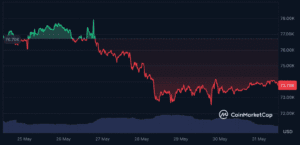
The recovery from Thursday’s crash low of $72,978 is modest, roughly 1.4%. But in a market that has been falling for three weeks straight, any bounce draws attention. The question every trader is asking is whether this is the start of something real or just another false dawn in a conflict cycle that keeps recycling hope and disappointment.


The answer depends entirely on what happens next between Washington and Tehran. And right now, the signals from both sides are pointing in opposite directions.
What Trump Actually Said
Trump’s comments came during a cabinet meeting on Friday. He described the naval blockade as a temporary measure designed to bring Iran to the negotiating table and suggested it had served its purpose.
“We’ve made our point,” he said. “The blockade was about leverage. We have leverage now. We don’t need to keep squeezing.”
The statement stopped short of a formal announcement. No executive order was issued. No military orders were given publicly. But the language was clearly designed to signal flexibility, both to Iran and to markets that have been pricing in sustained conflict for weeks.
Bitcoin’s response was immediate but restrained. The price ticked up from $73,100 to $74,000 within hours of the remarks. Oil dropped 2% on the prospect of resumed Iranian exports. The Nasdaq edged higher. Risk appetite improved across the board, but nobody was rushing to go all-in.
The restraint tells you everything. Three months ago, the first ceasefire announcement sent Bitcoin surging $5,000 in a day. Six weeks ago, the draft memorandum of understanding pushed it to $82,000. This time, the market barely moved. The trust has been burned out.
Iran Rejected the Terms Within Hours
Whatever optimism Trump’s comments created evaporated quickly.
Iranian state media published a response late Friday rejecting the conditions outlined in the draft memorandum of understanding. Tehran’s demands were specific and non-negotiable: the immediate release of $12 billion in frozen Iranian assets held in foreign banks, full sovereignty over the Strait of Hormuz without toll-free passage conditions, and no restrictions on Iran’s nuclear enrichment program during the 60-day window.
The US position requires Iran to remove naval mines from the waterway within 30 days, allow unrestricted commercial shipping, and accept limitations on nuclear activity as a precondition for broader sanctions relief. The gap between the two sides is enormous.
Treasury Secretary Bessent acknowledged the challenge. He said negotiations remain necessary to “wind down the broader pressure campaign” but that the US would not unfreeze assets until Iran demonstrates compliance with the ceasefire terms. That’s a sequencing problem that neither side seems willing to resolve. Iran wants money first. America wants compliance first. Both insist the other goes first.
For Bitcoin, the rejection reinforced the ceasefire fatigue that has been building for weeks. The market has watched multiple peace announcements followed by military strikes, retaliatory attacks, and collapsed negotiations. Each cycle produces a smaller price response because the previous one proved temporary.
Operation Economic Fury Adds a New Dimension
While diplomats negotiated, the Treasury Department was fighting a parallel war.
Secretary Bessent announced that “Operation Economic Fury” had seized approximately $1 billion in Iranian cryptocurrency assets, the largest state-sponsored crypto seizure in history. The operation neutralized what Bessent described as an on-chain architecture that had siphoned $400 million through Iran’s Persian Gulf Strait Authority toll collection system.
The seizure builds on the OFAC sanctions against the PGSA that we covered earlier this week. Iran’s attempt to use Bitcoin and USDT to collect shipping tolls from vessels passing through the Strait of Hormuz has now been dismantled from both ends: the wallets sanctioned, the infrastructure seized, and the financial networks identified and frozen.
For the crypto market, Operation Economic Fury is a double-edged sword. On one hand, it demonstrates that blockchain’s transparency enables enforcement at a scale that traditional financial systems can’t match. The $1 billion seizure happened because every transaction was recorded on a public ledger. On the other hand, it provides ammunition for critics who argue that crypto enables sanctions evasion by hostile states, a narrative that surfaces every time Congress debates new regulations.
The practical impact on Bitcoin’s price is minimal. The seized crypto has been removed from circulation, which is technically supply-reducing. But the amounts involved are small relative to daily trading volumes, and the market’s reaction has focused on diplomatic signals rather than enforcement details.
Where Bitcoin Sits on the Chart
The bounce from $72,978 to $74,000 hasn’t meaningfully changed the technical picture. Bitcoin remains in a downtrend, with every major moving average pointing lower.
The 50-day EMA sits at $76,500 and is falling. The 200-day EMA is at $81,500 and falling faster. The price is below both, which puts Bitcoin firmly in bearish territory by any standard technical definition.
Support has been established at $72,978, the flash crash low from Thursday’s Iran airstrikes. Below that, the April low of $70,740 is the last major floor. A breakdown through $70,740 would open the door to $68,000 and potentially $65,000, territory that hasn’t been tested since early 2025.
Resistance sits at $75,700, which is Strategy’s average cost basis and the level that capped Friday’s recovery attempt. Above that, $77,000 and $78,000 represent the zones where selling has consistently appeared over the past two weeks.
The Fear and Greed Index reads 25. It’s been stuck there for nearly a month. The RSI is approaching oversold on the daily chart. Long-term holder supply is at a record 15.8 million BTC. All of the contrarian indicators that typically signal a bottom are present. But they’ve been present for weeks without producing a sustained recovery.
The missing ingredient isn’t technical. It’s fundamental. Bitcoin needs a catalyst that changes the macro environment, not just a tweet that changes the mood for an afternoon.
The Three Things That Would Actually Change This
Strip away the noise, and there are only three developments that could break Bitcoin out of its current downtrend.
The first is a signed, enforced Iran deal that actually reopens the Strait of Hormuz. Not a draft. Not a memorandum. Not a hint from a cabinet meeting. Ships passing through without tolls, mines, or military escorts. That would send oil below $90, ease inflation expectations, and give the Fed room to signal rate cuts. Every other diplomatic gesture has been priced and forgotten.
The second is a rate cut signal from Fed Chair Warsh. His first FOMC meeting is June 17-18. If he surprises the market with dovish language or an actual cut, risk assets, including Bitcoin, would rally sharply. The current market consensus is that rates will stay steady or rise. A cut would be a genuine shock.
The third is a reversal in ETF flows. Nine consecutive days of outflows totaling $2.8 billion have been the primary mechanical force driving prices lower. Two or three consecutive days of strong inflows would break the pattern and signal that institutional conviction is returning.
Any one of these catalysts could push Bitcoin back above $77,000. All three arriving together could send it toward $85,000. None of them has arrived yet. And until they do, every bounce from the low $70s is a relief rally within a downtrend, not the start of a recovery.
The $74,000 bounce on Trump’s Hormuz comments is encouraging. But encouraging and tradeable are different things. This market needs proof, not promises.
FAQ
Why did Bitcoin bounce to $74,000?
Bitcoin recovered from $72,978 to approximately $74,000 after President Trump signaled that the US naval blockade of the Strait of Hormuz could be lifted. The comments suggested de-escalation with Iran, which eased risk sentiment across markets. Oil dropped 2%, and the Nasdaq edged higher on the same remarks.
Did Iran accept the ceasefire terms?
No. Iranian state media rejected the conditions within hours of Trump’s comments, demanding the immediate release of $12 billion in frozen assets, full sovereignty over the Strait of Hormuz, and no restrictions on nuclear enrichment. The gap between US and Iranian positions remains wide.
What would it take for Bitcoin to sustain a recovery?
Three catalysts would change the picture: a signed and enforced Iran deal that reopens the Strait of Hormuz, a rate cut signal from Fed Chair Warren at the June 17-18 FOMC meeting, or a reversal in Bitcoin ETF flows, which have seen $2.8 billion in outflows over nine consecutive days. Until at least one of these arrives, bounces are relief rallies within a continuing downtrend.
Disclaimer: This article is for informational purposes only and does not constitute financial advice. Cryptocurrency investments carry significant risk. Always conduct your own research before making any investment decisions.