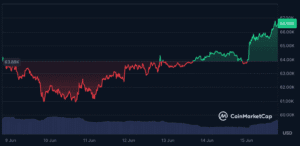
Bitcoin closed Sunday at $65,710. By 7:30 AM ET on Monday, it had pushed to $66,157, climbing 2% in 24 hours. The move marks the first time since June 12, the SpaceX IPO week, that Bitcoin has traded sustainably above $66,000. The price action breaks above what had been functioning as immediate resistance and clears the path toward more meaningful upside targets.
The recovery has been quietly building for several days while the headlines focused elsewhere. Spot Bitcoin ETFs recorded $85.8 million in inflows on Friday, ending a five-day outflow streak. Ethereum ETFs broke their 17-day outflow streak, the longest in crypto ETF history. The Iran peace deal that Trump announced for Sunday continues progressing toward a June 19 formal signing, with the Strait of Hormuz reopening expected to follow.


For traders who watched Bitcoin grind through the worst stretch of 2026, with the $59,770 low on June 4 and the persistent ETF outflows that defined late May and early June, the price action at $66,157 represents something specific. It’s the first signal that the market structure has shifted from “extreme fear with potential downside” to “recovery underway with defined upside catalysts.”
The FOMC meeting tomorrow and Wednesday will provide the next major test. If Kevin Warsh delivers anything but a hawkish surprise, Bitcoin’s path toward $68,000 to $70,000 opens immediately. If he confirms the market’s worst fears about sustained tightening, the $66,000 reclaim could fade as quickly as it formed. The next 48 hours will determine whether Monday’s move is the beginning of something or another false start in a long bear market.
What Reclaiming $66,000 Actually Means
The $66,000 level matters technically because it represents the upper boundary of the consolidation range that has contained Bitcoin since the SpaceX week. Between June 12 and June 14, BTC traded primarily between $62,500 and $65,500. The $65,500 level functioned as resistance throughout that window, rejecting multiple attempts to push higher.
Monday’s break above $66,000 confirms that the consolidation range has resolved to the upside. In technical analysis terms, this kind of resolution typically signals that buyers have absorbed the available supply at the resistance level and that the next leg of price discovery is moving higher rather than lower. The pattern is consistent with how Bitcoin has historically transitioned from accumulation phases to markup phases.
The next technical resistance sits at $68,000 to $70,000, where Bitcoin spent significant time during the May decline. This zone represents the area where sellers who bought near the recent highs may look to exit at break-even or modest losses, creating supply that the market needs to absorb. If Bitcoin clears $70,000 with sustained volume, the next significant resistance doesn’t appear until $73,000 to $75,000.
Support has shifted higher as well. The $63,000 to $64,000 zone that previously functioned as resistance now becomes potential support on pullbacks. If Bitcoin retests this level and finds buyers, the bullish structure remains intact. If it breaks back below $62,000, the Monday recovery would be invalidated and the market would face the question of whether the recent low at $59,770 is the actual cycle bottom or just a temporary support that gets retested.
The RSI on the daily chart has moved out of oversold territory but remains well below overbought levels, suggesting room for additional upside before momentum indicators flash warning signs. The technical setup supports the recovery thesis without requiring the kind of overheated conditions that typically precede sharp corrections.
The Catalysts Behind the Move
Three specific developments produced Monday’s move higher. Each one independently contributes to the recovery thesis. The combination is what makes the price action significant.
The first catalyst is the Iran peace deal progression. Trump announced on Saturday that the deal would be signed Sunday, with the Strait of Hormuz reopening immediately. While Sunday’s specific timeline slipped (Iran disputed the date), the broader diplomatic momentum has continued. The formal signing ceremony is now scheduled for June 19. Oil prices have responded with sustained declines from the elevated levels that prevailed during the conflict. Lower energy prices flow directly into lower headline inflation, which reduces pressure on the Fed to maintain hawkish positioning.
The second catalyst is the end of the ETF outflow streaks. Bitcoin ETFs recorded $85.8 million in inflows on Friday after five consecutive days of net outflows. BlackRock and Fidelity led the inflows, signalling that the largest institutional ETF allocators have shifted from net sellers to net buyers. Ethereum ETFs broke their 17-day outflow streak with $19.30 million in inflows on June 5, and the recovery has continued. The institutional selling that defined late May and early June has demonstrably reversed.
The third catalyst is the macro positioning shift heading into the FOMC. Market pricing for the June 17-18 meeting now reflects 97-98% probability of a rate hold with effectively zero probability of a hike. The hawkish surprise scenario that weighed on Bitcoin throughout late May has been largely priced out. If Warsh delivers a measured statement maintaining current rates with neutral forward guidance, the market reaction would likely be relief rather than disappointment.
The convergence of these three catalysts produced the conditions for Monday’s move. Each individual catalyst would have provided modest support. Together, they generated enough buying pressure to break Bitcoin out of the consolidation range and establish the recovery as more than just a temporary bounce.
The Standard Chartered Position Holds
Geoffrey Kendrick’s June 12 declaration that “crypto winter is over” and that Bitcoin’s cycle low was printed at $59,000 is being validated by Monday’s price action. The structural framework Kendrick described, with ETF outflows reversing, the FOMC stabilising, and Bitcoin dominance holding above 60%, is unfolding as he predicted.
The $66,157 price is now $7,157 above the June 4 low at $59,000. That’s a 12% recovery from the cycle bottom in just 11 days. Recoveries of this magnitude from extreme fear conditions typically signal genuine institutional rebalancing rather than retail-driven bounces. The breadth of the move, with Ethereum, Solana, XRP, and other major altcoins all participating, reinforces the institutional character of the rally.
For Kendrick’s $100,000 year-end target to prove correct, Bitcoin needs to continue grinding higher from current levels. The path from $66,000 to $100,000 would represent a 51% rally over the remaining six and a half months of 2026. Historical post-extreme-fear performance suggests this trajectory is achievable but not guaranteed. The catalysts arriving over the coming weeks, the FOMC outcome, the CLARITY Act floor vote, sustained Iran deal momentum, will determine whether the rally accelerates or stalls.
Standard Chartered’s broader institutional research framework has consistently outperformed the average crypto analyst predictions throughout the 2024-2026 cycle. The bank’s $100,000 Bitcoin target was set when prices were significantly lower, and its $4,000 Ethereum target was revised down from $7,500 specifically to reflect the value accrual challenges Ethereum has faced. The institutional research community is generally taking Kendrick’s positioning seriously, which contributes to the structural recovery in institutional positioning.
What the FOMC Reaction Will Tell Us
Tomorrow’s FOMC meeting is the next major test. The headline rate decision is essentially predetermined, with markets pricing 97-98% probability of a hold. The actual market-moving information will come from the statement language, the dot plot, and Warsh’s press conference.
If Warsh delivers a hold with measured language about ongoing data dependence, Bitcoin’s path higher continues. The market interprets neutral positioning as removing the worst-case scenario, and risk assets typically rally on the absence of negative surprises.
If Warsh delivers a hawkish hold with explicit references to inflation persistence and potential need for further tightening, Bitcoin would likely retreat toward the $63,000-64,000 zone. The reaction would be modest because hawkish positioning is partially priced in, but the recovery momentum would slow significantly.
If Warsh delivers a dovish surprise with hints at potential rate cuts later in 2026, Bitcoin could push aggressively higher. The dovish scenario looks unlikely given Friday’s hot PPI data, but Warsh’s first FOMC meeting carries genuine uncertainty about his policy philosophy. A surprise easing signal would produce one of the strongest single-day Bitcoin rallies of the year.
The dot plot accompanying the meeting matters specifically. The April dot plot showed two to three cuts expected by year-end 2026. The June dot plot is widely expected to show zero or one cut. If it shows officials projecting hikes for late 2026 or 2027, the hawkish shock would temporarily reverse the recovery thesis. If it shows officials still projecting cuts, the recovery accelerates immediately.
For positioning, the asymmetric setup suggests waiting for confirmation rather than trying to predict the outcome. Bitcoin at $66,157 with the recovery underway and the FOMC providing imminent clarity offers a defined risk-reward window. The next 48 hours will reveal which direction the recovery extends.
What This Means for the Broader Crypto Market
Bitcoin’s reclaim of $66,000 carries implications beyond BTC itself. The broader crypto market typically follows Bitcoin’s direction during recovery phases, with altcoins outperforming on the upside and underperforming on the downside.
Monday’s session showed exactly this pattern. While Bitcoin gained 2%, several major altcoins posted significantly stronger gains. HYPE rose 7.51%, XRP gained 3.20% (with the XRP Ledger 3.2.0 upgrade activating today), and Solana broke above $70 with a 3.59% advance. The altcoin outperformance on a day when Bitcoin’s gains were modest suggests genuine risk appetite returning to crypto markets.
For investors holding diversified crypto portfolios, the broad-based recovery validates the strategy of maintaining exposure across multiple major assets rather than concentrating entirely in Bitcoin. Altcoins that survived the recent decline are now positioned to capture significant upside if the broader recovery continues. The institutional infrastructure being built around Ethereum, Solana, and XRP provides structural support that didn’t exist in previous cycles, potentially producing better altcoin performance during this recovery than historical patterns suggest.
For investors with concentrated Bitcoin positions, the recovery validates the long-term holding thesis but also raises questions about whether to add exposure during the rally or wait for potential pullbacks. The patterns of Bitcoin recoveries from extreme fear conditions historically include corrections during the recovery phase, where opportunistic buyers can add positions at lower prices than the initial breakout level. Whether such pullbacks materialise depends on the FOMC outcome and subsequent catalysts.
For investors who reduced crypto exposure during the recent selloff, Monday’s move provides additional validation for re-entering positions. The structural recovery is now confirmed by both price action and institutional flow data. Dollar-cost averaging back into positions over the coming weeks aligns with the recovery thesis without requiring perfect timing.
The Bottom Line
Bitcoin reclaiming $66,000 represents the first concrete technical confirmation that the recovery thesis is functioning as institutional research predicted. The move clears the consolidation range that defined the post-SpaceX week, breaks above what had been functioning as immediate resistance, and aligns with the structural improvements in ETF flows and macro positioning that have been building for over a week.
The path forward requires continued execution. Tomorrow’s FOMC meeting is the next major test. The CLARITY Act vote expected this week represents another significant catalyst. The Iran deal’s formal June 19 signing would provide additional support. Sustained ETF inflows would confirm that the institutional rebalancing is genuine rather than temporary.
If these catalysts deliver, Bitcoin’s path toward $70,000 and beyond becomes the base case. If they disappoint, the recovery could stall and require additional accumulation before the next leg higher. The asymmetry currently favors patience over conviction trades, with the FOMC outcome providing the cleanest decision point for adding or reducing exposure.
For now, the price action speaks for itself. Bitcoin at $66,157 is above the consolidation range. The recovery is underway. The next 48 hours will determine whether it accelerates or stalls. The first real test was just passed.
FAQ
Why is Bitcoin reclaiming $66,000 significant?
The $66,000 level represented the upper boundary of the consolidation range that contained Bitcoin since the SpaceX IPO week. Monday’s break above this level confirms that the consolidation has resolved to the upside, with buyers absorbing supply at the resistance level. The reclaim is the first concrete technical signal that the recovery thesis from the June 4 low at $59,770 is functioning as institutional research predicted.
What’s the next major catalyst?
The FOMC meeting on June 16-17 is the next critical event. Markets are pricing 97-98% probability of a rate hold. The key information will come from the statement language, the dot plot showing officials’ projected interest rate paths, and Kevin Warsh’s first press conference as Fed Chair. A neutral or dovish outcome would extend the recovery toward $70,000. A hawkish surprise would pause the rally.
What are the price levels to watch?
Support has shifted higher to the $63,000-64,000 zone that previously functioned as resistance. The next resistance sits at $68,000-70,000, where Bitcoin spent significant time during the May decline. Above $70,000, the next major resistance doesn’t appear until $73,000-75,000. A break below $62,000 would invalidate the recovery thesis and put the June 4 low at $59,770 back into question.
Disclaimer: This article is for informational purposes only and does not constitute financial advice. Cryptocurrency investments carry significant risk. Always conduct your own research before making any investment decisions.