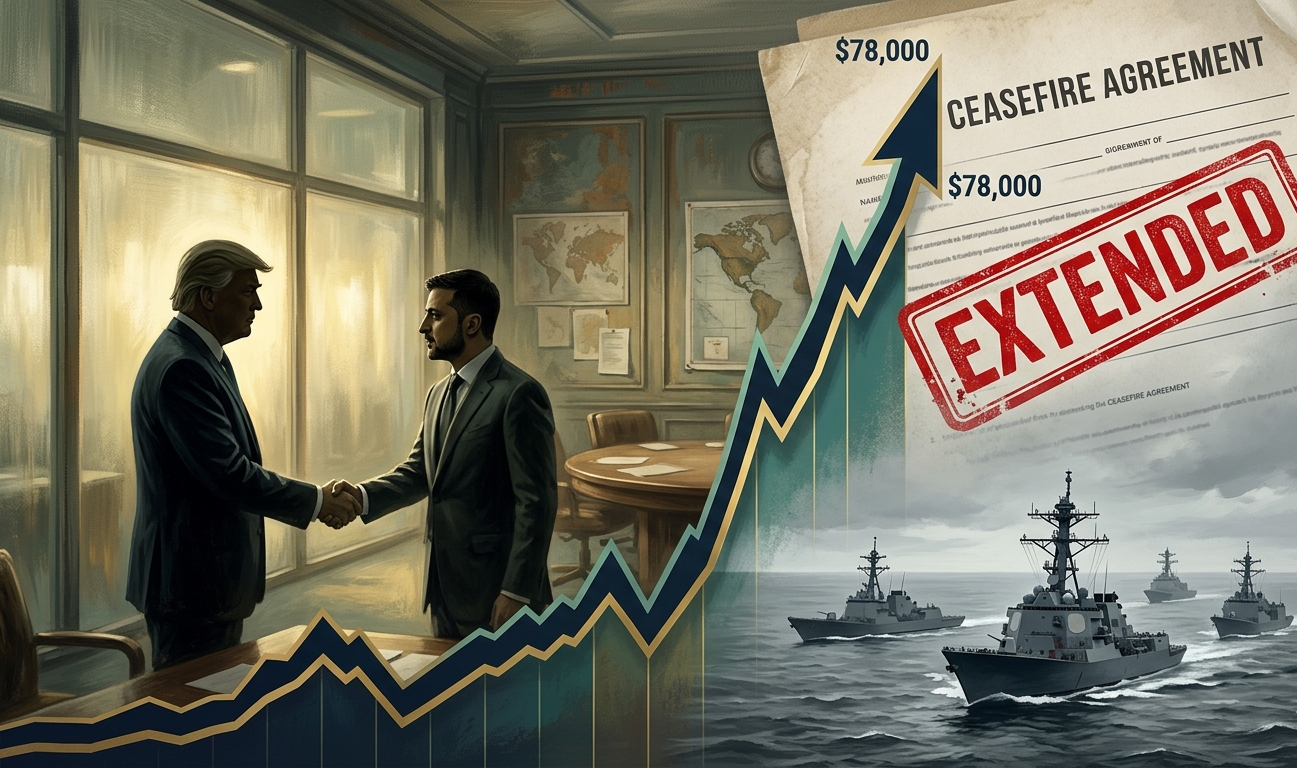
The deadline everyone was watching just got moved. On Tuesday evening, President Trump announced that the US would extend the Iran ceasefire indefinitely, hours before it was set to expire. Bitcoin responded by pushing above $78,000 on Wednesday morning, its highest price since early February and the clearest breakout of 2026 so far.
Bitcoin climbed to about $77,500 as traders reacted to President Trump’s decision to extend the Iran ceasefire and to Strategy’s $2.54 billion purchase of 34,164 bitcoins, its largest buy since 2024. Analysts say Bitcoin’s move above key short-term holder levels and rising institutional adoption reduce near-term liquidation risk, though a sustained rally may hinge on clearing $80,000.


The relief is real. But the details matter, and the details are complicated.
What Trump Actually Said
Trump posted on Truth Social that the extension came at the request of Pakistan’s Prime Minister and Field Marshal, who have been mediating between Washington and Tehran. He said the ceasefire would remain in effect “until such time as their proposal is submitted, and discussions are concluded, one way or the other.”
That last phrase is doing a lot of heavy lifting. It means the ceasefire has no fixed end date, which removes the deadline risk that has been hanging over crypto for weeks. No more counting down to April 22. No more pricing in the possibility of bombs falling by Wednesday. That alone is worth a few thousand dollars on Bitcoin’s price.
But Trump also said the US naval blockade of Iranian ports would continue. Iran’s Foreign Minister Abbas Araghchi called blockading Iranian ports an “act of war” and a violation of the ceasefire. Iran’s UN envoy said talks would only resume “as soon as Washington ends the naval blockade.” An Iranian senior adviser said the extension “means nothing” and Tehran should respond militarily.
So the ceasefire is extended, but Iran is angry about the blockade. Talks are supposed to happen in Islamabad, but no Iranian delegation has confirmed they are coming. Vance’s trip to Pakistan was cancelled. The situation is stable enough for markets to rally, but fragile enough that a single headline could reverse everything. Sound familiar? It should. That has been the pattern all month.
Why Bitcoin Rallied Anyway
Traders are not naive. They know the ceasefire extension is imperfect. They also know it is better than the alternative. The worst-case scenario heading into Tuesday was that the ceasefire expires, bombs resume, oil spikes to $120, and every risk asset sells off. That did not happen. The removal of that tail risk is what is driving the rally, not optimism about a permanent peace deal.
The new acquisition lifts Strategy’s holdings to 815,061 bitcoins, putting the position modestly in profit and coinciding with $1.4 billion in weekly inflows to global crypto funds, led by Bitcoin and Ether.
The institutional backdrop is adding fuel. Strategy’s $2.54 billion purchase. $1.4 billion in crypto fund inflows, the best week since January. Spot Bitcoin ETFs pulling in nearly $1 billion. Ethereum ETFs on a seven-day inflow streak. All of that institutional capital arrived before the ceasefire extension was announced. Now that the deadline risk is off the table, at least temporarily, the question is whether even more capital follows.
The $80,000 Test
Bitcoin has been stuck below $80,000 since the war began in late February. The $76,000 to $78,000 zone has acted as a ceiling for months, rejecting every rally attempt until this week. Now that BTC has cleared $78,000, the next meaningful resistance is $80,000, a round number with psychological significance and a cluster of sell orders sitting above it.
The 200-day simple moving average sits at $87,519. That is the level that needs to be reclaimed for technical analysts to confirm a full trend reversal. Getting from $78,000 to $87,000 requires either a genuine peace deal that sends oil crashing and reopens the rate cut path, or sustained institutional buying that overwhelms the sellers above $80,000. Neither is impossible, but neither is guaranteed.
What to Watch This Week
The FOMC meets on April 28 and 29. The Fed is not expected to cut rates, but the tone will matter. Kevin Warsh’s confirmation hearing on Tuesday gave some clues. Warsh struck a constructive tone on crypto, saying digital assets are “already part of the fabric of our financial services industry.” He also stressed the Fed’s independence from Trump’s pressure to cut rates.
If Warsh is confirmed and eventually replaces Jerome Powell, the crypto industry would have its most sympathetic Fed chair in history. That is a medium-term catalyst that has not been fully priced in.
In the near term, the ceasefire extension buys time but solves nothing. The blockade is still on. Iran is still furious. Oil is around $89. And the market has learned the hard way this month that every positive headline can reverse in 24 hours. The rally to $78,000 is real. Whether it becomes a rally to $80,000 depends on what comes out of Islamabad this week and whether the word “indefinitely” actually means what it says.