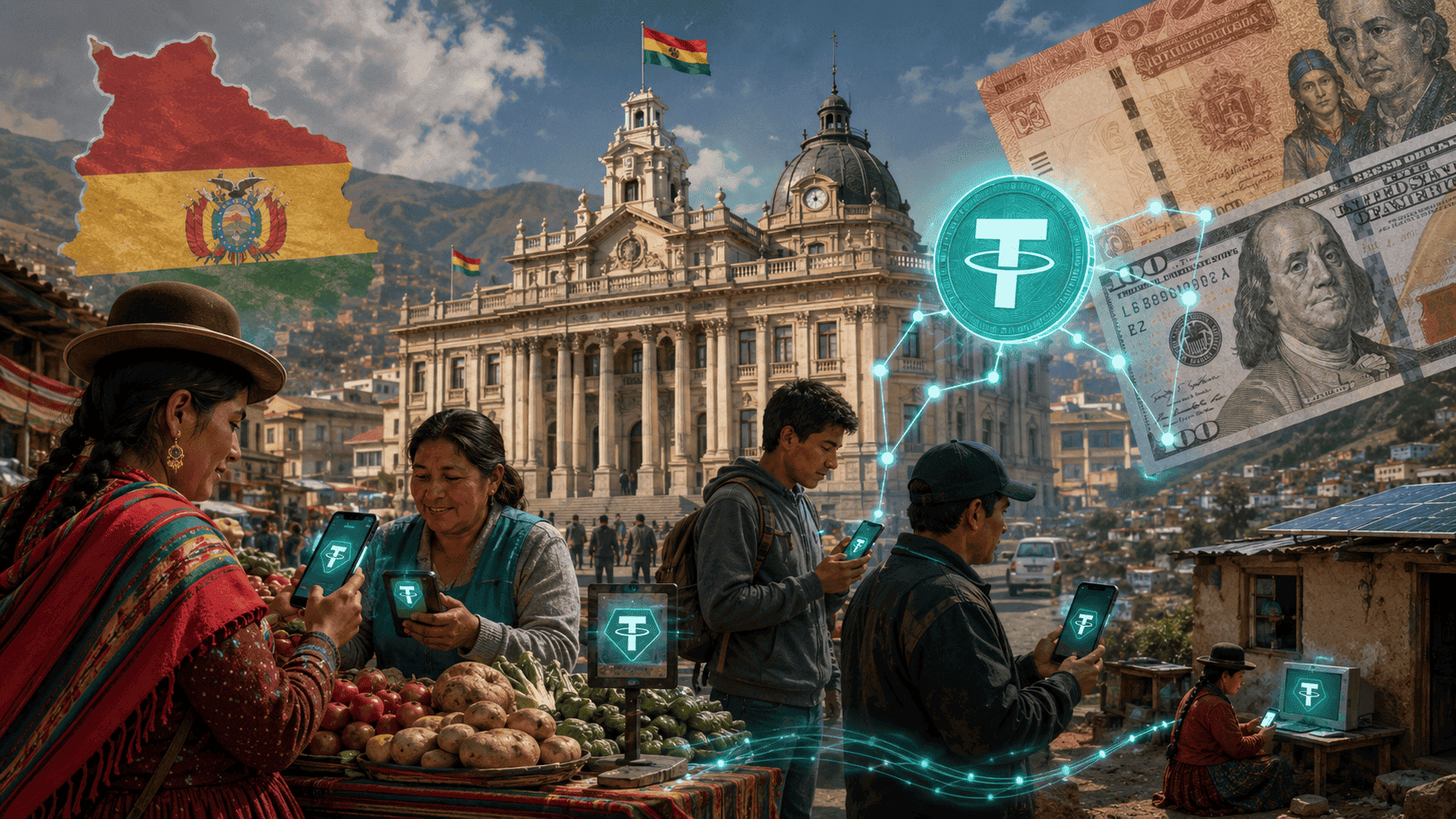
Few countries have reversed course on crypto as sharply as Bolivia. For over a decade, the South American nation maintained one of the strictest cryptocurrency bans in the hemisphere, prohibiting transactions outright. Today, its government is openly considering whether to make Tether’s USDT stablecoin an official part of the national payment system, circulating alongside the boliviano and the US dollar.
Economy Minister José Gabriel Espinoza confirmed the shift at a press conference. “We are working on and technically evaluating the possibility of including USDT in the Bolivian payment system so that it circulates as just another currency,” he said. The government is assessing whether the dollar-pegged stablecoin could formally coexist with the country’s existing currencies as a regulated payment option.


The proposal is striking not just for what it proposes, but for how quickly Bolivia arrived here. The turnaround from prohibition to potential national integration took barely two years, and it was driven less by ideology than by necessity. Bolivians voted with their wallets, and the government is now responding to a reality that has already taken hold on the ground. It’s one of the clearest real-world examples yet of citizens driving a country’s crypto policy rather than the other way around.
The Numbers That Forced the Shift
The catalyst for Bolivia’s rethink is a genuine surge in usage that followed a single administrative decision.
In June 2024, Bolivia’s central bank abruptly lifted its restrictions on crypto transactions. There was no lengthy public debate or major legislative overhaul, just a policy update. The effects were immediate. According to central bank data, crypto transaction volume climbed from $46.5 million in the first half of 2024 to $294 million during the same period the following year. Over the full year after restrictions were removed, volumes hit $430 million, a 630% increase.
Crucially, this demand wasn’t speculative. It was transactional. People were paying for services, settling invoices, and moving remittance money across borders, much of it channeled through USDT on low-cost blockchain networks. In a country where traditional banking access remains uneven and confidence in local monetary instruments is fragile, a stable digital dollar solved real problems that the existing financial system couldn’t.
The underlying driver is a shortage of physical US dollars. Bolivia has long operated as a partially dollarized economy reliant on cash and informal exchange houses. As dollars grew scarce and the country ended its long-standing fixed dollar peg to move to a floating exchange rate earlier this year, businesses and consumers needed an alternative store of value and means of payment. USDT, pegged one-to-one to the dollar and movable over a phone, filled that gap naturally.
An Ecosystem Already Building
What makes Bolivia’s case notable is that the private sector didn’t wait for the government to formalize anything. Financial institutions have already been integrating USDT for months.
State-owned Banco Unión integrated USDT into its Yasta e-wallet in April 2026, letting customers buy the stablecoin for international payments and remittances. Banco FIE launched a “Crypto Account” enabling users to buy and sell USDT through its mobile app. Back in October 2024, one of the nation’s largest banks, Banco Bisa, began offering crypto custody services, allowing members to store and transfer USDT (and only USDT). Payments platform Oobit has enabled USDT use from self-custodial wallets at over 150 million Visa-enabled stores.
State energy company YPFB even announced plans to use crypto for energy imports, a direct response to the dollar shortage affecting critical imports. Bolivia’s central bank has looked to El Salvador for help with building a crypto regulatory framework. In other words, by the time the government began openly discussing national payment integration, a functioning USDT ecosystem was already operating across banks, wallets, and merchants. The proposed integration would formalize something that has largely already happened.
Tether, unsurprisingly, welcomed the news. CEO Paolo Ardoino posted that USDT is “more and more used as a cornerstone within several emerging market economies.” USDT is the largest stablecoin by market capitalization, ranking third among all crypto assets at over $184 billion.
Why It Matters Beyond Bolivia
The real significance of Bolivia’s move isn’t the $430 million figure. It’s the precedent of a government actively building infrastructure around a private stablecoin rather than fighting it.
This is a meaningful distinction. El Salvador famously made Bitcoin legal tender in 2021, but Bitcoin’s volatility limited its use for everyday payments, and adoption for daily transactions stayed low. Bolivia’s approach is different and arguably more pragmatic: instead of mandating a volatile asset from the top down, it’s considering formalizing a stable asset that citizens have already chosen from the bottom up. If Bolivia proceeds, it could create a template for other dollarized economies facing dollar shortages: integrate what people already trust, and manage the trade-offs.
That template has broad relevance. Across Latin America and other emerging markets, the same conditions, currency instability, dollar scarcity, expensive remittances, and limited banking access, are driving similar demand. The region recorded nearly $1.5 trillion in crypto transactions over a three-year stretch ending June 2025, according to Chainalysis data. Analysts expect other economies facing persistent dollar shortages to watch Bolivia’s experience closely. A successful integration would move stablecoins from a trading-settlement layer into the real economy at national scale.
The Real Challenges Ahead
Bolivia’s exploration is genuine, but it faces serious hurdles that shouldn’t be glossed over.
The most significant is compliance. Bolivia remains on the Financial Action Task Force’s “grey list,” which flags countries with strategic deficiencies in their anti-money-laundering frameworks. Espinoza acknowledged this directly, noting that crypto assets “must be carefully evaluated” given Bolivia’s grey-list status. Official USDT adoption would require rigorous anti-money-laundering controls to avoid worsening the country’s standing with international regulators. Building those controls into a national payment system is complex and time-consuming.
There are also unresolved practical questions. What happens during a blockchain network congestion event when transactions slow or fees spike? Who handles dispute resolution when a payment goes wrong, given that blockchain transactions are irreversible? How does a government manage monetary policy when a significant share of transactions runs on a private stablecoin it doesn’t control? These are the same “digital dollarization” concerns the IMF and other bodies have raised: dominant private stablecoins can erode a central bank’s monetary sovereignty. For Bolivia, integrating USDT means accepting some loss of control over its own monetary system.
The process remains early. Espinoza confirmed the proposal is under technical review with no implementation rules yet, and neither the central bank nor lawmakers have published a formal framework or timeline. This is an evaluation, not a done deal.
Still, the direction of travel is clear and remarkable. A country that banned crypto outright for over a decade is now seriously weighing whether a stablecoin should circulate as official money. Whatever Bolivia ultimately decides, its journey, from prohibition to $430 million in volumes to national-integration talks in roughly two years, is one of the most vivid demonstrations yet of how quickly stablecoins can embed themselves into an economy when the underlying need is real. The citizens moved first. The government is catching up.
Disclaimer: This article is for informational purposes only and does not constitute financial advice. Cryptocurrency investments carry significant risk. Always conduct your own research before making any investment decisions.