Elon Musk has never been a quiet figure in crypto, but his latest comment may be one of his bluntest yet.
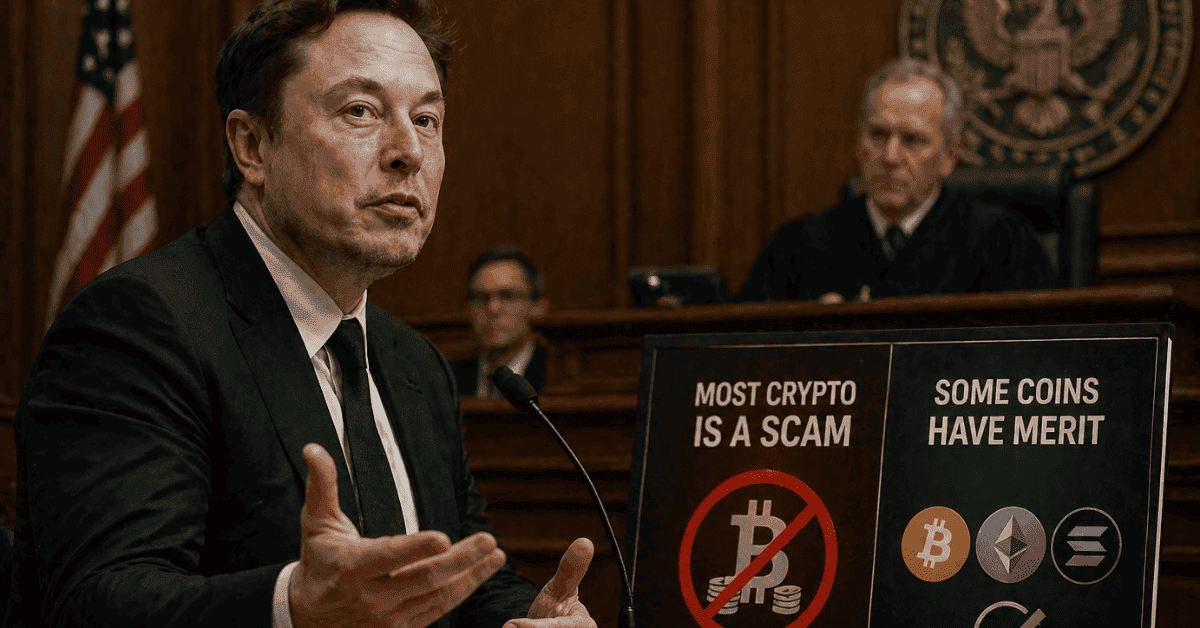
During court testimony in his lawsuit against OpenAI, Musk was asked to explain cryptocurrency to a jury. According to Fortune, citing a post from New York Times reporter Mike Isaac, Musk said: “Some of them have merit, but most of them are scams.”

That is not quite the same as saying exactly 99% of crypto is a scam, but the message was clear. Musk, one of the most influential public figures ever associated with crypto markets, told a courtroom that most cryptocurrencies should be treated with suspicion.
The remark landed because Musk has long been linked to digital assets. Tesla bought Bitcoin, briefly accepted Bitcoin payments and later accepted Dogecoin for some merchandise. Musk’s public posts have also repeatedly moved Dogecoin and other meme coin narratives.
So when Musk tells a jury that most crypto is a scam, the comment carries more weight than a normal celebrity aside.
The Comment Came During the OpenAI Trial
The courtroom moment did not come from a crypto lawsuit. It came during Musk’s legal battle with OpenAI.
Musk is suing OpenAI and its leadership over claims that the company abandoned its original nonprofit mission. During testimony, crypto reportedly came up in the context of OpenAI’s earlier fundraising discussions and whether an initial coin offering had ever been considered.
CryptoBriefing reported that OpenAI previously explored the idea of a token sale, with Musk’s testimony surfacing as part of the wider trial. The comment about crypto scams came as Musk was explaining the broader crypto market to the court.
That context matters. Musk was not giving a formal investment outlook or announcing a new Tesla crypto policy. He was answering questions in legal testimony. Still, the quote immediately spread because it touches one of the industry’s most sensitive questions: how much of crypto is genuine innovation, and how much is speculative noise?
Musk Still Likes Bitcoin, But Not Most Coins
Musk’s comment was not a total rejection of crypto.
The key phrase was “some of them have merit.” Fortune framed the remark by noting that Musk still likes Bitcoin, even as he criticized most of the broader crypto market.
That distinction fits Musk’s history. He has previously expressed support for Bitcoin’s monetary design and has repeatedly joked about or promoted Dogecoin. Tesla still reports digital asset holdings on its balance sheet, and Musk’s companies have experimented with crypto payments in limited ways.
The difference is that Musk now appears more willing to separate a small number of crypto assets from the long tail of tokens.
That is a view many investors already share. Bitcoin is often treated as crypto’s most durable asset because of its fixed supply, decentralization and deep liquidity. Ethereum has a separate case as the largest smart contract platform. But thousands of smaller tokens have weak utility, thin liquidity or business models that rely heavily on hype.
Musk’s court comment may simply have said the quiet part loudly.
Why the “Most Crypto Is a Scam” Line Resonates
The crypto industry has a trust problem.
For every legitimate project building infrastructure, payments, custody, DeFi or tokenized assets, there are also meme coins, pump-and-dump schemes, fake presales, influencer coins, phishing campaigns and rug pulls. Retail users often struggle to tell the difference.
That is why Musk’s comment resonated so quickly. It captures what many casual observers already believe: crypto may contain real innovation, but the market is flooded with low-quality tokens and scams.
The problem is not only fraud. It is also incentive design. New tokens can be launched cheaply. Social media can amplify hype quickly. Liquidity can appear overnight and disappear just as fast. In that environment, speculative projects can look legitimate long enough to attract buyers before insiders or early holders exit.
That does not mean all crypto is fraudulent. It means the burden of proof is higher. Projects need real users, transparent token economics, credible teams, working products and clear disclosure if they want to be taken seriously.
Dogecoin Makes the Comment More Complicated
Musk’s own crypto history makes the statement more complicated.
He has been one of Dogecoin’s most famous supporters. His posts about DOGE helped turn the meme coin into a mainstream asset during the last major retail crypto boom. That attention also brought legal scrutiny.
A lawsuit accusing Musk and Tesla of manipulating Dogecoin was dismissed in 2024. Reuters reported that U.S. District Judge Alvin Hellerstein ruled Musk’s Dogecoin-related statements were aspirational and not factual promises, making them unsuitable as the basis for a securities fraud claim.
That legal win did not erase the broader debate over celebrity influence in crypto. Musk’s comments can still move markets, and many traders continue to watch his posts closely.
That is why his courtroom skepticism matters. The same person who helped make meme coins part of mainstream financial culture is now publicly warning that most crypto assets are scams.
A Warning for Retail Investors
The practical takeaway is simple: investors should be careful with any token whose main selling point is hype.
A serious crypto project should be able to answer basic questions. What problem does it solve? Who uses it? How is the token needed? Who controls the supply? Are insiders locked up? Is liquidity real? Are claims backed by public data?
If those answers are vague, the risk rises quickly.
Musk’s comment also lands at a time when regulators and law enforcement are still chasing crypto fraud globally. Scam centers, fake investment platforms, phishing operations and fraudulent token launches remain a major problem. Even if the largest assets are more mature, the long tail of crypto remains dangerous for inexperienced users.
The Bottom Line
Elon Musk did not appear to say exactly that 99% of crypto is a scam. The reported quote was: “Some of them have merit, but most of them are scams.”
That is still a harsh statement, especially from someone with Musk’s history in Bitcoin and Dogecoin. It does not kill the case for crypto, but it does sharpen the divide between serious digital asset infrastructure and speculative token noise.
For the industry, the challenge is clear. If crypto wants mainstream trust, it needs fewer empty tokens, fewer hype cycles and more products people actually use.
Musk’s courtroom line may fade from headlines quickly, but the criticism behind it will not. Most crypto still has to prove it is more than a trade.
Disclaimer: This article is for informational purposes only and does not constitute financial, investment, or legal advice. Always conduct your own research before making any investment decisions.