
For roughly a century, credit ratings have been the foundational language of fixed-income markets. Investors price bonds, structure portfolios, and allocate trillions of dollars based on the assessments produced by three rating agencies: Moody’s, Standard & Poor’s, and Fitch. The ratings define which assets pension funds can hold, how much capital banks need to set aside, and where credit risk sits across the global financial system.
Until June 17, 2026, every one of those ratings stopped at the edge of the blockchain. Tokenized bonds, tokenized money market funds, tokenized structured products, the entire emerging on-chain fixed-income ecosystem operated without standardised, machine-readable access to the rating data that institutional investors require. Smart contracts couldn’t natively evaluate the credit quality of the assets they touched. Institutional allocators looking at tokenized debt had to hunt down ratings through traditional channels, breaking the operational efficiency that on-chain assets were supposed to provide.


That barrier just collapsed.
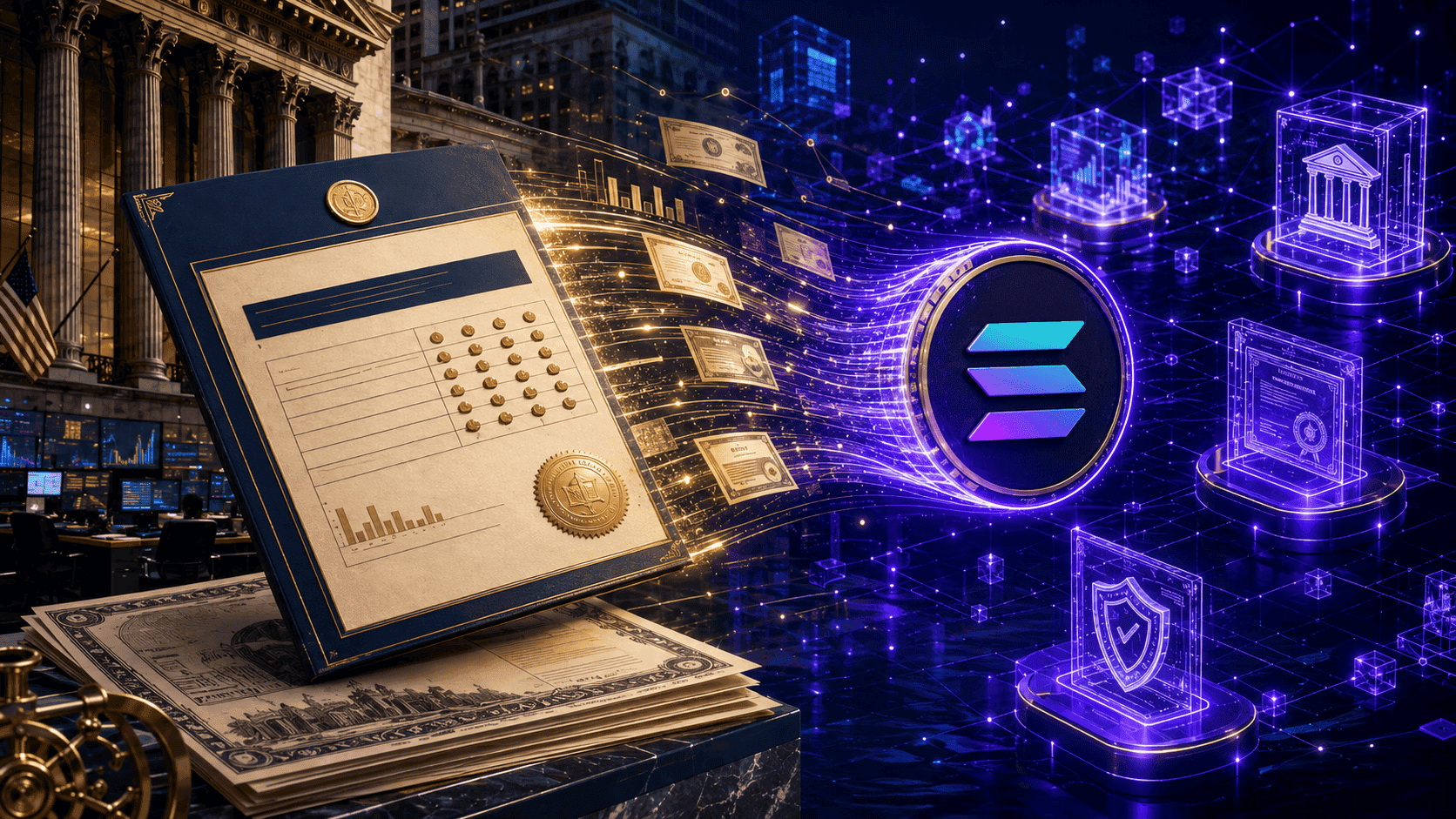
Moody’s deployed its Token Integration Engine (TIE) on Solana mainnet on June 17 through a partnership with tokenization platform Alphaledger. The integration makes Solana the first major public, permissionless blockchain to carry live Moody’s credit ratings in machine-readable form. Issuers of fixed-income securities tokenized on Alphaledger can now embed Moody’s ratings directly into the token metadata of their bonds, so the credit signal travels with the asset on-chain rather than sitting behind a Bloomberg terminal.
For the broader crypto industry, this is one of the most significant institutional adoption events of 2026 and arguably of crypto’s entire history. One of the Big Three rating agencies, an institution that operates across more than 40 countries and rates trillions of dollars in debt securities, just declared a public blockchain to be production-ready for its core data infrastructure. The implications cascade through every category of institutional crypto adoption.
What TIE Actually Does
The Token Integration Engine is Moody’s framework for embedding credit ratings directly into tokenized assets at the protocol level. Understanding the technical mechanism helps explain why the deployment matters beyond the headlines.
The process works through a clean API exchange between Alphaledger and Moody’s analytics infrastructure. Alphaledger first tokenizes a security on Solana through its Vulcan Forge platform. The platform submits bond data to Moody’s via API. Moody’s runs its standard credit analysis offchain using the same methodology that produces ratings for traditional fixed-income securities. The resulting rating then writes back into the token’s onchain metadata on Solana.
Critically, the methodology doesn’t change. Moody’s isn’t creating a parallel ratings system for crypto. It’s making its existing ratings system programmatically accessible on a public chain. The same analytical rigor that backs the ratings on a $100 million municipal bond traded through traditional channels now backs the ratings embedded in tokenized municipal bonds traded on Solana.
The machine-readable format is the key technical achievement. Smart contracts can query the rating data programmatically without requiring human intervention. A DeFi lending protocol could automatically adjust loan-to-value ratios based on the credit ratings of collateral assets. A tokenized fund could exclude securities below specified rating thresholds without manual screening. An automated market maker could price assets differently based on their credit quality. The applications scale with the ability of protocols to integrate the rating data.
For traditional institutional buyers, the data format matters in different ways. Pension funds, insurance companies, and asset managers operating under regulatory mandates that require investment-grade-rated holdings can now identify compliant tokenized assets directly on-chain. The friction that previously required separate database lookups or terminal queries disappears entirely.
Moody’s deliberately designed TIE as network-agnostic. The Solana deployment follows the initial TIE deployment on the Canton Network in March 2026, which made Moody’s the first credit rating agency with capabilities to deliver ratings on an institutional-grade blockchain. Both deployments demonstrate that the same underlying infrastructure can support different blockchain environments, with Solana representing the first major public chain expansion.
Why Solana Got Chosen Over Ethereum
The choice of Solana for Moody’s first major public blockchain deployment carries significant signal value about how institutional providers are evaluating different networks for high-stakes infrastructure.
Solana has become one of the fastest-growing venues for tokenized real-world assets in 2026. The network’s RWA value has climbed to approximately $2 billion, with BlackRock, Franklin Templeton, Apollo, and other major asset managers issuing tokenized products there. The institutional traction reflects Solana’s specific advantages including transaction speed, low fees at high volume, and the protocol’s continued performance improvements through upgrades like Catchain 2.0.
The competitive comparison with Ethereum and other chains matters. Ethereum remains the largest blockchain by total tokenized asset value, but its higher transaction costs and slower confirmation times create friction for the operational use cases that institutional finance requires. Layer 2 solutions partially address these issues but introduce additional complexity that institutional integration teams often prefer to avoid.
Solana’s pure base-layer performance allows institutional integrations to operate without Layer 2 dependencies. For a credit rating provider that needs reliable, predictable performance for high-frequency rating updates and queries, that simplicity has value beyond the marketing differences between chains.
The Solana Foundation’s institutional outreach efforts have also produced tangible results that other foundations haven’t matched. Recent integrations include R3 bringing tokenized assets from its Corda platform (used by HSBC, Bank of America, the Bank of Italy, and the Monetary Authority of Singapore) to Solana. Western Union launched its US dollar stablecoin on Solana for low-cost remittances. State Street and SoFi both extended Solana integrations in May. The cumulative effect creates a network effect where each institutional integration makes additional integrations more attractive.
The Moody’s deployment represents the most consequential institutional integration of the year for Solana specifically. Credit ratings are foundational data infrastructure. Having Moody’s choose Solana over alternatives validates the network’s positioning at a level that few other integrations can match. Rajeev Bamra, Moody’s head of digital economy strategy, framed it directly: “Investors need independent credit analysis wherever they transact, and increasingly, that’s onchain.”
What This Unlocks for Institutional Finance
The Moody’s deployment removes one of the central obstacles that has constrained institutional crypto adoption beyond Bitcoin and Ethereum trading.
For institutional bond buyers, the on-chain ratings enable systematic allocation strategies that weren’t previously feasible. Pension funds, insurance companies, and other regulated investors operate under mandates that often require investment-grade ratings for fixed-income holdings. Without standardised on-chain rating data, evaluating tokenized bonds required custom integrations or manual processes that didn’t scale. With Moody’s ratings embedded in tokens, allocators can deploy capital at scale across rated tokenized debt with the same efficiency they apply to traditional bonds.
For DeFi protocols, the embedded ratings create programmable risk management at the protocol level. Lending protocols like Aave, Compound, and Spark could adjust borrowing limits, liquidation thresholds, and risk parameters based on the credit ratings of collateral assets. The capability shifts DeFi from operating primarily on collateral type (ETH, BTC, stablecoins) to operating on collateral quality (investment-grade rated, speculative-grade rated, etc.) similar to how traditional finance handles credit risk.
For tokenization platforms, the Moody’s integration makes their products more attractive to institutional buyers. Alphaledger specifically benefits as the integration partner, but the broader tokenization industry gains a foundational data layer that supports more sophisticated on-chain financial products. Issuers can now offer tokenized debt with the same trust signals that institutional buyers require for traditional debt.
For the broader real-world asset (RWA) market, the deployment accelerates the trajectory toward mainstream institutional adoption. Boston Consulting Group and Ripple estimate the tokenized asset market could reach $18.9 trillion by 2033. McKinsey projects $2 trillion by 2030. The Moody’s deployment removes one of the specific obstacles that had been limiting institutional flows. Other obstacles remain (regulatory clarity, custody infrastructure, legal frameworks), but the credit rating gap is now closed for assets that issue through Alphaledger on Solana.
For Solana specifically, the integration positions the network as institutional infrastructure rather than just a high-performance blockchain for crypto-native applications. The distinction matters because institutional adoption produces different growth dynamics than retail or crypto-native adoption. The 2026 institutional integration wins (BlackRock, Franklin Templeton, Apollo, Western Union, State Street, SoFi, R3, and now Moody’s) collectively represent the kind of infrastructure positioning that produces multi-year compound growth rather than cycle-driven volatility.
The Multi-Chain Strategy
Moody’s deployment on Solana isn’t the end of the strategy. It’s a milestone in a multi-chain expansion that will likely continue for years.
The Token Integration Engine is explicitly network-agnostic. Moody’s plans to continue expanding TIE coverage across additional digital finance networks, lines of business, and instrument types as adoption grows. The Canton deployment in March 2026 covered institutional-permissioned blockchain use cases. The Solana deployment covers public permissionless blockchain use cases. Future deployments could cover Ethereum, XRP Ledger, additional Layer 1s, or various Layer 2 networks depending on where institutional adoption develops most rapidly.
Moody’s has previously published credit scores onchain through Untangled Finance on Polygon’s Amoy testnet, using zero-knowledge proofs to publish verified rating data without exposing underlying sensitive information. The firm has also collaborated with Metrika and Particula on digital asset risk analytics across multiple networks. Each effort represents a different dimension of the broader strategy to make credit ratings native to on-chain environments.
For competing rating agencies, Moody’s first-mover position creates pressure to develop similar capabilities. Standard & Poor’s and Fitch face the choice of either developing competing on-chain rating infrastructure or ceding the on-chain rating market entirely to Moody’s. The competitive response will likely emerge over the coming quarters as the other Big Three rating agencies recognise that institutional clients will increasingly require on-chain rating capabilities.
The longer-term implication is that on-chain credit data may become standard primitive across institutional RWAs, comparable to how price oracles are now standard primitives for DeFi. Once enough tokenized assets carry embedded ratings, the network effect makes additional integrations close to inevitable. Issuers will want to offer rated tokenized debt to attract institutional buyers. Buyers will demand rated tokenized debt to satisfy regulatory mandates. Rating agencies will compete to provide the ratings. The infrastructure becomes self-reinforcing.
What This Means for SOL Holders
For Solana investors specifically, the Moody’s integration carries implications that go beyond the immediate institutional credibility it provides.
Each major institutional integration on Solana strengthens the structural demand for SOL through several mechanisms. Validator activity increases as more institutional applications run on the network. Transaction volumes grow as embedded ratings, tokenized assets, stablecoin payments, and other institutional use cases generate sustained on-chain activity. The capacity for SOL to capture value from this activity depends on protocol design, but the broader adoption trajectory is unambiguously favourable.
The price action hasn’t necessarily reflected the institutional momentum yet. SOL has been tracking broader market conditions more than protocol-level news through the recent FOMC volatility. This is consistent with where institutional adoption sits right now: real infrastructure progress, not yet reflected in near-term price catalysts.
The longer-term thesis for Solana rests on whether the cumulative institutional integrations translate into sustained network activity and value capture by SOL. The Moody’s integration adds one more data point to a trajectory that includes BlackRock, Franklin Templeton, Apollo, Western Union, State Street, SoFi, R3, and various tokenization platforms. Each integration individually is meaningful. The cumulative pattern is what makes Solana’s institutional positioning genuinely distinctive among Layer 1 blockchains.
For investors evaluating Solana exposure, the Moody’s deployment provides additional evidence supporting the institutional adoption thesis. The thesis hasn’t fully translated to price action yet, but the structural foundation continues building at a pace that’s difficult to match elsewhere in crypto. Whether the eventual catch-up between fundamentals and price produces meaningful returns depends on broader market conditions and timing factors that no single integration can determine.
A hundred-year-old trust signal just landed on a public blockchain. Solana got chosen for it. The next chapter of institutional crypto adoption is being written in machine-readable credit ratings embedded directly into the tokenized assets that will define the next decade of fixed-income markets.
FAQ
What did Moody’s launch on Solana?
Moody’s Ratings deployed its Token Integration Engine (TIE) on Solana mainnet on June 17, 2026, through a partnership with tokenization platform Alphaledger. The integration allows issuers of tokenized bonds and other fixed-income securities to embed Moody’s credit ratings directly into the token metadata on Solana. This is the first time Moody’s credit ratings have been embedded and machine-readable at scale on a major public, permissionless blockchain.
Why is this significant?
Credit ratings define how trillions of dollars in fixed-income securities get priced, traded, and held. For approximately 100 years, these ratings have been distributed through closed channels including Bloomberg terminals and institutional data licenses. Moving the data on-chain in machine-readable form allows smart contracts to natively evaluate credit quality, enables programmable risk management in DeFi protocols, and removes a major friction point for institutional capital evaluating tokenized debt. One of the Big Three rating agencies declaring a public blockchain production-ready for core data infrastructure is a major institutional adoption milestone.
Why did Moody’s choose Solana?
Solana has become one of the fastest-growing venues for tokenized real-world assets with approximately $2 billion in tokenized assets. BlackRock, Franklin Templeton, Apollo, Western Union, State Street, SoFi, and R3 have all built integrations on Solana in 2026. The network’s transaction speed, low fees, and predictable performance support the operational requirements of institutional finance better than higher-latency alternatives. The Moody’s deployment follows the initial TIE deployment on the Canton Network in March 2026, with Solana representing the first major public chain expansion.
Disclaimer: This article is for informational purposes only and does not constitute financial advice. Cryptocurrency investments carry significant risk. Always conduct your own research before making any investment decisions.