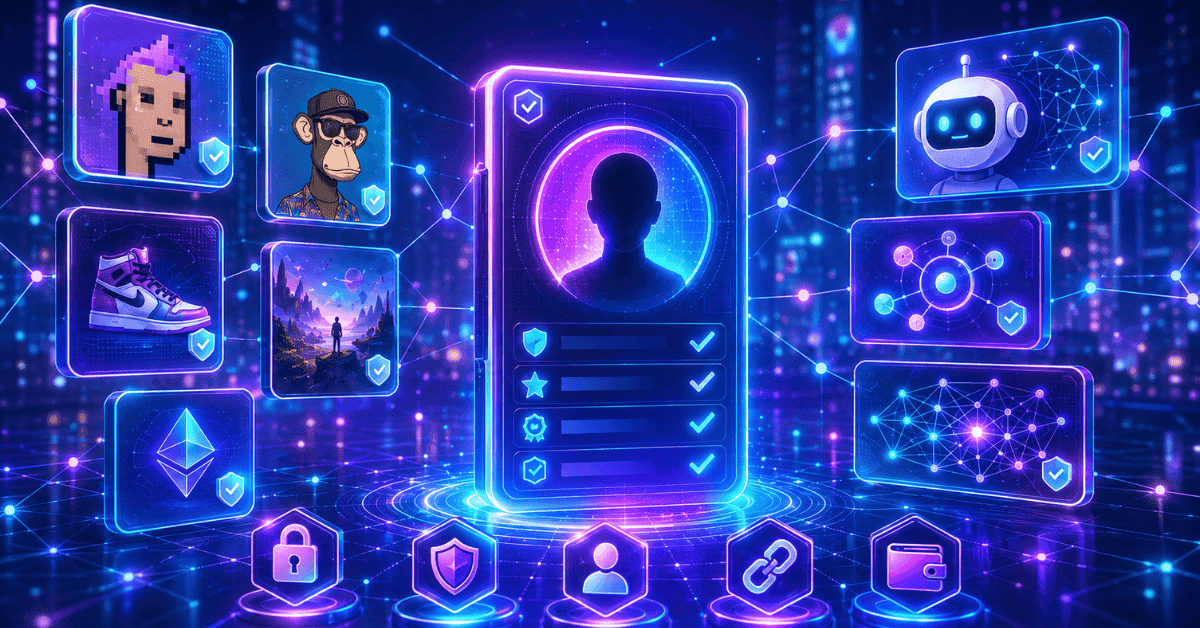
NFT identity layer ideas are suddenly looking more interesting as the internet fills with AI agents, synthetic content and automated online activity.
LinkedIn co-founder Reid Hoffman reportedly told CoinDesk at Consensus Miami that NFTs may be due for a “rebirth” because AI agents will force the internet to rethink identity and trust. The point is not that profile-picture collections are about to become the center of crypto again. The more interesting argument is that NFTs may become useful as identity receipts in an AI-heavy internet.


That is a very different NFT comeback story from “Bored Apes are back.”
The Old NFT Pitch Was About Art, Status and Ownership
During the NFT boom, the market focused on art, collectibles, community access and speculation.
Some buyers cared about digital art. Others wanted status. Many were simply trying to flip a JPEG for more than they paid. The result was a market that became culturally huge, financially overheated and eventually painful for many late buyers.
That history still affects how people hear the word “NFT.” For a lot of users, NFTs still mean overpriced cartoon pictures, celebrity drops and collapsed floor prices.
Hoffman’s argument points somewhere else. Instead of asking whether NFTs can return as speculative art assets, he is asking whether the underlying idea can help solve online identity problems.
That is a much more practical question.
AI Agents Make Identity More Complicated
The internet already has a trust problem.
Bots, fake accounts, spam, phishing, deepfakes and impersonation scams are everywhere. AI agents make that problem much harder. If software agents begin booking meetings, negotiating deals, making payments, publishing content or talking to other agents, users need to know what they are interacting with.
Is this agent controlled by a real company? Is it authorized to act for a person? Has it been verified? Does it have a reputation? Can it prove ownership of an account, credential or permission?
Those are identity questions, not art questions.
NFTs could potentially serve as portable, verifiable records that connect an agent, account or digital object to a trusted identity layer. The NFT itself would not need to be expensive or visually interesting. It could simply act as a proof of permission, provenance or membership.
NFTs as Receipts, Not JPEGs
The phrase “NFT” may be part of the problem.
Most people associate NFTs with images. But technically, an NFT is a unique token that can represent ownership or proof of something. That “something” could be art, but it could also be an access pass, a credential, a verified agent ID, a software license or a reputation marker.
In an AI internet, the most useful NFT may not be something you display. It may be something a system checks in the background.
For example, an AI assistant could hold a verified credential showing it is authorized to schedule meetings for a company. A creator could issue provenance tokens proving which content is original. A marketplace could require agents to hold identity NFTs before making transactions. A DAO could use NFTs to manage agent permissions.
That is less glamorous than a million-dollar JPEG, but it may be more durable.
Why Crypto Fits This Problem
Crypto is useful here because it provides shared verification.
Traditional identity systems often depend on centralized platforms. A social network verifies an account. A company controls login credentials. A payment processor authorizes a merchant. That works inside one platform, but it becomes messy across the open internet.
Blockchains offer a different model. A credential can be checked publicly, transferred under rules, revoked if needed and used across multiple applications. That makes them attractive for AI agents that may need to move across platforms, services and payment systems.
This does not mean every identity problem needs a blockchain. Many will not. But for portable, cross-platform verification, crypto has a real argument.
The Big Challenge Is Privacy
There is a major risk: identity systems can become surveillance systems.
If every AI agent, creator or user has a permanent on-chain identity trail, that can create new privacy problems. Public records are useful for verification, but dangerous if they expose too much about behavior, relationships or transactions.
That means any serious NFT identity system would need selective disclosure, privacy protections and careful design. The goal should not be to make every action public forever. The goal should be to prove what needs to be proven without exposing everything else.
This is where zero-knowledge proofs, decentralized identifiers and privacy-preserving credentials may become important.
This Is Not a Quick NFT Market Rescue
Hoffman’s thesis does not mean NFT floor prices will suddenly recover.
The identity use case is different from the collectible market. It may not help every old collection. It may not revive abandoned projects. It may not create another speculative mania around profile pictures.
Instead, it suggests NFTs could come back in a quieter form: as infrastructure.
That may be less exciting for traders hoping old bags recover, but it is more interesting for builders. If NFTs become part of AI identity, the winners may be wallets, identity protocols, agent platforms, credential systems and applications that make verification easy for normal users.
The Bottom Line
NFT identity layer use cases may become one of the more serious comeback stories for NFTs.
Reid Hoffman’s point is not that the old NFT market will simply return. It is that AI agents could create a new need for trusted digital identity, and NFTs may be one tool for solving it.
That is the better version of the NFT comeback: not celebrity mints, not hype-driven floor prices, but verifiable identity in an internet where humans, bots and AI agents all interact.
NFTs may come back, not because of art, but because the internet is getting too synthetic to trust without receipts.
Disclaimer: This article is for informational purposes only and does not constitute financial, investment, or legal advice. Always conduct your own research before making any investment decisions.