
Rising yields and weaker risk appetite are putting fresh pressure on crypto markets, with Bitcoin sliding toward the mid-$70,000s and Ethereum trading close to the $2,100 area.
Bitcoin is trading around $76,923, after touching an intraday low near $76,655. Ethereum is trading around $2,118, after dropping as low as $2,107 during the session. The move keeps both assets under pressure as traders react to higher Treasury yields, inflation worries, and another wave of leveraged position closures.


The liquidation damage has been sharp. Market updates citing CoinGlass data placed total crypto liquidations at about $661 million over 24 hours, with more than 107,000 traders affected as Bitcoin fell to a two-week low near $76,700.
Rising Yields Put Crypto Back Under Pressure
The latest selloff is not only a crypto story. It is also a macro story.
Higher Treasury yields make risk assets less attractive because investors can earn more from government debt without taking as much volatility. When yields rise quickly, traders often cut exposure to assets such as Bitcoin, Ethereum, tech stocks, and smaller altcoins. That is what makes this move uncomfortable for crypto bulls.
Bitcoin had already been struggling to hold the upper-$70,000 area after a weaker stretch in ETF flows and broader risk sentiment. Earlier market coverage linked the pullback toward $79,000 to higher U.S. Treasury yields, oil-price pressure, and inflation concerns, all of which pushed investors into a more defensive mood.
That pressure has now deepened, with BTC moving closer to the mid-$70,000s. The important question is whether this is a fast leverage flush inside a wider range, or the start of a deeper macro-driven reset.
Bitcoin’s Mid-$70,000s Zone Becomes the Market’s Main Test
Bitcoin’s move toward the mid-$70,000s puts the market back near an important support area.
At around $76,923, BTC is still above the deeper low-$70,000 zone, but the chart has weakened after losing momentum near $80,000. Traders are now watching whether buyers defend the $76,000 to $75,000 area, because a clean break below that range could invite more forced selling and push the market toward the next support band.
The problem is that leverage can make support levels fragile. If too many traders are holding long positions with borrowed funds, a small price drop can trigger forced liquidations. Those forced sales can push price lower, which then triggers more liquidations. That is how a normal pullback can turn into a fast market flush.
The current liquidation data suggests that this is exactly what traders are dealing with. With total liquidations above $661 million over 24 hours, the market is not only selling because people are choosing to exit. Some positions are being closed automatically by exchanges because traders no longer have enough margin to keep them open.
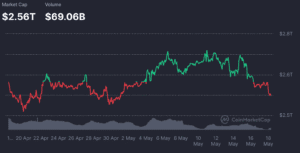
Ethereum Near $2,100 Shows Altcoin Pressure Is Spreading
Ethereum is also under pressure, with ETH trading near $2,118 after touching an intraday low close to $2,107.
That level matters because Ethereum often shows whether the selloff is spreading beyond Bitcoin. When BTC falls but ETH holds up well, traders may treat the move as a Bitcoin-specific reset. When ETH also weakens toward key support, it usually means the broader crypto market is turning more defensive.
ETH also has a large derivatives market, which can intensify moves during sharp selloffs. Recent liquidation-risk updates showed that if ETH fell below $2,082, long liquidation pressure across major centralized exchanges could rise sharply. That gives traders a clear level to watch if the current selloff continues.
For Ethereum bulls, the first job is simple. ETH needs to hold the low-$2,100 area and avoid a deeper break toward $2,080. If that support fails, the next move could become more mechanical as leverage is forced out of the market.
Liquidations Turn a Pullback Into a Faster Selloff
Liquidations are one reason crypto can fall much faster than traditional markets during stress.
When traders use leverage, they borrow funds to make larger bets. That can increase profits when the trade goes right, but it also increases losses when the market moves against them. If the account margin falls too low, the exchange closes the position automatically.
That process creates forced selling. It can also make price action look worse than the original news would suggest. In this case, more than 107,000 traders were reportedly liquidated over 24 hours, showing how crowded leveraged positions had become before the selloff accelerated.
The liquidation wave also explains why traders should be careful about reading every drop as purely fundamental. Rising yields and macro pressure started the risk-off move, but leverage likely made the decline faster and more painful. Once forced selling begins, price can overshoot before buyers return.
This is why the next few sessions matter. If liquidations cool and spot buyers defend support, the market may stabilize. If leverage keeps unwinding, Bitcoin and Ethereum could remain under pressure even without a new macro shock.
ETF Flows and Macro Data Now Matter More
Crypto traders are watching more than price charts right now.
Bitcoin’s ETF flow picture has become important because spot ETFs have been one of the strongest demand channels in this cycle. When ETF inflows slow or turn negative, Bitcoin loses a key support. When that happens at the same time as Treasury yields rise, the market can weaken quickly because both macro demand and crypto-native leverage are moving against bulls.
Recent market coverage linked Bitcoin’s drop toward $78,000 to surging Treasury yields and a second straight day of heavy ETF outflows. That combination gave traders a clear reason to reduce risk before the latest move toward the mid-$70,000s.
The next macro signals will be important. Traders will be watching bond yields, oil prices, inflation expectations, Federal Reserve commentary, ETF flows, and stablecoin balances on exchanges. If yields cool and ETF demand improves, Bitcoin may get room to recover. If yields keep rising, rallies could remain shallow.
What Traders Should Watch Next
The first level to watch is Bitcoin’s $75,000 to $76,000 support area.
If BTC holds that zone and liquidations slow, traders may start looking for a recovery back toward $78,000 and then $80,000. A move back above $80,000 would not erase all the damage, but it would show that buyers are still active after the liquidation wave.
The second level is Ethereum near $2,100. If ETH holds that area, altcoin sentiment may stabilize. If ETH breaks below $2,100 and moves toward the $2,080 liquidation zone, the broader market could face another round of stress.
The third signal is whether stablecoin liquidity moves back into spot buying. Stablecoins sitting on exchanges can provide buying power, but they only matter if traders actually deploy them. If stablecoin balances rise while spot demand stays weak, the market may remain cautious.
For now, the setup is fragile. Bitcoin and Ethereum are not collapsing into free fall, but they are trading in a market where yields, ETF flows, and leverage are all pulling in the wrong direction.
FAQ
Why are rising yields bad for Bitcoin?
Rising yields can pressure Bitcoin because they make safer assets such as government debt more attractive. When yields rise quickly, traders often reduce exposure to volatile assets like crypto.
How much was liquidated in the crypto market?
Recent market updates citing CoinGlass data placed total crypto liquidations at about $661 million over 24 hours, with more than 107,000 traders affected.
What levels matter for Bitcoin and Ethereum now?
Bitcoin traders are watching the $75,000 to $76,000 area, while Ethereum traders are watching the $2,100 zone and the nearby $2,080 liquidation-risk area.
Disclaimer: This article is for informational purposes only and does not constitute financial, investment, or legal advice. Always conduct your own research before making any investment decisions.