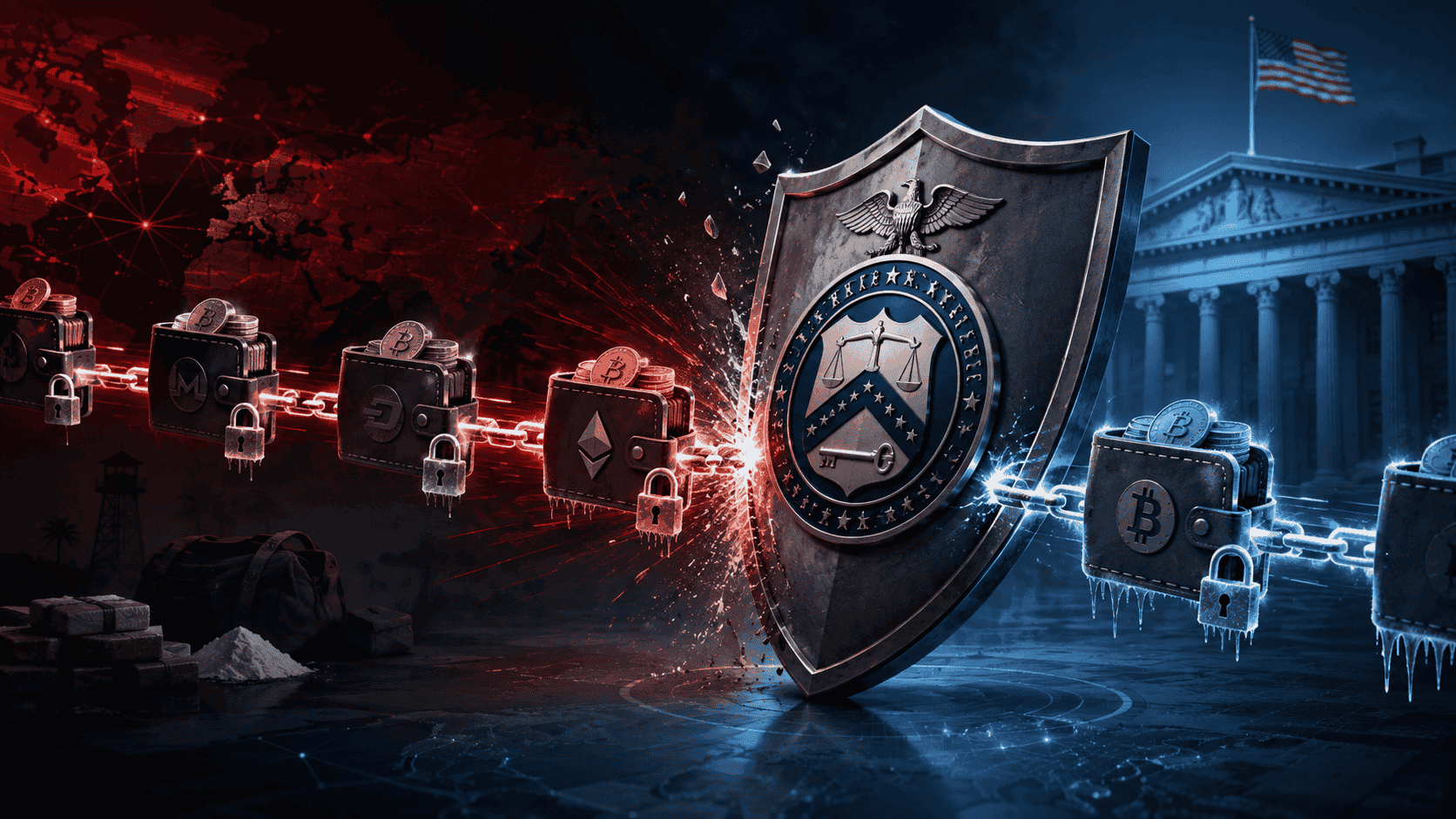
The US Treasury took direct aim at one of the most dangerous criminal organisations in the world this week, and the weapon of choice was blockchain sanctions.
On May 20, the Office of Foreign Assets Control (OFAC) designated 11 individuals and two Mexican companies connected to the Sinaloa Cartel for laundering drug money through cryptocurrency. Six Ethereum wallet addresses were added to the Specially Designated Nationals (SDN) list, effectively freezing any assets in those wallets and making it illegal for any US person or business to interact with them.


The action targets the financial infrastructure behind one of the largest fentanyl trafficking operations in the world. It’s the latest in a sustained campaign by the Treasury Department, which has now sanctioned over 600 individuals and entities connected to the Sinaloa Cartel since 2024.
How the Cartel Used Crypto to Move Drug Money
The laundering operation worked like a pipeline connecting American streets to Mexican bank accounts, with crypto as the bridge in between.
It starts with cash. Fentanyl and other drugs are sold on the streets of US cities, generating enormous amounts of physical currency. That cash then needs to get back to Mexico without being detected by law enforcement.
In the traditional version of this process, the cartel would use bulk cash smuggling, shell companies, or trade-based schemes. All of those methods are slow, risky, and increasingly difficult as authorities have gotten better at intercepting them.
Crypto offered a faster alternative. According to OFAC and blockchain analytics firm Chainalysis, the cartel’s money laundering cell would collect cash from street-level drug sales across the United States, convert that cash into stablecoins and other crypto assets through a network of brokers, layer the funds across multiple wallets and exchanges to obscure the trail, and then transfer the crypto to Mexico-based brokers who converted it back into local currency.
The whole process could happen in hours rather than days. And unlike a suitcase full of cash crossing the border, a crypto transfer leaves no physical evidence at a checkpoint.
The People and Companies That Got Sanctioned
The sanctions centre on the Los Chapitos faction of the Sinaloa Cartel, led by the sons of Joaquin “El Chapo” Guzman. At the heart of the financial network is Armando de Jesus Ojeda Aviles, who OFAC identified as the faction’s leading money laundering operative.
Five of the six Ethereum addresses added to the SDN list are attributed to Ojeda Aviles alone. That pattern is consistent with what blockchain analysts call “multi-wallet fragmentation,” a technique where a single individual spreads funds across several wallets to make tracking more difficult.
The sixth address belongs to Liliana Orozco Romero, another designated individual in the network.
Two Mexican companies were also sanctioned. Gorditas Chiwas, described as a restaurant in Chihuahua, and Grupo Especial Mamba Negra, a security firm. Both allegedly served as front operations to launder or store cartel proceeds. The image of a taco restaurant and a private security company helping move millions in drug money through Ethereum wallets captures just how creative criminal organisations have become in exploiting new financial tools.
Today, Treasury’s Office of Foreign Assets Control sanctioned more than a dozen individuals and entities, comprising two distinct networks, linked to the terrorist Sinaloa Cartel and its fentanyl trafficking activities. The Sinaloa Cartel is responsible for a significant portion…
— Treasury Department (@USTreasury) May 20, 2026
What “Sanctioned” Actually Means for Crypto
When OFAC adds a wallet address to the SDN list, the consequences are immediate and severe.
Any US person or business that interacts with those addresses, whether by sending funds, receiving funds, or processing transactions, faces strict liability. That means penalties can apply even if you didn’t know the wallet was sanctioned. Ignorance is not a defence.
For crypto exchanges operating in or serving US customers, those six Ethereum addresses are now permanently blocked. Binance, Coinbase, Kraken, and every other regulated platform must screen transactions against the SDN list and freeze any assets associated with designated addresses.
For DeFi protocols, the situation is more complicated. Decentralised systems don’t have a compliance team that can block a wallet. But US-based developers, front-end operators, and liquidity providers can still face legal consequences for facilitating transactions with sanctioned addresses. That tension between decentralisation and regulatory compliance remains one of the most unresolved issues in crypto.
For regular users, the practical risk is extremely low. Unless you’re directly transacting with cartel-linked wallets, OFAC sanctions don’t affect your day-to-day crypto activity. But the action is a reminder that blockchain transactions are permanent and public. Law enforcement doesn’t need to catch you at the border. They just need to follow the on-chain trail.
Crypto Is One Tool in a Much Larger Operation
It’s important to put this in context. Cryptocurrency is not the primary method cartels use to move money. It’s one layer in a much broader laundering infrastructure that still relies heavily on bulk cash smuggling, Chinese money laundering organisations, trade-based schemes, and corrupt financial intermediaries.
According to Chainalysis, the cartel’s crypto operations represent a supplement to traditional methods rather than a replacement. The advantage of crypto is speed and convenience for certain corridors. The disadvantage, from the cartel’s perspective, is that blockchain transactions create a permanent record that skilled analysts can trace.
That traceability is exactly what made this week’s sanctions possible. Blockchain analytics firms like Chainalysis and TRM Labs work directly with OFAC and law enforcement to map illicit financial networks on-chain. The same transparency that privacy advocates sometimes criticise about public blockchains is what allows authorities to identify, track, and ultimately sanction criminal wallet addresses.
Over 50% of OFAC-designated cryptocurrency addresses in 2025 were associated with the illicit drug market. That percentage is likely to grow as cartels continue experimenting with crypto and as law enforcement tools become more sophisticated.
Why This Matters for the Crypto Industry
Every time cryptocurrency appears in a headline next to words like “cartel” and “fentanyl,” it reinforces the narrative that crypto is primarily a tool for criminals. That narrative is misleading, but it’s persistent, and it gives ammunition to regulators who want to impose stricter controls on the entire industry.
The reality is far more nuanced. The vast majority of cryptocurrency activity is legal. Stablecoins process billions in legitimate commerce every day. Bitcoin ETFs hold over $56 billion in institutional capital. The world’s largest banks are building crypto custody and trading services. Using the actions of drug cartels to characterise an entire industry is like blaming the highway system for bank robberies because the getaway car used a road.
That said, the industry has a responsibility to take these issues seriously. Exchanges that maintain robust compliance programmes, stablecoin issuers like Tether that actively freeze illicit funds, and analytics firms that help law enforcement trace criminal activity are all part of the solution. The more the industry demonstrates it can police itself, the less justification regulators have for heavy-handed intervention.
This week’s OFAC action is a reminder that crypto operates in the real world with real consequences. The technology is neutral. How people use it is not.
Disclaimer: This article is for informational purposes only and does not constitute financial advice. Cryptocurrency investments carry significant risk. Always conduct your own research before making any investment decisions.