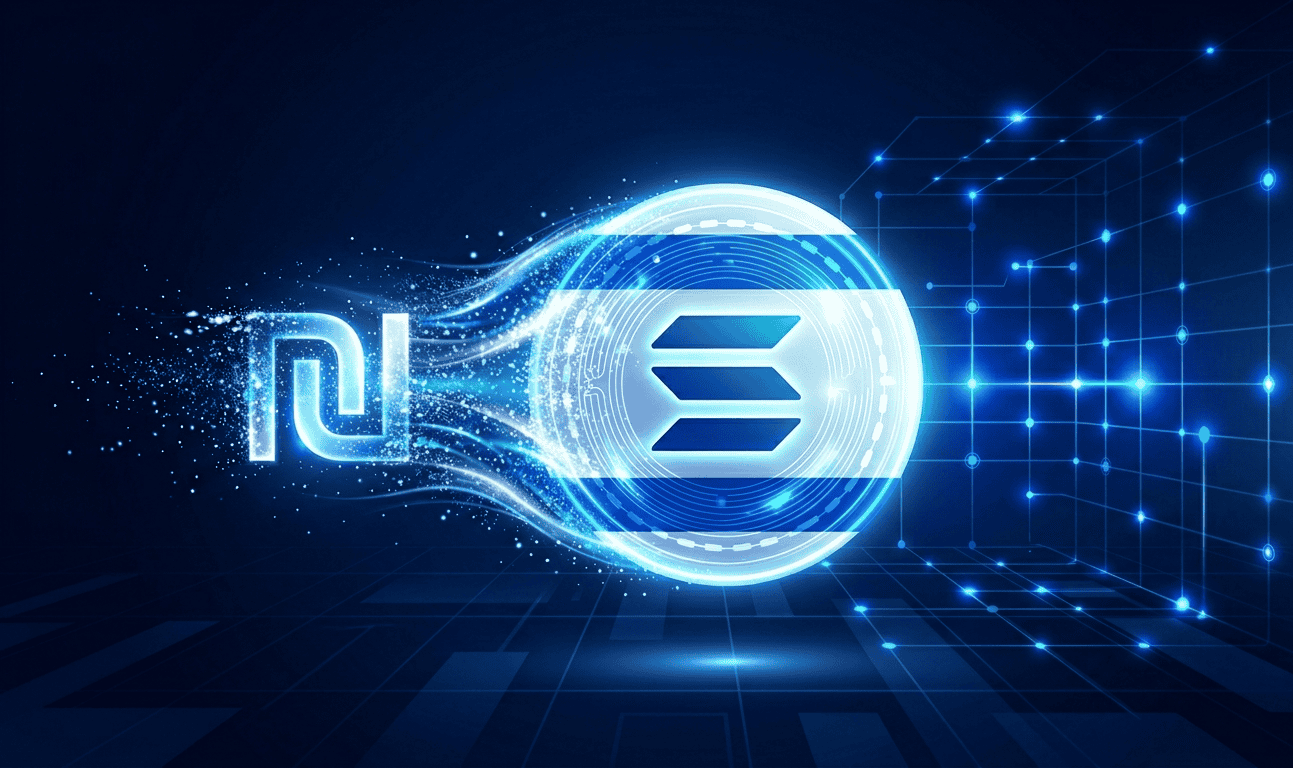
Israel just became one of the few countries in the world with a regulated, locally-issued stablecoin pegged to its own currency. On Monday, the Israel Capital Market, Insurance and Savings Authority approved BILS, a shekel-backed stablecoin issued by crypto exchange Bits of Gold. The approval came after a two-year pilot programme on the Solana blockchain.
BILS is the first stablecoin pegged to the Israeli shekel. In a market dominated by dollar-pegged tokens like USDT and USDC, that makes it a rarity. The global stablecoin market exceeds $320 billion in market cap with annual transaction volumes around $46 trillion. Almost all of that is denominated in US dollars. BILS is a bet that local currencies can find a place on-chain too.


What Is BILS and How Does It Work?
BILS is straightforward. It is a digital token on the Solana blockchain that is worth one Israeli shekel. For every BILS token in circulation, there is a corresponding shekel held in a segregated bank account in Israel. You can redeem it for the underlying shekel at any time.
The token was built by Bits of Gold, Israel’s oldest crypto exchange, founded over a decade ago. Fireblocks provides the institutional infrastructure for issuance and custody. QEDIT, a zero-knowledge proof specialist, handles privacy features so that transaction data can be verified without exposing sensitive details.
Bits of Gold CEO Youval Rouach called it “a direct bridge between the Israeli shekel and the global digital assets economy.” The stablecoin is designed for real-time payments, on-chain trading against major stablecoins like USDC, smart contract execution, and global shekel transfers.
The timing is interesting. The shekel is currently at a 30-year high against the US dollar, trading at roughly 1 ILS to 0.34 USD. A shekel stablecoin launched during a period of currency strength is better positioned than one launched during weakness.
Why Did Israel Choose Solana?
Solana’s speed and cost made it the obvious choice for a payments-focused stablecoin. Transactions settle in under a second and cost fractions of a cent. For a token designed to handle everyday payments and real-time transfers, those economics matter.
Solana also has a growing track record with institutional stablecoins. Circle moved a significant portion of USDC issuance to Solana in 2025. PayPal’s PYUSD runs on Solana. Multiple new stablecoin projects have chosen the network for the same reasons Bits of Gold did: it is fast, cheap, and proven at scale.
The pilot ran inside a regulatory sandbox, a controlled environment where the regulator could monitor everything. Over two years, the Capital Market Authority tested Bits of Gold’s ability to issue and manage the stablecoin safely. That included custody risk management, daily operations, business continuity, technology risks, cybersecurity, and compliance with regulatory standards.
The fact that the regulator spent two full years testing before approval says something about how seriously Israel is taking this. This is not a rush job. It is one of the most thoroughly vetted stablecoin launches anywhere in the world.
How Does BILS Compare to Other Stablecoins?
The stablecoin market is almost entirely dollar-denominated. USDT holds roughly $150 billion. USDC holds about $60 billion. Euro stablecoins are growing but still tiny. Shekel stablecoins did not exist until this week.
BILS is not trying to compete with USDT or USDC on scale. It is solving a different problem. Israeli businesses and individuals who want to move shekels on-chain currently have to convert to dollars first, buy USDC or USDT, do their transaction, and then convert back. Each conversion costs money and adds friction. BILS removes those steps. You can go from shekels in your bank account to shekels on the blockchain and back without touching dollars at all.
For Israeli DeFi users, BILS opens up the possibility of shekel-denominated lending, borrowing, and yield farming. For Israeli businesses doing cross-border payments, it offers a faster, cheaper alternative to traditional bank wires. For the Israeli government, it provides a regulated on-ramp to the digital asset economy that it can monitor and control.
What Does This Mean for Crypto Regulation in Israel?
The BILS approval is part of a broader regulatory overhaul. The Israel Tax Authority and Finance Ministry are working together to set comprehensive rules for the crypto industry, including stablecoin activities. A draft bill on stablecoin issuance is expected to be published for public comment soon.
Israel has been relatively quiet on crypto regulation compared to the EU (which has MiCA), the UK (which is building a full licensing framework), and the UAE (which has VARA and ADGM). The BILS approval signals that Israel is moving from observation to action.
The approach is cautious and methodical. Two years of sandbox testing. Segregated reserve accounts in local banks. Regulatory supervision at every step. That is very different from the “launch first, regulate later” approach that has characterised much of the stablecoin market globally.
For the broader industry, BILS is a proof of concept. If a shekel stablecoin can work on Solana under strict regulatory supervision, the same model can be applied to the Turkish lira, the South African rand, the Brazilian real, and dozens of other currencies that currently have no on-chain representation. The dollar may dominate stablecoins today, but the next wave of adoption could come from local currencies serving local markets.
Frequently Asked Questions
What is the BILS stablecoin?
BILS is the first regulated stablecoin pegged to the Israeli shekel. It is issued by Bits of Gold, built on the Solana blockchain, and backed 1:1 by shekels held in segregated Israeli bank accounts. It was approved after a two-year regulatory pilot programme.
Why was Solana chosen for the BILS stablecoin?
Solana offers sub-second transaction finality and near-zero fees, making it ideal for a payments-focused stablecoin. The blockchain already hosts major stablecoins including USDC and PayPal’s PYUSD, providing a proven infrastructure for institutional-grade tokens.
What can BILS be used for?
BILS is designed for real-time shekel payments, on-chain trading against other stablecoins like USDC, smart contract execution, and global shekel transfers. Bits of Gold plans to integrate it with financial institutions and payment providers for broader use.