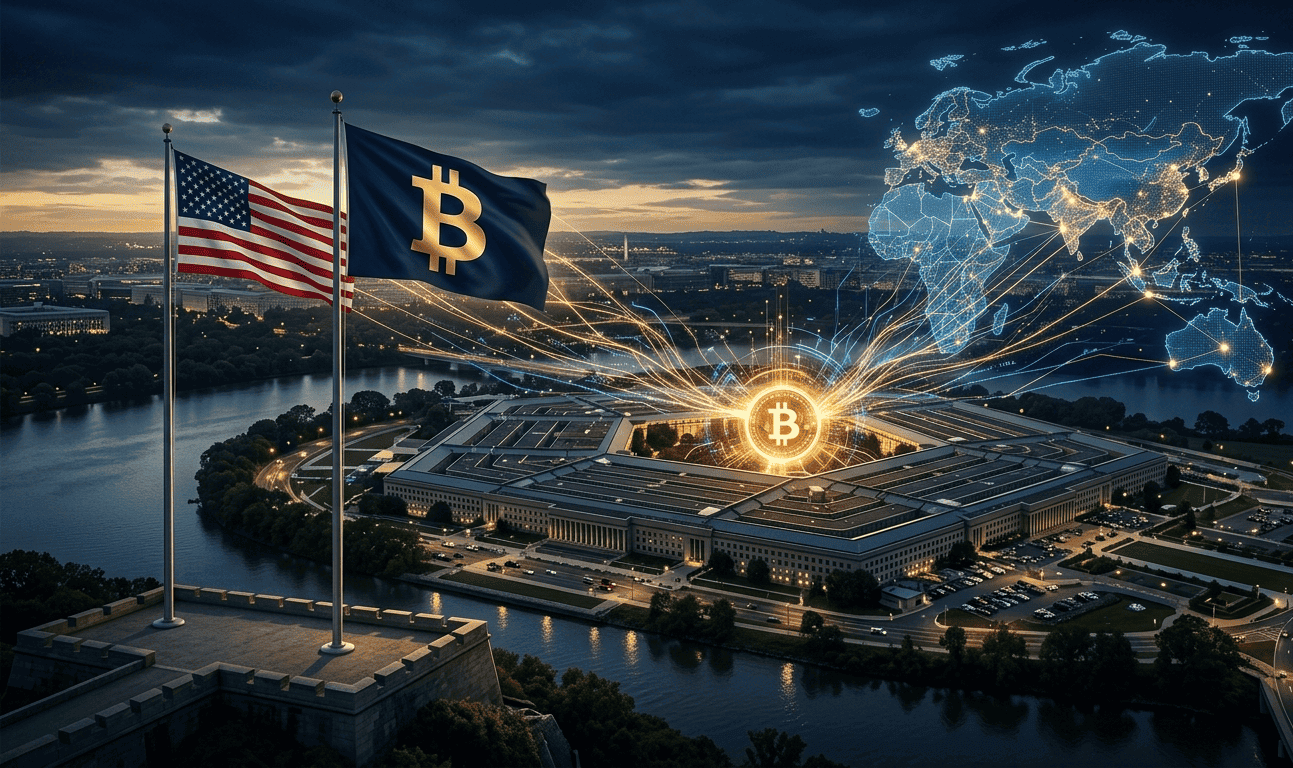
The head of the world’s largest military just told Congress that Bitcoin is a weapon. Not a financial asset. Not a speculative investment. A weapon.
Defence Secretary Pete Hegseth told the House Armed Services Committee on April 30 that the Pentagon is running classified Bitcoin projects that provide the US military “a lot of leverage in a lot of different scenarios.” He called himself a “long enthusiast of Bitcoin and crypto potential” and confirmed that the Department of Defence is actively working on both using and countering the technology.


“A lot of the things we are doing, enabling it or defeating it, are classified efforts that are ongoing inside our department,” Hegseth said.
That is the US Defence Secretary, on the record, in front of Congress, confirming that Bitcoin sits inside the Pentagon’s strategic toolbox alongside missiles, satellites, and cyberweapons. This is the most consequential institutional endorsement Bitcoin has received since the approval of spot ETFs.
What Did Hegseth Actually Say?
The exchange happened during questions from Texas Representative Lance Gooden. Gooden framed Bitcoin as a national security issue, citing Iran demanding BTC for Hormuz transit, North Korean ransomware operations, and China’s growing crypto mining and accumulation strategies.
“Over the past decade, Bitcoin has evolved from a fringe asset into a matter of national security,” Gooden said. He then asked Hegseth directly whether the US is using Bitcoin to project power and secure a strategic advantage against China.
Hegseth’s answer was short and unusually direct. He confirmed classified programmes exist inside the Pentagon covering both offensive and defensive uses of Bitcoin. He did not give operational details. But the phrase “enabling it or defeating it” tells you the Pentagon is not just studying Bitcoin. It is using it for something, and it is also building tools to counter adversaries who use it against US interests.
The US Military Is Already Running a Bitcoin Node
Hegseth’s comments were not isolated. Two weeks earlier, Admiral Samuel Paparo, commander of US Indo-Pacific Command, told the Senate Armed Services Committee that INDOPACOM is running a live Bitcoin node and testing the protocol in operational settings.
INDOPACOM covers the Pacific theatre, the geographic region where any military confrontation with China would play out. The fact that this specific command is testing Bitcoin infrastructure suggests the technology has applications in communications, logistics, or financial operations in contested environments where traditional banking and messaging systems might be disrupted.
Paparo said Bitcoin has “direct implications for power projection” and that “anything that supports all instruments of national power for the United States of America is to the good.”
A live military Bitcoin node is not theoretical. It is running right now on Defence Department infrastructure in the Indo-Pacific. Whatever they are testing, it is operational enough to warrant a four-star admiral discussing it in an open Senate hearing.
Why Is the Pentagon Interested in Bitcoin?
Three reasons, all tied to how the world has changed in 2026.
First, sanctions evasion. Iran is collecting Bitcoin tolls at the Strait of Hormuz. North Korea stole $577 million from DeFi protocols in April alone. Russia uses crypto mining to offset the impact of Western sanctions. Adversaries are using Bitcoin to move money outside the US-controlled financial system. The Pentagon needs to understand and counter that.
Second, financial resilience. In a conflict with China, traditional financial infrastructure could be disrupted. SWIFT could be targeted. Undersea cables carrying banking data could be cut. Satellite communications could be jammed. Bitcoin operates on a decentralised network that does not depend on any single point of infrastructure. If everything else goes down, a Bitcoin node still works.
Third, strategic competition. Russia now accounts for roughly 16% of global Bitcoin mining, making it the second-largest mining hub globally. China, despite its 2021 domestic ban, still represents nearly 12% through underground and offshore operations. Both countries are exploring digital assets to settle energy transactions and reduce dependence on the dollar. If the US does not secure a position in Bitcoin’s infrastructure, its rivals will.
Hegseth framed Bitcoin’s decentralised architecture as a counterweight to China’s “model of digital control”. China’s digital yuan is state-controlled, surveilled, and programmable. Bitcoin is the opposite. In Hegseth’s framing, the two represent competing visions of how money and data should work, and the US needs to be on the right side of that competition.
What Does This Mean for Bitcoin?
In the short term, probably nothing for the price. Bitcoin traded at $77,000 after the hearing, roughly where it was before. Markets do not move on congressional testimony about classified programmes.
In the medium term, it changes the narrative significantly. Bitcoin is no longer just a financial asset that institutions buy through ETFs. It is now, officially, a national security asset that the Pentagon considers part of its strategic toolkit. That framing makes it harder for any future administration to ban or restrict Bitcoin. You do not ban something the military is using.
Trump signed an executive order in March 2025 establishing a US strategic Bitcoin reserve seeded with approximately 200,000 BTC from government forfeitures. Senator Lummis is pushing legislation to expand that to 1 million BTC. Hegseth’s testimony adds a defence and national security rationale to the strategic reserve argument that goes beyond financial returns.
For Bitcoin holders, the message from Washington has never been clearer. The SEC chair says crypto is “part of the fabric” of finance. The Fed chair nominee calls himself constructive on digital assets. The Commerce Secretary’s family has financial ties to the world’s largest stablecoin issuer. And now the Defence Secretary says Bitcoin gives the US military leverage against China.
Whether you think that level of government embrace is good or bad for Bitcoin’s founding principles is a separate question. But there is no ambiguity about the direction. Bitcoin has gone from something the US government wanted to regulate to something the US government wants to use.