
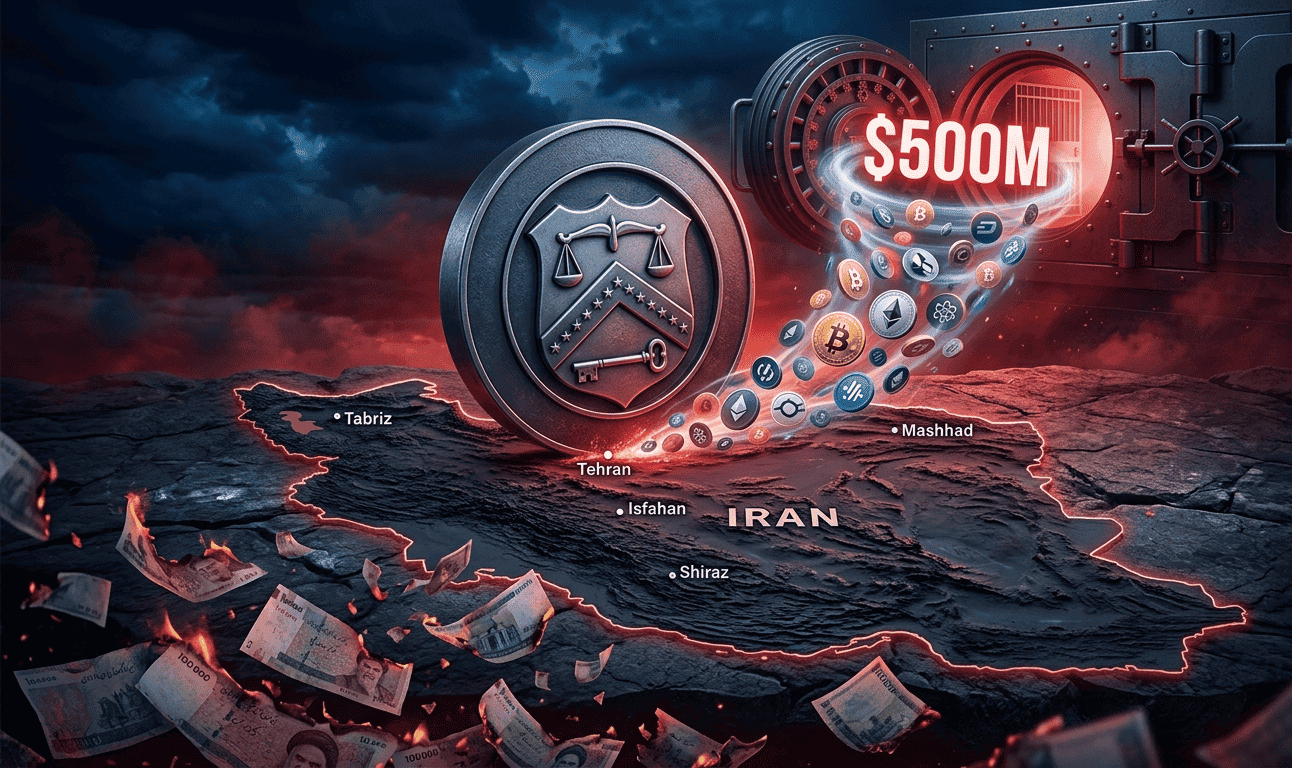
The number keeps growing. When we covered the Tether freeze two weeks ago, the total was $344 million. Now it is nearly $500 million.
Treasury Secretary Scott Bessent confirmed on Fox Business that the US has seized approximately $500 million in Iranian cryptocurrency assets under Operation Economic Fury. The breakdown: roughly $350 million in crypto seized through OFAC enforcement actions, plus an additional $100 million grabbed separately. The $344 million Tether freeze on two Tron wallets was the largest single action, but it was not the only one.


“We were able to grab about 350 million crypto assets, and then on top of another 100 that we had recently gotten, so we’re almost at half a billion there,” Bessent said. “And we are freezing bank accounts everywhere.”
The Iranian rial has crashed 60 to 70% against the dollar. Iran’s largest bank collapsed in December. Bessent says the regime is in “crisis.” And crypto is now one of the primary weapons Washington is using to make it worse.
What Is Operation Economic Fury?
Trump ordered the Treasury Department to launch the campaign in March 2025. The goal is simple: cut off every financial channel Tehran uses to fund its military, its proxies, and its government operations.
The operation works on multiple fronts simultaneously. OFAC has sanctioned over 1,000 Iran-related individuals, vessels, and aircraft since February 2025. The Treasury is freezing Iranian bank accounts worldwide. It is targeting retirement funds that Iranian officials parked overseas. It is going after real estate. And it is seizing crypto.
Bessent described it as a year-plus operation that is now “sprinting toward the finish line.” The recent acceleration came after Trump personally directed officials three weeks ago to intensify the pressure. Since then, Treasury has warned buyers of Iranian oil that secondary sanctions could hit their industries and banks. It sanctioned 35 people and organisations connected to an underground banking network. It hit 14 individuals involved in acquiring missile and drone components.
The crypto piece is the newest and fastest-growing part of the campaign. Before 2026, OFAC’s Iran enforcement focused on traditional banking and oil smuggling. Crypto was a secondary concern. Now it is central.
Why Is Crypto So Important to Iran?
Because Iran has no other options. The country has been cut off from SWIFT since 2018. Its banks cannot process international wire transfers. It cannot settle trade in dollars or euros through normal channels.
Crypto bypasses all of that. Chainalysis estimated that Iran’s crypto ecosystem reached $7.8 billion in 2025. The IRGC accounted for roughly half of all on-chain activity by Q4. The Central Bank of Iran acquired about $507 million in USDT specifically for currency stabilisation and trade settlement. Iran is not experimenting with crypto. It is running a parallel financial system through it.
The regime also started charging Bitcoin tolls for ships passing through the Strait of Hormuz. Empty tankers pass free. Loaded ones pay roughly $1 per barrel of oil in BTC or USDT. That toll system alone could generate hundreds of millions per year if it continues.
Meanwhile, scammers have been impersonating Iranian authorities and demanding Bitcoin from stranded ships for fake “safe passage” clearances. The war has turned the Strait of Hormuz into a crypto economy all on its own.
How Did Tether Help the US Seize $344 Million?
The largest single action was the April 23 freeze of two Tron wallets holding $213 million and $131 million respectively. Tether executed the freeze at the smart contract level after receiving direction from OFAC and multiple US law enforcement agencies.
A US official told CNN that investigators traced confirmed transactions between the wallets and Iranian exchanges, plus transfers through intermediary addresses connected to Central Bank of Iran-associated wallets. Chainalysis matched the frozen addresses to known IRGC transaction patterns.
Tether has now supported over 2,300 law enforcement cases across 340 agencies in 65 countries and helped freeze over $4.4 billion in total assets. The company is the single most active private-sector enforcement partner in crypto sanctions.
That capability is what makes stablecoins useful to Washington. Bitcoin cannot be frozen at the protocol level. Nobody controls it. USDT can be frozen with a single function call. Tether controls the blacklist. And Tether cooperates with OFAC. For sanctions enforcement, that is the difference between a weapon and a paperweight.
Is It Actually Working?
Bessent thinks so. He pointed to Iran’s largest bank collapsing in December as evidence the pressure is working. He said the rial’s 60 to 70% decline against the dollar has created “massive inflation.” He predicted that Iran’s oil storage will fill up soon, forcing the regime to cap wells, which would cause “permanent problems” for its energy infrastructure.
“The regime won’t be able to pay their soldiers, and equally important, is they won’t be able to fund their proxies, whether it’s Hezbollah, Hamas, around the world,” Bessent said.
Not everyone agrees. Daniel Tannebaum of the Atlantic Council told CNN the freeze is “meaningful” but questioned whether it moves the needle given how heavily sanctioned Iran already is. Iran has been adapting to sanctions for decades. It finds new wallets, new chains, new intermediaries. $500 million hurts, but Iran’s crypto ecosystem processed $7.8 billion last year.
The bigger impact may be psychological. Every crypto user in a sanctioned country just watched the US freeze half a billion dollars overnight through stablecoin controls. That changes risk calculations for anyone holding large USDT balances in jurisdictions that might attract American attention. It also pushes sanctioned actors further toward privacy coins and decentralised exchanges where issuer-level freezes are not possible.
For the crypto industry, the $500 million seizure confirms what the $344 million freeze signalled: stablecoins are now a primary tool of geopolitical warfare. The company that issues 60% of the world’s stablecoin supply acts as Washington’s enforcement arm when asked. Whether you see that as responsible compliance or centralised control depends on where you sit.
Frequently Asked Questions
How much Iranian crypto has the US seized in total?
Treasury Secretary Bessent confirmed the total is approximately $500 million. This includes roughly $350 million in crypto assets seized through OFAC enforcement plus an additional $100 million grabbed separately. The largest single action was Tether freezing $344 million in USDT across two Tron wallets on April 23.
How is the US seizing Iranian crypto?
Through OFAC sanctions and cooperation with stablecoin issuers. Tether can freeze USDT at the smart contract level, making tokens unmovable. Chainalysis traces transaction patterns to identify IRGC-linked wallets. OFAC then designates the addresses and Tether executes the freeze. Over 1,000 Iran-related entities have been sanctioned under Operation Economic Fury since February 2025.
Is Operation Economic Fury working against Iran?
Bessent says yes, citing Iran’s largest bank collapsing in December, a 60-70% decline in the rial, and growing pressure on the regime’s ability to fund military operations and proxies. Critics argue Iran has been adapting to sanctions for decades and will find alternative channels. The $500 million seizure is significant but represents a fraction of Iran’s $7.8 billion crypto ecosystem.