
Solana is under fresh pressure after a wave of whale selling and ecosystem-linked outflows added to an already weak week for SOL.
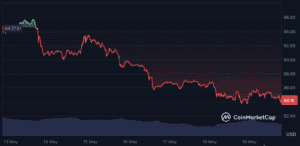
SOL has dropped roughly 12% over the past week, making it one of the weakest performers among the top 10 crypto assets by market capitalization. The move comes as broader crypto sentiment remains defensive, but Solana-specific selling has made the token stand out during the downturn.


SOL is trading around $84.15, with an intraday low near $83.50 and a high near $85.73. That keeps the token close to the short-term support area traders have been watching near $82 to $84.
Whale Selling Adds Pressure to SOL
The latest Solana weakness is not only about the wider crypto market. Large-wallet activity is also weighing on sentiment.
Blockchain analytics data cited in market updates shows that one long-term Solana holder originally staked 991,079 SOL more than five years ago and recently sold 30,000 SOL, worth about $2.56 million. The same wallet has reportedly been unwinding positions for about a year and has sold 965,274 SOL, valued near $137.7 million, while still holding about 381,140 SOL in staking positions.
That kind of activity matters because long-term holders can shape market psychology. When an older wallet starts selling after years of holding, traders often worry that more supply could come to market. The fear is not only the size of one sale. It is the possibility that the wallet may continue reducing exposure if price stays weak.
This does not prove that Solana’s long-term outlook has changed. It does show that supply from older holders is becoming a short-term factor at a time when buyers are already cautious.
Pump.fun Outflows Bring Another Supply Concern
Whale selling is not the only Solana-specific issue traders are watching.
Pump.fun has also resumed SOL outflows after a long pause. Market updates citing on-chain activity show that the platform deposited 174,408 SOL, worth about $14.76 million, to Kraken. A linked wallet then sold 117,877 SOL for about $9.96 million USDC at an average price near $84.52, before moving the stablecoins back to the exchange.
This matters because Pump.fun has been one of Solana’s most important ecosystem stories. The launchpad helped drive heavy meme coin activity, transaction demand, and fee attention across the network. When a major Solana-linked platform appears to restart large SOL sales, traders naturally ask whether ecosystem participants are taking liquidity out of the market.
The concern is stronger because SOL is already close to support. Large sales can be absorbed in strong markets, but they feel heavier when broader crypto liquidity is weak and buyers are not chasing risk.
SOL’s Support Zone Is Now the Main Test
The short-term chart has become simple: SOL needs to hold the low-$80s.
At around $84, Solana remains above the deeper support area near $82, but the margin is not large. If buyers defend the $82 to $84 zone and volume improves, SOL could try to stabilize and recover toward $88. A stronger recovery would need price to move back toward $90 and hold there, because that area has become a confidence marker after recent weakness.
If the support zone breaks, traders may look for a deeper move into the high-$70s. That would make the weekly decline look more serious and could increase pressure on leveraged positions.
The important point is that Solana has not only fallen because of one wallet or one platform sale. Whale activity, Pump.fun outflows, broader risk-off sentiment, and weaker altcoin liquidity are all hitting at the same time.
Institutional Signals Are Also Mixed
Solana’s market story has become more complicated because institutional positioning is no longer one-way bullish.
Market updates also pointed to Goldman Sachs’ latest 13F filing, which showed the bank exited spot Solana and XRP ETF positions in the first quarter of 2026. That does not automatically mean institutions are abandoning Solana, but it adds to a weaker sentiment backdrop while whale sales are already in focus.
This is a different setup from periods when Solana was moving higher on ETF optimism, network activity, and meme coin demand. Those stories still matter, but traders are now looking more closely at whether capital is rotating away from SOL during a broader market reset.
Institutional exits, whale selling, and ecosystem treasury sales are not the same thing. They have different motives and different time horizons. But when all three appear during the same weak week, the market tends to treat them as a combined pressure signal.
Solana’s Network Story Is Still Active
The selling pressure does not erase Solana’s network activity.
Solana remains one of the busiest blockchains in crypto, with heavy decentralized exchange activity, stablecoin usage, meme coin trading, and growing interest around AI-agent applications. That activity is why many traders still treat SOL as one of the most important large-cap altcoins, even during pullbacks.
The issue is that strong network activity does not always protect price in the short term. Tokens can fall while usage remains high if sellers are aggressive, broader liquidity weakens, or traders reduce altcoin exposure.
That is what makes the current setup important. Solana bulls need to show that real demand can absorb whale and ecosystem-linked supply. If SOL holds support while selling pressure fades, the market may treat this as a sharp but manageable reset. If support breaks, traders may worry that the selling is not finished.
What Happens Next?
The next few sessions will show whether Solana’s selloff is mostly a liquidity flush or the start of a deeper downtrend.
The first signal is whether SOL can hold the $82 to $84 support area. A steady defense would suggest buyers are still active near current levels. A clean break would likely increase pressure and make traders look toward lower support.
The second signal is whether more large wallets move SOL to exchanges. Whale deposits do not always mean immediate selling, but they usually raise concern because exchange transfers make tokens easier to sell.
The third signal is Pump.fun activity. If large SOL outflows continue, traders may keep treating ecosystem treasury sales as a pressure point. If those flows slow, the market may focus more on broader crypto direction.
For now, Solana has a clear problem to solve. The network still has strong activity, but the token is dealing with visible supply pressure during a weak altcoin market.
FAQ
Why is Solana under pressure this week?
Solana is under pressure because broader crypto sentiment is weak, while whale sales and Pump.fun-linked SOL outflows have added token-specific selling concerns.
How much has SOL fallen?
Recent market updates show SOL has dropped roughly 12% over the past week, making it one of the weakest large-cap crypto assets during the current downturn.
What support level matters for SOL now?
Traders are watching the $82 to $84 area. Holding that zone could help SOL stabilize, while a break below it may increase downside pressure.
Disclaimer: This article is for informational purposes only and does not constitute financial, investment, or legal advice. Always conduct your own research before making any investment decisions.