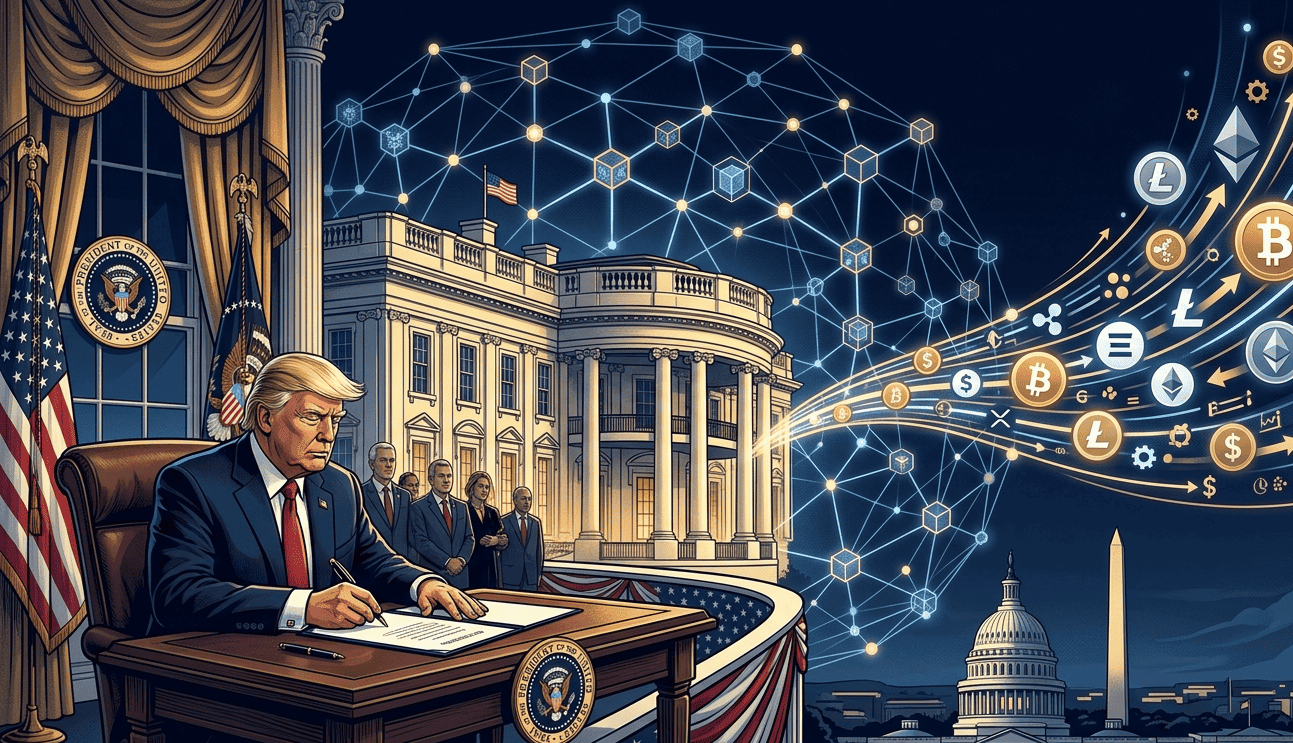
President Trump just signed an executive order that could fundamentally change how crypto companies operate in the United States.
The order, titled “Integrating Financial Technology Innovation into Regulatory Frameworks”, was signed on May 19. It directs every major federal financial regulator to update its rules so that crypto and fintech companies can plug directly into the traditional financial system, including, for the first time, the Federal Reserve’s own payment network.


In plain terms, the President is telling regulators to stop treating crypto companies like outsiders and start giving them the same access to banking infrastructure that traditional financial firms have enjoyed for decades.
This comes just five days after the CLARITY Act cleared the Senate Banking Committee on a 15-9 bipartisan vote. The White House has set a July 4 target for full congressional passage. Combined with the GENIUS Act for stablecoins, this executive order rounds out the most aggressive pro-crypto regulatory push in US history.
What the Executive Order Actually Does
The order has two main parts, each with clear deadlines.
Within 90 days, federal regulators must review their existing rules and identify anything that unfairly blocks crypto and fintech firms from accessing Federal Reserve payment accounts and services. That includes the payment processing, lending, deposits, and securities infrastructure that forms the backbone of the American financial system.
Within six months, regulators must take concrete steps to fix what they find. That means re-evaluating the criteria for Federal Reserve master accounts, which have historically been reserved for traditional banks and credit unions. Crypto companies like Kraken (which already holds a Fed master account through its Wyoming bank) and Ripple (which applied last year) would benefit directly.
The 12 regional Federal Reserve banks will each have the authority to independently approve or deny applications from crypto firms, subject to standard risk management requirements. A transparent application process must be available within the first 90 days.
Why Fed Access Matters So Much
To understand why this is a big deal, you need to understand what a Federal Reserve master account gives you.
Right now, most crypto companies can’t access the Fed’s payment network directly. When a crypto exchange wants to process a dollar withdrawal for a customer, it has to go through a traditional bank as an intermediary. That bank charges fees, imposes restrictions, and can cut off access at any time.
This arrangement has created a well-documented problem called “debanking.” For years, traditional banks have quietly refused to serve crypto companies, either because of regulatory pressure or because they viewed crypto clients as too risky. The result was that many legitimate crypto businesses couldn’t get basic banking services, even when they were fully licensed and compliant.
Direct Fed access would change that entirely. A crypto company with a Federal Reserve master account could process payments, settle transactions, and move dollars through the same system that every major bank in America uses. No middleman. No bank deciding whether to serve them. Direct access to the plumbing.
A Second Order Targets Financial Crime Rules
Trump actually signed two executive orders on the same day. The second one, titled “Restoring Integrity to America’s Financial System,” updates the Bank Secrecy Act and customer identification requirements.
This order directs regulators to modernise anti-money laundering rules that were originally written for traditional banks decades ago. The goal is to make compliance requirements more practical for digital asset companies without weakening the underlying protections against financial crime.
The two orders work together. The first opens the door for crypto companies to enter the traditional financial system. The second updates the rules they’ll need to follow once they’re inside.
For an industry that has spent years arguing it wants regulation rather than prohibition, this is exactly what “regulatory clarity” looks like in practice.
How the Industry Reacted
The response from the crypto industry was overwhelmingly positive, but not without some caution.
The Independent Community Bankers of America (ICBA) pushed back, arguing that giving non-bank firms access to Federal Reserve services could create risks if those firms don’t face the same supervisory standards as traditional banks. Representative Maxine Waters sought further details on how approvals would work, arguing that access to the nation’s financial infrastructure shouldn’t be granted without complete transparency.
On the crypto side, the reaction was closer to celebration. The executive order validates what companies like Kraken, Ripple, Anchorage Digital, and Circle have been building toward for years: a regulated path into the heart of the US financial system.
Kraken already holds a Federal Reserve master account through its Wyoming bank. Ripple applied for a national trust charter and Fed master account last year. Both companies are positioned to be among the first crypto firms to benefit from the new framework.
The Bigger Picture for Crypto in America
Step back and look at what’s happened in the past two weeks alone.
The CLARITY Act cleared the Senate Banking Committee. The GENIUS Act established a federal framework for stablecoins. Kevin Warsh, who holds over $100 million in personal crypto investments, took over as Fed Chair. And now the President has signed an executive order directing regulators to open the financial system to crypto companies.
That’s a level of coordinated pro-crypto policy action that would have been unthinkable even a year ago. The regulatory environment in the United States has shifted from hostile to actively supportive in the space of a few months.
For the global crypto industry, the implications are significant. The US is now positioning itself as the most attractive jurisdiction for crypto companies that want to operate within a clear, regulated framework. Other countries, particularly in Asia and Europe, will need to respond or risk losing talent and capital to American shores.
The next major milestone is July 4, when the White House wants the CLARITY Act fully passed by Congress. If that deadline is met, the US will have both a stablecoin law and a comprehensive crypto market structure law in place before the end of summer. That combination would give the industry the clearest regulatory foundation it has ever had, anywhere in the world.
What This Means for Everyday Crypto Users
For regular people who buy, sell, and hold crypto, this executive order won’t change your experience overnight. You won’t wake up tomorrow with a Federal Reserve account.
But over time, the effects will be real. When crypto companies have direct access to the Fed’s payment system, transfers between exchanges and bank accounts could become faster and cheaper. The risk of being “debanked” drops significantly. And the overall legitimacy of the industry increases, which tends to attract more users, more capital, and better products.
The most important shift is psychological. When the President of the United States signs an order telling regulators to integrate crypto into the financial system, it sends a message that digital assets are here to stay. That kind of top-down legitimacy matters for adoption, for institutional investment, and for the long-term health of the industry.
Disclaimer: This article is for informational purposes only and does not constitute financial advice. Cryptocurrency investments carry significant risk. Always conduct your own research before making any investment decisions.