
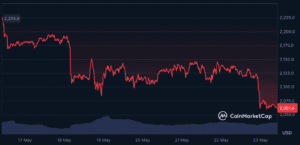
Just when it seemed like things might be turning around, Ethereum fell below $2,100 on Friday, hitting its lowest point since the recovery started in April. This drop wiped out six weeks of steady gains and has investors seriously concerned.
The numbers aren’t pretty. Ethereum is down about 57% from its all-time high of $4,953 in August 2025 and has dropped 30% so far this year. It’s lagging far behind Bitcoin, with the ETH/BTC ratio at multi-year lows. The Fear and Greed Index is at 28, which is deep in the ‘Fear’ zone.


At the same time, major holders are selling. Harvard’s endowment sold its entire $87 million ETH stake. Whale trader Garrett Jin moved all 577,896 ETH ($1.35 billion) to Binance in just four days. Ethereum ETFs have seen over $2.4 billion in outflows across five straight months, and some top Wall Street analysts are predicting Ethereum could reach $3,500 or more by December.
Clearly, someone’s outlook is off. The real question is, who has it right?
Selling Pressure Hasn’t Let Up
To understand why ETH is struggling, it helps to look at who’s selling and how much they’re offloading. It’s damaging. Harvard’s $87 million exit made headlines, but it’s part of a broader pattern. Ethereum ETFs have been bleeding money consistently since January. Unlike Bitcoin ETFs, which pulled in $858 million in a single week earlier this month, Ethereum funds can’t find a rhythm. Inflows appear one day and are wiped out by outflows the next.
Large holders selling adds even more pressure. Garrett Jin’s $1.35 billion transfer to Binance was one of the biggest single-wallet moves in Ethereum’s history. Around the same time, BlackRock and Fidelity moved a combined $80 million in ETH to exchanges.
When large holders send tokens to exchanges, it usually means they plan to sell. It’s not always the case, but it happens often enough that traders see it as a bad sign. When several big players move billions in the same week, it’s tough to overlook.
The technical picture confirms what the flow data suggest. The technical data backs this up. ETH fell below $2,200, a support level it had held since April, and kept dropping. Both the 50-day and 200-day moving averages are trending down. The RSI is now at 36, close to oversold. Every key technical indicator is signaling caution for traders. It’s falling harder than nearly every other major crypto asset. That relative weakness demands an explanation, and there are three big reasons behind it.
First, there’s more competition. Ethereum used to be the main smart contract platform, attracting most DeFi activity, NFT trading, and developers. Now, that’s changed. Solana even passed Ethereum in monthly DEX volume in April. Base, Arbitrum, and other Layer 2 networks are drawing activity away from Ethereum’s main chain. Developers now have more options, and some are picking faster, cheaper platforms.
Second, there’s a big gap in ETF interest. Bitcoin ETFs have been highly successful, raising over $56 billion and helping support Bitcoin’s price. Ethereum ETFs have attracted only a small share of that. As a result, most institutional money is flowing into Bitcoin rather than being split between the top two assets, as many thought it would.
Third, it’s about the story. Bitcoin’s message is simple: it’s digital gold, a scarce asset, and a store of value for institutions. Ethereum’s story is more complex. It’s a platform and infrastructure that powers DeFi and tokenisation. But convincing a pension fund to buy ETH because it’s ‘the settlement layer for the future of finance’ is harder than selling the idea that ‘there will only ever be 21 million Bitcoin.’
Mark Cuban summed this up recently, saying he was ‘more disappointed in Bitcoin, not as disappointed in Ethereum.’ Even Ethereum’s supporters are describing it as the less disappointing choice, not a strong buy.
The Bull Case That Refuses to Die
This is where things get interesting. Even though the price is struggling, Ethereum’s fundamentals may be stronger than ever.
Just two weeks ago, BlackRock, the world’s largest asset manager, filed to put its $7 billion money-market fund on Ethereum using ERC-20 tokens. This isn’t just speculation—it’s a major financial institution choosing Ethereum as the base for one of its main products.
Ethereum now has 189.5 million wallet holders, which is more than three times Bitcoin’s 59 million. Over 66% of all ETH is staked, so there’s less available for trading. Ethereum also leads in DeFi, with $45.7 billion locked more than all other blockchains combined.
The upcoming Glamsterdam upgrade aims to allow parallel transaction processing, raise the gas limit from 60 million to 200 million, and boost throughput to 10,000 transactions per second. If successful, it would be the biggest performance upgrade since The Merge and could lower gas fees by 78%.
Jane Street, a top Wall Street trading firm, recently added $82 million in ETH ETF positions. Since June 2025, institutional buyers have picked up about 3.8% of all Ethereum in circulation.
Right now, the fundamentals and the price are sending opposite signals. Either the fundamentals are wrong, and ETH will keep falling, or the price just hasn’t caught up yet and could rebound. In the past, these gaps usually closed over time. The big question is when.
What the Analysts Are Saying
Year-end predictions for ETH are all over the place, underscoring the disagreement about its future.
On the bullish end, Standard Chartered has maintained a $7,500 target for Ethereum by the end of 2026. Tom Lee at Fundstrat sees ETH reaching $7,500 to $16,000 if the broader crypto bull market materializes. Jeremy Britton, CFO of BostonTrading, has projected $9,000 based on Ethereum’s utility and network effects.
In the moderate camp, InvestingHaven’s forecast targets an average of $2,700 for 2026, with a ceiling of $3,500. That represents roughly a 28% to 67% gain from current levels. Finder’s expert panel expects ETH near $5,026 by year-end. Most institutional models cluster between $3,000 and $4,000.
On the bearish side, Alexander Kuptsikevich of FxPro has a $2,000 target. Changelly’s technical model suggests ETH may not break above $2,538 for the remainder of the year. And the most aggressive bears point to the possibility of a decline toward $1,800 or even $1,400 if the $2,000 psychological support fails.
The most credible forecasts range from $1,800 to $7,500. This widespread sentiment says more about the uncertainty around Ethereum than any single prediction.
The Key Levels Every ETH Holder Should Watch
Now that ETH is below $2,100, the technical outlook is clearer than when the price was moving sideways.
Right now, support is at $2,075 to $2,085. If that doesn’t hold, the next key level is the psychological $2,000 mark. Below $2,000, there’s not much support until $1,800, which was the bottom during the February-March selloff.
For ETH to recover, it needs to get back above $2,200, which was its support for six weeks before the recent drop. Moving above $2,300 would suggest the breakdown was temporary. The $2,400 level, which has stopped every rally in May, remains the key to a real rally. $2,000 is a crucial level both technically and psychologically. If ETH stays above it, the oversold RSI and negative sentiment could spark a relief rally. If it falls below, selling could speed up as stop losses and leveraged positions get liquidated. Analysts estimate about $800 million in long liquidation risk below $2,162.
For traders, this is a high-risk situation. For long-term holders, it’s a test of patience and belief in Ethereum’s strong adoption fundamentals.
The Disconnect That Defines Ethereum in 2026
The main issue for Ethereum right now is the gap between its growing network and its current market price.
On the one hand, BlackRock is tokenizing funds on Ethereum. There are 189.5 million wallets, two-thirds of ETH is staked, JPMorgan is settling tokenized Treasuries, and the Glamsterdam upgrade is on the way.
On the other side, ETH’s price is down 57% from its high. Harvard is selling, whales are dumping, ETFs are seeing outflows, and the ETH/BTC ratio is at its lowest in years.
One of these views must be off. Either the adoption numbers are misleading, and Ethereum’s utility isn’t adding value, or the market is just temporarily out of sync and will correct in time.
History gives some clues. In past cycles, Ethereum’s price was often at its lowest when its fundamentals were quietly improving. Assets that look the worst at the bottom often bounce back the most, since most sellers have already exited.
Whether this is the turning point or the pain continues depends on factors outside Ethereum’s control, such as the Fed’s interest rate decisions, Bitcoin’s path, and global risk appetite. What Ethereum can control, its technology, network growth, and institutional relevance, still looks strong.
Eventually, the price should catch up. The big question for ETH holders is: how much longer will it take?
FAQ
Why did Ethereum drop below $2,100?
The decline was driven by heavy selling by institutional holders (Harvard dumped $87 million, and whale Garrett Jin deposited $1.35 billion with Binance), five consecutive months of ETF outflows exceeding $2.4 billion, and a breakdown below the $2,200 technical support level that had held since April. The broader market environment, with rising Treasury yields and risk-off sentiment, added further pressure.
What are analysts predicting for Ethereum by the end of 2026?
Predictions range from $1,800 on the bearish end to $7,500 on the bullish end. Standard Chartered targets $7,500.
Should I buy Ethereum at these prices?
Ethereum is trading 57% below its all-time high, even as its adoption metrics (189.5 million wallets, 66% of supply staked, BlackRock building on the network) are at record levels. The RSI is approaching oversold territory, which has historically preceded bounces.
Disclaimer: This article is for informational purposes only and does not constitute financial advice. Cryptocurrency investments carry significant risk. Always conduct your own research before making any investment decisions.