Look at the top 10 cryptocurrencies right now and the picture looks grim. Bitcoin is down 2% over the past seven days. Ethereum has dropped further. XRP, Solana, and most major tokens are in the red.
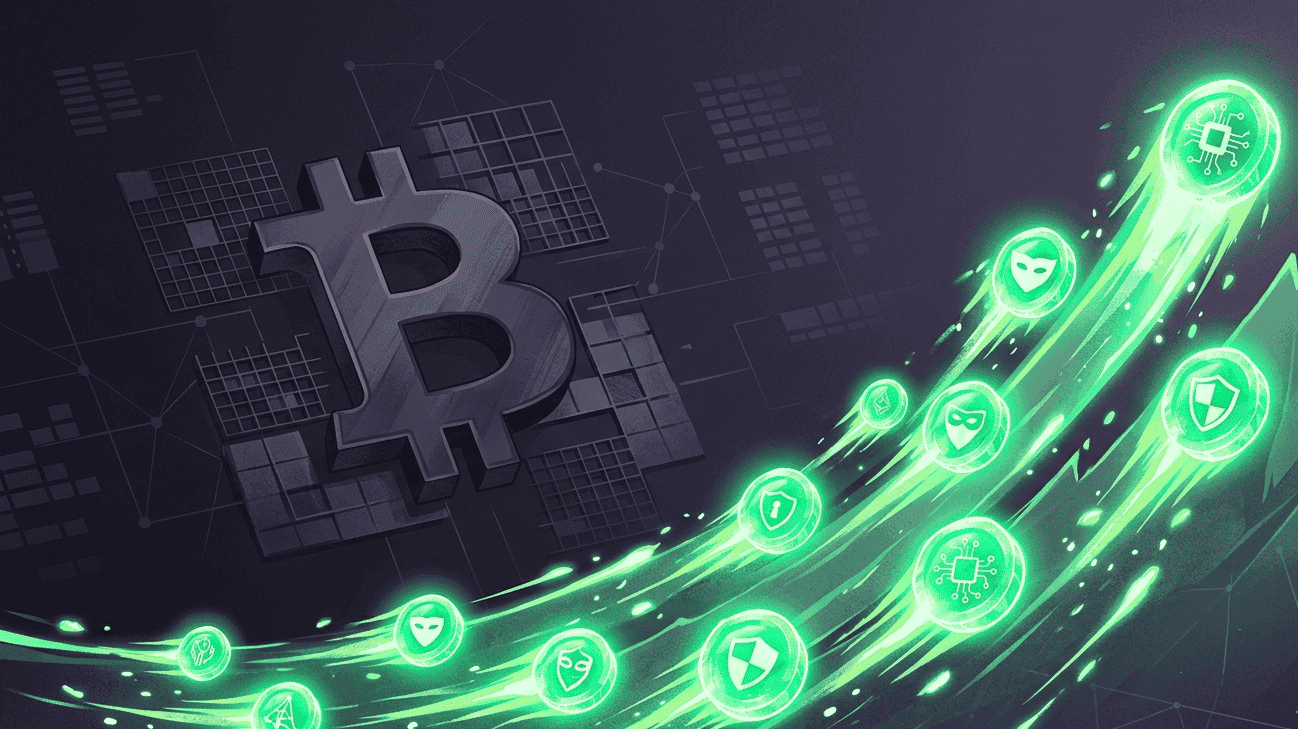
But dig a little deeper and a completely different story emerges. Privacy coins and quantum-resistant tokens are posting gains of 6% to 25% while the rest of the market treads water. Zcash, Quantum Resistant Ledger (QRL), Qubitcoin (QTC), and Starknet (STRK) are all climbing. Hyperliquid’s HYPE token is up 45% in a week.


There is always a bull market somewhere. Right now it’s in tokens that solve two of the biggest problems looming over crypto: surveillance and quantum computing.
The Privacy Trade Is the Strongest Narrative of 2026
Privacy coins have been the top-performing sector in crypto since late 2025. Zcash has rallied over 700% in the past eight months. Monero hit new all-time highs. Dash has tripled. And the momentum hasn’t stopped.
The driving force is straightforward. As more financial activity moves onto public blockchains, everything becomes visible. Every Bitcoin transaction, every Ethereum swap, every wallet balance is recorded permanently and can be traced by anyone with the right tools.
That transparency was once considered a feature. Now, for a growing number of investors, it’s becoming a risk. AI-powered blockchain analytics can map transaction patterns, cluster wallet addresses, and build detailed financial profiles of on-chain users with a speed and accuracy that wasn’t possible even two years ago.
Governments are also expanding their surveillance capabilities. Tether froze $515 million in USDT across 371 wallets in a single month. Wealth tax discussions are gaining traction in multiple countries. And the line between “regulatory compliance” and “financial surveillance” is getting blurrier by the day.
In that environment, tokens that can hide transaction details, shield wallet balances, or make funds untraceable carry a premium that didn’t exist before.
Vitalik Buterin Just Pushed Privacy Up the Agenda
The privacy narrative got another major boost on Wednesday when Ethereum co-founder Vitalik Buterin outlined steps being taken to bring privacy features to the world’s largest smart contract blockchain.
When the founder of a $280 billion network starts talking publicly about the need for transaction privacy, it validates the entire thesis. Ethereum isn’t going to become a privacy coin overnight, but the fact that its leadership sees privacy as a priority tells you how the industry’s thinking has shifted.
Arthur Hayes, one of the most influential voices in crypto and co-founder of BitMEX, has gone further. He’s been arguing that privacy is a fundamental necessity as AI, large tech firms, and government surveillance erode financial freedom. Andreessen Horowitz called privacy “the most important moat in crypto” in its 2026 investment outlook.
These aren’t fringe opinions from anonymous Twitter accounts. These are some of the most powerful people in the industry saying the same thing: privacy is not optional anymore.
Quantum-Resistant Tokens Are the Next Wave
Alongside privacy coins, a newer category is gaining attention: tokens built to withstand attacks from quantum computers.
The quantum threat to crypto is no longer theoretical. A researcher broke a 15-bit cryptographic key on public quantum hardware in April. Google published research suggesting a full attack on Bitcoin’s encryption could require fewer than 500,000 physical qubits, with some estimates going as low as 10,000. Project Eleven’s 110-page report placed the baseline “Q-Day” scenario at 2033.
Tokens designed to resist quantum attacks are now seeing real demand. QRL (Quantum Resistant Ledger) uses hash-based signatures that are immune to the type of mathematical attacks quantum computers excel at. Starknet uses zk-STARKs, a proof system that doesn’t rely on the elliptic curve cryptography that quantum computers threaten.
Zcash sits at the intersection of both trends. It’s a privacy coin that has also announced plans to become fully quantum-proof within 12 to 18 months. Quantum-recoverable wallets are expected to roll out within weeks, making Zcash one of the first major networks to offer active protection against the coming quantum threat.
For investors, the appeal is clear. If quantum computers eventually break the encryption protecting Bitcoin, Ethereum, and most other blockchains, the tokens that saw it coming and built defences will be the ones still standing.
The Numbers Behind the Rotation
The sector performance data tells a stark story about where capital is flowing in May 2026.
Zcash is up over 700% since September 2025. Monero gained 123% in 2025 and has continued climbing in 2026. Dash tripled. Privacy coins as a sector have outperformed every other crypto category over the past eight months.
Meanwhile, Bitcoin is down 13% year-to-date. Ethereum has fallen 30%. Solana is off 33%. The traditional majors are struggling while privacy and quantum-resistant tokens push higher.
Trading volume data supports the trend. Emerging markets now account for 81% of privacy token trading volume, driven by users seeking protection from capital controls, currency restrictions, and government overreach. The use case is real, and it’s growing faster in the parts of the world where financial freedom matters most.
DEX volumes across the top 12 decentralised exchanges for perpetual futures have risen to a $612 billion monthly average in 2026, up from $532 billion in 2025. A meaningful portion of that growth is flowing into privacy-related tokens and platforms.
What’s Driving Investors Away From Bitcoin Toward These Tokens
The shift isn’t about Bitcoin being broken. It’s about investors getting more sophisticated in how they allocate capital.
In previous cycles, a crypto bull market meant everything went up together. Bitcoin rallied, altcoins followed, and even the worst projects saw their tokens pump. That’s not happening in 2026. Institutional money flows almost entirely into Bitcoin through ETFs. Retail speculation has cooled. And the tokens that are rallying are the ones with clear, defensible use cases rather than hype.
Privacy coins offer protection against surveillance. Quantum-resistant tokens offer protection against a future technology threat. Decentralised exchange tokens like HYPE offer real revenue from actual trading volume. Each of these narratives is grounded in something tangible.
The common thread is utility. The market is rewarding tokens that solve real problems and punishing tokens that exist purely as speculation. For investors who are willing to look beyond the top 10, the opportunities are significant.
But the risks are real too. Privacy coins face ongoing regulatory threats. Several have been delisted from exchanges in multiple countries. Quantum-resistant technology is still early, and the tokens in this category are smaller and less liquid than established assets. And any rally that gains 25% in a week can just as easily give it back.
The Takeaway
The crypto market isn’t dead. It’s just rotating. Capital is moving away from the biggest tokens and into specific sectors with strong narratives and real-world demand.
Privacy coins, quantum-resistant tokens, and decentralised exchange tokens are the three sectors leading the market right now. Each one is driven by a story that goes beyond price speculation: the need for financial privacy in an AI-surveilled world, the need for quantum-proof security before it’s too late, and the need for trading infrastructure that works without centralised intermediaries.
Bitcoin and Ethereum will have their day again. But right now, the most interesting opportunities in crypto are happening in places most investors aren’t looking.
Disclaimer: This article is for informational purposes only and does not constitute financial advice. Cryptocurrency investments carry significant risk. Always conduct your own research before making any investment decisions.