Bitcoin is trying to stabilize after defending the $76,000 area, but bulls still need a clean move back toward $80,000 before traders can call the latest bounce convincing.
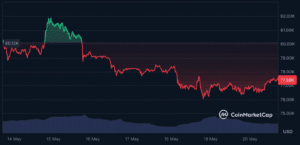
BTC is trading near $77,419, after touching an intraday low of about $76,180 and recovering toward the upper-$77,000 range. That keeps Bitcoin above the support zone that traders have been watching, but still below the $80,000 level that has become the first major confidence test after the recent selloff.


The rebound comes while sentiment remains fragile. Bitcoin has been consolidating near $77,000 as macro worries, a U.S. credit-rating downgrade, and roughly $648 million in ETF outflows weigh on risk appetite. Rising Treasury yields and high oil prices are also keeping pressure on global markets, which makes it harder for BTC to break higher without stronger spot demand.
Bitcoin Holds the Line Near $76,000
The most important short-term development is that Bitcoin has not broken down through $76,000.
The intraday low near $76,180 shows that sellers tested the support zone, but buyers stepped in before the market could slide into a deeper liquidation move. That does not make the chart fully bullish yet. It simply means the first defense worked.
For bulls, holding $76,000 matters because it keeps the market inside a recovery range instead of confirming a fresh leg lower. If BTC can continue closing above that area, traders may become more willing to test the upper side of the range near $78,500 and then $80,000.
For bears, the setup is still attractive because every bounce remains below the level Bitcoin recently lost. Until BTC reclaims $80,000 with stronger volume, sellers can argue that the market is only pausing inside a broader risk-off move.
The $80,000 Level Is the First Real Confidence Test
Bitcoin does not need to hit a new high to improve sentiment. It first needs to recover $80,000.
That level matters because it is close to where recent support turned into resistance. When BTC fell below $80,000, it shifted trader psychology. A level that once looked like a floor became the line Bitcoin needs to reclaim to prove that demand is returning.
A move above $80,000 would not end all downside risk, but it would change the tone. It would show that buyers are willing to absorb selling pressure and push price back into the previous range. From there, traders would likely watch the $81,500 to $82,500 area, which recent market updates identified as a higher resistance zone after Bitcoin slipped from earlier levels.
If Bitcoin fails near $80,000, the rebound may look more like a relief bounce than a real recovery. That would keep the $76,000 area under pressure and raise the risk of another support test.
ETF Outflows Keep Bulls Under Pressure
The biggest crypto-native problem is still ETF flow weakness.
Bitcoin ETFs helped drive institutional demand during stronger periods of the cycle, but recent outflows have worked in the opposite direction. Current market updates point to about $648 million in ETF outflows as one of the reasons Bitcoin is struggling to rebuild momentum near $77,000.
ETF flows matter because they show whether large investors are adding or reducing exposure. When ETFs are taking in money, they can absorb supply and support spot demand. When ETFs are seeing outflows, the market loses one of its cleanest institutional demand signals.
That does not mean ETF outflows will continue forever. Flows can change quickly if Bitcoin stabilizes, macro pressure eases, or investors view the dip as attractive. But for now, weak flows make the $80,000 test harder because bulls need to overcome both technical resistance and institutional caution.
Macro Pressure Is Still Working Against Risk Assets
Bitcoin’s price action is also being shaped by the bond market.
Rising U.S. yields make life harder for non-yielding assets like Bitcoin. When Treasury yields climb, investors can earn more from government debt, which raises the opportunity cost of holding volatile assets. That is especially important during periods when oil prices are high, inflation fears are rising, and traders are worried about central bank policy.
Reuters reported that surging U.S. Treasury yields and high oil prices are pressuring broader markets, with the 30-year yield at its highest level since 2007 and Brent crude holding near $111. That backdrop explains why Bitcoin has struggled to act like a safe haven in the short term. Traders are treating BTC more like a high-beta risk asset while macro conditions remain tight.
This is why Bitcoin’s bounce from $76,000 needs confirmation. A technical rebound can happen even in a weak macro environment, but a sustained rally usually needs either stronger spot demand or calmer outside markets.
Leverage Could Make the Next Move Sharper
The next move may be fast because leverage remains a factor.
When Bitcoin trades near a widely watched support level, leveraged traders often crowd around the same zones. If BTC breaks below $76,000, stop-loss orders and forced liquidations could accelerate the move. That is why some analysts have warned that a failure of the $76,000 area could open a path toward $70,000 if demand does not recover.
The same logic can work in the other direction. If Bitcoin pushes above $80,000 and short sellers are crowded, a short squeeze could help price move quickly toward the next resistance range. That is why the current setup is not calm, even though BTC is consolidating.
For now, the clean trading range is visible. The downside line is around $76,000. The upside test is $80,000. A break on either side will likely decide the next short-term trend.
What Bulls Need to See Next
The first thing they need is a sustained hold above $76,000. A single intraday defense is helpful, but repeated tests can weaken support if buyers do not push price higher afterward.
The second thing they need is a move back above $78,500 with improving volume. That would show that buyers are not only defending lows but also chasing price higher.
The third and most important signal is a clean reclaim of $80,000. If Bitcoin can move above that level and hold it, sentiment may improve quickly because traders would see the recent breakdown as a failed move rather than the start of a deeper trend.
The fourth signal is ETF flow stabilization. Even flat or smaller outflows would be better than another heavy redemption wave. If ETF flows turn positive again while BTC holds support, the market could regain confidence faster.
What Bears Need to See Next
A failed recovery near $78,500 to $80,000 would support the view that Bitcoin is still in a weak short-term structure. If sellers defend that zone and price rolls over, the $76,000 level would likely come back into focus quickly.
A clean break below $76,000 would be more serious. It would show that buyers failed to protect the support zone and could push traders to look toward lower liquidity areas. In that case, the market may start discussing $72,000 and $70,000 as possible downside targets, especially if ETF outflows continue and yields stay elevated.
Bears also want macro pressure to remain high. If Treasury yields keep rising and oil stays strong, Bitcoin may struggle to attract new risk capital, even if its long-term holders remain confident.
FAQ
Why is $76,000 important for Bitcoin?
The $76,000 area is the support zone Bitcoin just defended after an intraday low near $76,180. If BTC holds that level, bulls have a chance to rebuild momentum. If it breaks, downside pressure could increase.
Why does Bitcoin need to reclaim $80,000?
The $80,000 level is the first major confidence test after Bitcoin’s recent breakdown. A move above it would show that buyers are returning, while another rejection could keep the market stuck in a weak range.
Are ETF outflows hurting Bitcoin price?
Yes. Recent market updates point to about $648 million in ETF outflows, which has added pressure while BTC consolidates near $77,000.
Disclaimer: This article is for informational purposes only and does not constitute financial, investment, or legal advice. Always conduct your own research before making any investment decisions.