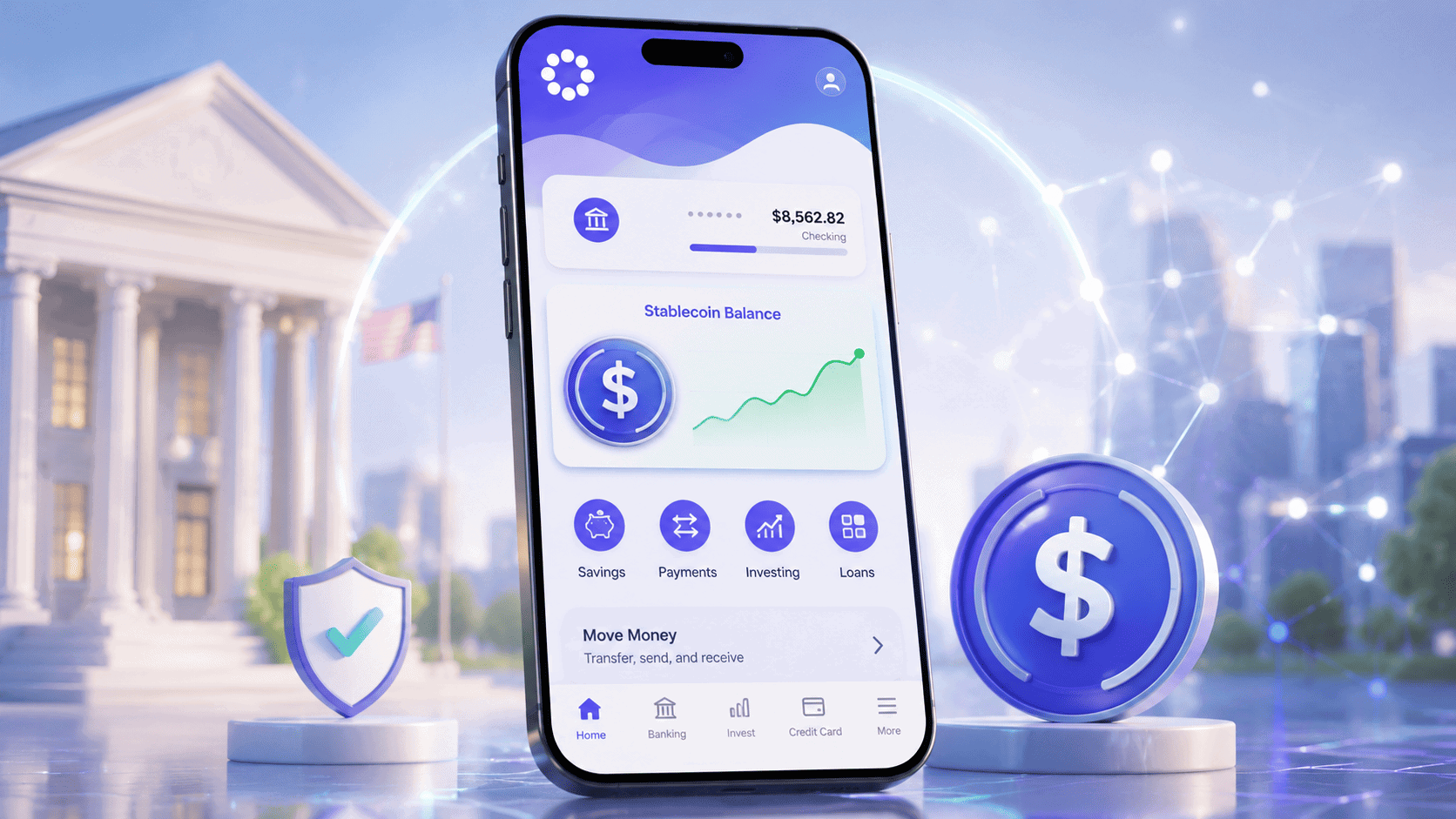
SoFi Technologies launched SoFiUSD on Wednesday, becoming the first US national bank to issue a stablecoin and make it available directly inside a consumer banking app. Members can now buy, sell, hold, and convert the dollar-backed token in the same app they already use to save, spend, borrow, and invest.
No separate crypto wallet. No exchange account. No seed phrases or gas fees to worry about. Just a new feature sitting alongside your checking account and investment portfolio in an app you already have on your phone.


SoFiUSD is issued by SoFi Bank, N.A., and regulated by the Office of the Comptroller of the Currency. Each token is redeemable 1:1 for US dollars. It’s live on Ethereum and Solana, with more blockchains planned. And within weeks, SoFi plans to let members convert their stablecoins into interest-bearing tokenized deposits that could qualify for FDIC insurance.
CEO Anthony Noto put it simply. “People no longer have to choose between blockchain technology and regulated banking products.”
Why This Is Different From Everything That Came Before
USDC exists. USDT exists. PayPal has PYUSD. So why does SoFiUSD matter?
The difference is distribution. USDC, USDT, and PYUSD all require users to either visit a crypto exchange or navigate a separate interface to access them. Even PayPal’s stablecoin lives in a different section of the app from your main banking features. There’s always a wall between “your bank stuff” and “your crypto stuff.”
SoFi tore that wall down. SoFiUSD lives inside the same banking interface where members check their balances, pay bills, and manage investments. The experience of buying a stablecoin is identical to that of moving money between a savings and a checking account. Tap a button, confirm the amount, done.
That seamlessness matters enormously for adoption. The reason most people don’t use stablecoins isn’t that the technology doesn’t work. It’s that accessing them requires stepping outside the financial apps they already trust. SoFi eliminated that step entirely.
A company spokesperson framed it directly. “SoFiUSD is designed for members who already engage with crypto but want a safer way to do it. SoFi is a nationally chartered bank, with robust compliance, comprehensive oversight, and a steadfast commitment to consumer protection. It is the exact environment where stablecoin adoption should happen.”
What SoFi Members Can Actually Do With SoFiUSD
At launch, the functionality is focused on the basics: buy, sell, hold, and convert. Members can purchase SoFiUSD with dollars from their SoFi account and convert it back to cash at any time at a 1:1 rate. The stablecoin can also be held as a digital asset within the app’s portfolio view.
The roadmap gets more interesting quickly. Within the coming weeks, SoFi plans to roll out three features that push well beyond basic stablecoin functionality.
Tokenized deposits will let members convert SoFiUSD into deposit accounts that earn interest and may qualify for FDIC insurance under separate account terms. That would make SoFi one of the first platforms to offer a pathway from a blockchain-based stablecoin into a federally insured savings product, all within the same app.
Cross-border transfers using SoFiUSD will allow members to send money internationally around the clock at lower costs than traditional wire transfers. For the millions of Americans who regularly send money overseas to family, this could be a genuine alternative to services like Western Union and Wise that charge significantly higher fees.
Institutional access through Bullish, a centralized digital asset exchange, will bring SoFiUSD to professional traders. The partnership is designed to support stable pricing and high-volume execution for institutional clients who need deep liquidity.
SoFi also runs Galileo, a technology platform that powers financial services for fintechs, banks, and brands across 133 million accounts globally. If SoFiUSD is eventually integrated into Galileo’s infrastructure, the stablecoin’s reach could extend far beyond SoFi’s own 15 million members.
The GENIUS Act Made This Possible
SoFi’s stablecoin launch didn’t happen in a regulatory vacuum. It’s a direct product of the GENIUS Act, the federal stablecoin framework that passed last year and gave nationally chartered banks a clear legal pathway to issue their own digital dollars.
Before the GENIUS Act, the legal status of bank-issued stablecoins was uncertain. Banks knew they had the technical capability to issue tokens, but the regulatory risk of doing so without explicit authorization kept most of them on the sidelines. The GENIUS Act removed that uncertainty by establishing rules around reserves, redemption, reporting, and consumer protections specifically for payment stablecoins issued by federally regulated institutions.
SoFi Bank holds an OCC national bank charter, which places it in the highest tier of regulatory authorization under the GENIUS Act framework. That means SoFiUSD benefits from the same supervisory oversight that governs traditional banking products, giving members a level of regulatory confidence that standalone crypto stablecoins can’t match.
The timing is deliberate. SoFi first announced SoFiUSD late last year but initially limited access to enterprise partners such as card networks and retailers. Opening it to all 15 million consumer members now, just as the CLARITY Act advances through the Senate and Trump’s executive order pushes the Fed to integrate crypto into the payment system, positions SoFi at the intersection of every major regulatory tailwind in the market.
The Competition Just Got a Lot More Intense
SoFi’s launch puts immediate pressure on every other bank and fintech in America.
The survey published this weekend, showing that one in three European investors would switch banks for crypto access, tells you how strong consumer demand for integrated crypto-banking products has become. SoFi just answered that demand more directly than any US bank has before.
For USDC and USDT, SoFiUSD represents a new kind of competition. Circle and Tether built their stablecoins for the crypto-native market, for exchanges, DeFi protocols, and traders who already understood blockchain. SoFiUSD is built for the other 95% of the population, people who use banking apps but have never touched a DEX or connected a MetaMask wallet.
For traditional banks like JPMorgan, Bank of America, and Wells Fargo, SoFi’s move raises an uncomfortable question: if a digital-first bank with 15 million members can launch a stablecoin inside its app, how long before your customers start asking why you can’t?
Bank of America and Citigroup are both reportedly developing their own stablecoins. Twenty institutions are waiting to issue through Anchorage Digital. E*Trade launched crypto trading with a 0.5% fee. UBS is preparing to offer crypto trading to wealth clients. The race is on, and SoFi just crossed the finish line first.
SoFi’s stock rose 3.5% on Wednesday morning after the announcement. The market clearly views the stablecoin launch as a competitive advantage, not a risk.
What You Need to Know Before Using SoFiUSD
SoFi was transparent about the risks, and they’re worth understanding before using the product.
SoFiUSD is not a deposit. It is not insured by the FDIC or SIPC. It is not legal tender. The value could theoretically fluctuate, although the 1:1 dollar peg and liquid asset backing are designed to prevent that. Blockchain transactions are generally irreversible and may be subject to delays or permanent loss.
Those disclaimers mirror what every stablecoin issuer discloses. But they’re particularly important in this context because SoFiUSD lives inside a banking app right next to FDIC-insured checking and savings accounts. The proximity could create confusion among members who assume that everything in their SoFi app is subject to the same protections.
The planned tokenized deposit feature addresses this directly. By offering a pathway to convert SoFiUSD into FDIC-insured deposit accounts, SoFi creates a clear bridge between the uninsured stablecoin and the insured banking product. Members who want the convenience of stablecoins with the protection of bank deposits could have both, within the same app, under different account terms.
For members comfortable with the distinction, SoFiUSD offers something genuinely new: a bank-issued stablecoin that lives alongside your mortgage, your investment account, and your credit card. All in one place. All regulated. All from an institution you already trust.
Disclaimer: This article is for informational purposes only and does not constitute financial advice. Cryptocurrency investments carry significant risk. Always conduct your own research before making any investment decisions.