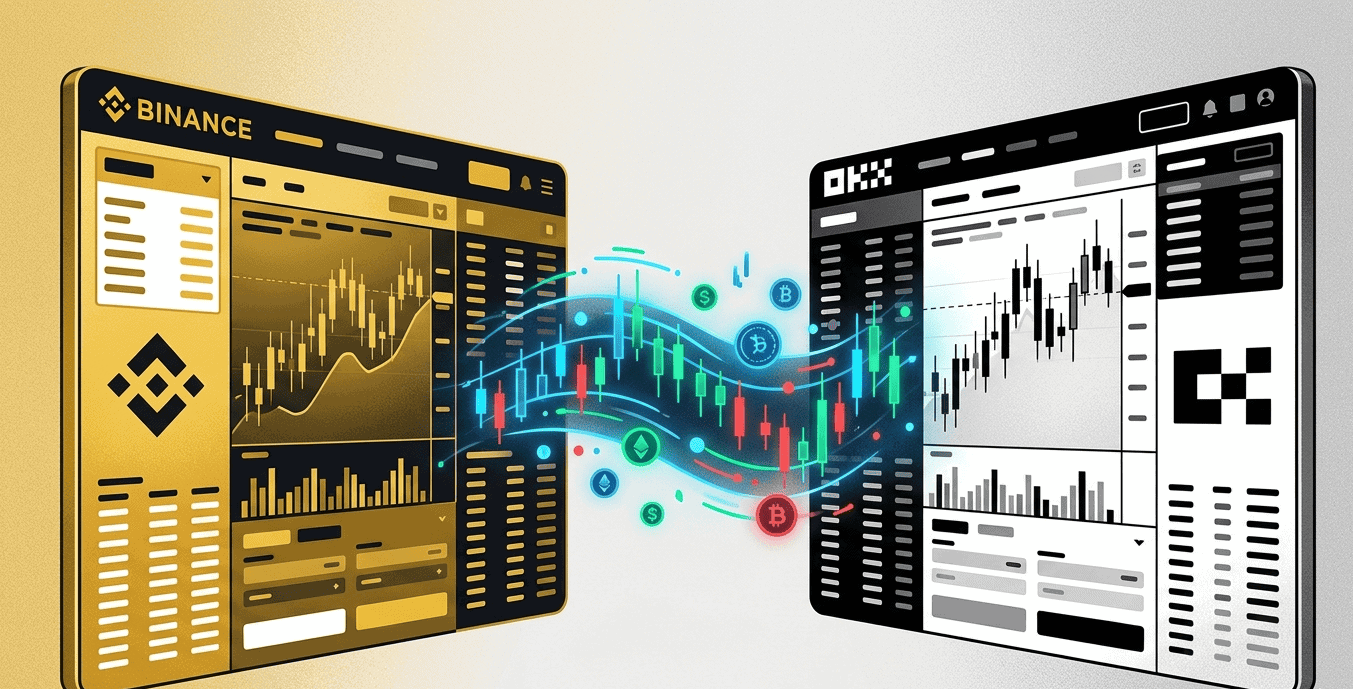
If you trade crypto outside the United States, your decision probably comes down to two exchanges: Binance and OKX.
Binance is the undisputed volume king. It processes over $16 billion in daily trading volume, lists more than 480 cryptocurrencies, and supports 45+ fiat currencies. It’s the platform where the most liquidity lives. If you want to trade an obscure altcoin at 3 AM on a Sunday and still get filled instantly, Binance is where you go.


OKX takes a different approach. It lists fewer tokens, processes less volume, and doesn’t try to out-scale Binance on raw numbers. Instead, it focuses on how the trading experience actually feels. Its interface is cleaner. Its Web3 wallet is the best built into any major exchange. Its unified account system lets you trade spot, margin, and futures from a single balance. And its trading bot ecosystem is more advanced than anything Binance offers.
Both are excellent platforms. Both are available in most of the world outside the US. And both are actively improving. The question isn’t which one is better in absolute terms. Which one is better for the way you trade?
Binance vs OKX: Side by Side
| Feature | Binance | OKX |
|---|---|---|
| Best For | Volume, selection, fiat access | UX, Web3, automation |
| Founded | 2017 | 2017 |
| Daily Volume | $16B+ | $8B+ |
| Cryptocurrencies | 480+ | 350+ |
| Spot Maker Fee | 0.10% (0.075% with BNB) | 0.08% |
| Spot Taker Fee | 0.10% (0.075% with BNB) | 0.10% |
| Futures Maker Fee | 0.02% | 0.02% |
| Futures Taker Fee | 0.05% | 0.05% |
| Max Leverage | 125x | 100x |
| Fiat Currencies | 45+ | 30+ |
| Web3 Wallet | Basic | Industry-leading |
| Trading Bots | Limited | Advanced (grid, DCA, arbitrage) |
| Account System | Separate wallets | Unified account |
| Insurance Fund | $1B SAFU | Proof-of-reserves, no named fund |
| US Available | No (Binance.US is separate) | Partial (OKX.US) |
| P2P Trading | Yes | Yes |
| Copy Trading | Yes | Yes |
| Staking | Yes | Yes |
| Launchpad | Yes (Binance Launchpad) | Yes (OKX Jumpstart) |
| Beginner Friendly | ★★★ | ★★★★ |
Fees: OKX Wins on Base Rates, Binance Wins With BNB
This comparison isn’t as straightforward as it looks.
At the base tier, OKX has the edge. Its spot maker fee of 0.08% is lower than Binance’s 0.10%. Taker fees are identical at 0.10%. Futures fees are the same on both platforms at 0.02% maker and 0.05% taker.
But Binance has a trick that OKX can’t match. If you hold BNB and use it to pay trading fees, you get a 25% discount, reducing both maker and taker fees to 0.075%. That makes Binance cheaper than OKX for any trader willing to hold some BNB in their account.
For a trader executing $10,000 in monthly spot volume at maker rates, the annual cost works out to approximately $90 on Binance with a BNB discount versus $96 on OKX. The difference is minimal at that scale. At a monthly volume of $100,000, the gap widens to $900 versus $960 annually. Still not life-changing, but it compounds.
Where OKX fights back is with withdrawal fees. OKX charges lower fees for moving Bitcoin and Ethereum off the platform, which matters for traders who regularly transfer funds to cold storage or DeFi protocols. If you make frequent on-chain withdrawals, OKX’s lower withdrawal costs can offset Binance’s trading fee advantage.
At the highest volume tiers, Binance’s VIP program offers steeper discounts that OKX’s equivalent can’t match. For institutional traders or high-frequency operations moving millions per month, Binance’s fee structure becomes significantly cheaper at scale.
The bottom line: Binance is cheaper if you hold BNB or trade at high volume. OKX is cheaper if you prefer not to hold a native token and value lower withdrawal costs. For casual traders doing under $10,000 per month, the difference between the two is negligible.
Trading Features: Binance Has More, OKX Has Better
This is where the philosophical difference between the two platforms becomes most apparent.
Binance offers everything. Spot trading across 480+ tokens. Futures with up to 125x leverage. Options. Margin trading. P2P marketplace. Binance Launchpad for new token sales. Binance Alpha for early-stage project discovery. An OTC desk for large trades. Binance Earn for passive income. Convert for simple swaps. A fan token platform. An NFT marketplace. Grid trading bots. Auto-invest. Dual investment products.
The sheer breadth is unmatched. No other exchange in the world offers as many products under one roof. If a financial product exists in crypto, Binance probably has a version of it.
The trade-off is complexity. Navigating Binance’s interface can feel overwhelming, especially for newer traders. Features are stacked on top of features. Menus lead to submenus. Finding what you need sometimes requires three or four clicks when it should require one.
OKX offers fewer products but integrates them more thoughtfully. Its unified account system is the single biggest differentiator and one of the most underrated features of any major exchange.
On Binance, your spot balance, margin balance, and futures balance are separate. Moving funds between them requires manual transfers. On OKX, everything lives in one account. Your spot holdings automatically serve as collateral for margin and futures positions. You don’t have to move money around before opening a trade. The system handles it seamlessly.
For active traders who switch between spot and derivatives frequently, that unified structure saves time and reduces the friction that causes missed trades. It’s the kind of feature that doesn’t sound exciting in a comparison table but makes a real difference in daily use.
OKX’s trading bot ecosystem is also more advanced. Grid bots, DCA bots, arbitrage bots, and smart portfolio rebalancing tools are all built in and more sophisticated than Binance’s equivalents. For traders who want to automate strategies, OKX provides better tools out of the box.
Web3 and DeFi: OKX Wins Decisively
This category isn’t closed. OKX built one of the best Web3 wallets in the entire crypto industry and integrated it directly into the exchange platform.
The OKX Web3 Wallet supports over 100 blockchains, includes a built-in DEX aggregator that finds the best swap rates across decentralized exchanges, and uses MPC (multi-party computation) technology for private key management. MPC splits your private key across multiple parties so that no single device or server holds the complete key. If one component is compromised, the key remains secure.
The wallet lets you interact with DeFi protocols, mint NFTs, bridge assets across chains, and manage tokenized positions without ever leaving the OKX ecosystem. It’s essentially a full-featured self-custody wallet built into a centralized exchange.
Binance also has a Web3 wallet, but it’s more basic. It supports fewer chains, lacks DEX aggregator functionality, and doesn’t align with OKX’s MPC security architecture. Binance has invested more heavily in its centralized products than in bridging the gap to DeFi.
For traders who split their activity between centralized exchange trading and decentralized protocol interaction, OKX’s Web3 integration is a genuine game-changer. You can execute a spot trade, bridge the proceeds to Arbitrum, deposit into an Aave lending pool, and check your portfolio across every chain, all within the same app.
Binance would require you to withdraw to a separate wallet, use a third-party bridge, and manage your DeFi positions through a different interface entirely. The OKX approach is simply more integrated.
Security: Different Approaches, Different Risks
Both platforms take security seriously, but their track records and approaches differ in important ways.
Binance maintains the Secure Asset Fund for Users (SAFU), a $1 billion emergency insurance fund that can compensate users in the event of a security breach. The fund has been publicly verified and was drawn upon during a 2019 hack that resulted in the theft of 7,000 BTC. Binance covered all user losses from the SAFU fund, and no customer lost money.
OKX doesn’t have a publicly named insurance fund of equivalent size. Instead, it relies on proof-of-reserves transparency, publishing regular attestations showing that customer assets are fully backed 1:1. OKX’s proof-of-reserves reports are among the most detailed in the industry and have been independently verified.
Neither platform has suffered a major security breach in recent years. Both use cold storage for the majority of customer funds, require multi-factor authentication, and employ dedicated security teams.
The risk profiles diverge on the regulatory front. Binance has faced significantly more regulatory scrutiny than OKX. The $4.3 billion DOJ settlement in 2023, the UK sanctions against associated exchange HTX, the WSJ investigation alleging $850 million in Iran-linked flows, and former CEO CZ’s imprisonment all represent serious reputational and operational risks.
OKX has faced fewer headline-grabbing regulatory actions. The company withdrew from several markets proactively rather than waiting for enforcement and has generally taken a more cautious approach to regulatory compliance. Its partnership with ICE (the company that owns the New York Stock Exchange) to launch oil futures on crypto rails signals a level of institutional credibility that Binance’s recent regulatory history makes harder to claim.
That said, both exchanges are offshore platforms that operate outside the direct supervision of US regulators. Neither offers the same regulatory protections as US-regulated exchanges like Kraken or Coinbase. Users should understand that trading on either platform carries counterparty risk that doesn’t exist on domestically regulated alternatives.
Liquidity: Binance Still Dominates
For traders who prioritize execution quality above everything else, Binance remains the clear winner.
Binance processes more than twice OKX’s daily volume. That translates into tighter spreads, deeper order books, and better fills on large orders. If you’re trading a major pair like BTC/USDT, the difference is minimal since both platforms offer excellent liquidity. But if you’re trading a mid-cap altcoin or entering a large position that could move the market on a thinner exchange, Binance’s liquidity advantage matters.
The difference is most visible in altcoin markets. Binance lists over 480 tokens while OKX lists around 350. Many of the tokens available on Binance but not on OKX are smaller-cap projects with limited liquidity. If you’re an altcoin hunter who wants access to new projects as soon as they list, Binance’s Launchpad and Alpha programs give you first-mover access that OKX’s Jumpstart can’t match in breadth.
OKX compensates for its smaller size with stronger derivatives liquidity relative to its size. Its futures order books are competitive with Binance on major pairs, and its options market has been growing steadily. For derivatives-focused traders, the liquidity gap between the two platforms is narrower than the spot market gap suggests.
Which One Should You Actually Choose?
Here’s how to make the decision.
Choose Binance if you trade a wide variety of altcoins and need access to 480+ tokens. If you want the deepest liquidity in the market for large orders. If you’re willing to hold BNB for fee discounts. If you value early access to new token launches through Launchpad. Or if you want the $1 billion SAFU fund as a safety net.
Choose OKX if you value a clean trading interface over raw feature count. If you actively use DeFi and want Web3 wallet integration built into your exchange. If you want advanced trading bots for automated strategies. If you prefer the unified account system that eliminates manual fund transfers. Or if regulatory risk concerns make you prefer a platform with fewer headline-grabbing enforcement actions.
Use both if you’re a serious trader who wants Binance’s liquidity for spot and altcoin trading alongside OKX’s unified account and Web3 tools for derivatives and DeFi. Many professional traders maintain accounts on both platforms and route orders based on which exchange offers the best execution for each trade.
And regardless of which exchange you choose, the same rule applies: don’t store more crypto on any exchange than you’re actively trading. Move the rest to a hardware wallet where you control the keys. Exchanges are for trading. Self-custody wallets are for holding.
FAQ
Which exchange has lower fees, Binance or OKX?
OKX has a lower base spot maker fee (0.08% vs 0.10%). But Binance becomes cheaper if you hold BNB, which gives a 25% fee discount, dropping both maker and taker fees to 0.075%. Futures fees are identical on both platforms. OKX charges lower withdrawal fees. For casual traders, the difference is negligible. For high-volume traders, Binance’s VIP tiers offer steeper discounts at scale.
Which exchange is more secure?
Both use cold storage, multi-factor authentication, and dedicated security teams. Binance maintains a $1 billion SAFU insurance fund that has been used to cover user losses. OKX publishes detailed proof-of-reserves attestations. Binance has faced more regulatory actions ($4.3B DOJ settlement, UK sanctions links, Iran allegations). OKX has taken a more cautious regulatory approach with fewer enforcement headlines.
Which exchange is better for DeFi and Web3?
OKX wins decisively. Its built-in Web3 wallet supports 100+ blockchains, includes a DEX aggregator, uses MPC private key security, and lets you interact with DeFi protocols without leaving the app. Binance’s Web3 wallet is more basic with fewer chains and less DeFi integration. For traders who split activity between centralized and decentralized platforms, OKX’s architecture is significantly more advanced.
Disclaimer: This article is for informational purposes only and does not constitute financial advice. Cryptocurrency investments carry significant risk. Always conduct your own research before making any investment decisions.