
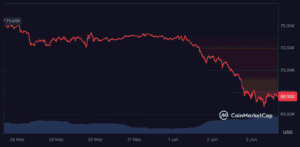
Bitcoin is trading at $66,922 on Tuesday morning. That puts it 47% below the $126,198 all-time high reached in October 2025. The decline has been relentless. No sustained bounce. No multi-week recovery. Just a grinding, methodical selloff that has taken BTC from $82,000 in early May to below $67,000 in early June.
The numbers are stark. Spot Bitcoin ETFs posted $2.3 billion in net outflows in May, the worst month since their launch. Over 40% of Bitcoin’s total supply is now held at a loss. Strategy is $5.7 billion underwater. The Fear and Greed Index has been stuck below 25 for weeks. And the three forces that drove the selloff, ETF outflows, the Iran conflict, and Strategy’s first sale, haven’t shown any signs of reversing.


Every holder is asking the same question: when does this end?
The honest answer is that nobody knows the exact date. But analysts, on-chain data, and historical patterns all point toward a timeline that’s worth understanding even if it doesn’t give you the precision you want.
The Analysts Are Split Into Three Camps
The range of credible recovery forecasts has never been wider, reflecting genuine uncertainty about how long the current downturn lasts.
The optimists see a recovery beginning this month. CoinDCX projects BTC could reach $76,500 to $78,000 by June 30 if the price reclaims the EMA cluster at $76,400 to $76,700. Meta AI’s model predicts $95,000 by the end of June, which would require a 42% rally in less than four weeks. That forecast is aggressive to the point of being unrealistic given the current flow data, but it reflects the view that Bitcoin is deeply oversold and due for a sharp reversion.
The moderates see a recovery taking until late 2026 or early 2027. 24/7 Wall Street described the most realistic window for reclaiming the $126,000 all-time high as late 2026 to early 2027, where analyst forecasts cluster and post-halving cycles typically peak. That timeline assumes ETF flows eventually reverse, the Fed cuts rates in the second half, and no additional geopolitical shocks derail the recovery.
The bears think the bottom hasn’t arrived yet. Analyst Benjamin Cowen places probability on a new cycle low in 2026, with October as his base case for the trough. 10X Research and Peter Brandt see potential for Bitcoin to drop to the $60,000-$65,000 range before any meaningful recovery begins. Under the bearish scenario, reclaiming $126,000 becomes a 2027 event at the earliest.
All three camps agree on one thing: the recovery path runs through specific price levels and specific catalysts. Without those, the timeline stretches further regardless of which camp is right about the bottom.
The Price Levels That Define the Recovery Path
Bitcoin doesn’t recover in a straight line. It needs to reclaim specific technical levels in sequence, with each level serving as a checkpoint confirming the trend is shifting.
The first level is $73,869, the 0.236 Fibonacci retracement. Bitcoin needs to close above this level for three consecutive days to neutralize the current bearish setup. It’s the minimum proof that selling pressure is easing and buyers are stepping back in. Right now, BTC is nearly $7,000 below this level.
The second level is $76,400 to $76,700, where the 20-day, 50-day, and 100-day EMAs cluster. Reclaiming this zone would confirm that the short-term downtrend has broken and shift the momentum from sellers to buyers. Every rally attempt in May failed at or below this level.
The third level is $82,785, the upper channel resistance where early May’s rally was rejected. Breaking above this confirms that the multi-week correction is over and a new uptrend has begun.
The fourth level is $100,000 to $110,000, the zone where holders who bought near the top will look to sell at breakeven. Pushing through this supply wall requires sustained institutional buying.
And the final level is $126,198, the all-time high. Breaking into price discovery above it is the hardest thing any asset can do and requires the kind of conviction that only comes from strong macro tailwinds, rising ETF inflows, and a market that believes the future is better than the present.
Each step builds on the previous one. Skip one, and the recovery stalls. The path from $67,000 to $126,000 isn’t one leap. It’s five checkpoints that take weeks or months to clear.
The Three Catalysts That Actually Matter
Forget the noise. Three things will determine whether Bitcoin recovers in 2026 or whether the bear market extends into 2027.
The first is the FOMC meeting on June 17-18. Fed Chair Warsh’s first rate decision is the most important macro event on the calendar. If he signals rate cuts despite elevated inflation, risk assets rally, and the institutional rotation that drove ETF outflows reverses. If he signals that rates will stay higher for longer, the sell-off deepens and the recovery timeline pushes further out. Everything else is secondary to what Warsh says in two weeks.
The second is the Iran peace process. Every escalation in the Strait of Hormuz sends oil higher, fuels inflation, and removes the Fed’s ability to cut rates. A signed, enforced deal that reopens shipping would crash oil below $90, ease CPI, and create the conditions for rate cuts. Without a deal, the macro headwind that has been compounding every Bitcoin selloff since February continues.
The third is ETF flow reversal. The mechanical reality is simple. When institutions buy Bitcoin through ETFs, the price goes up. When they sell, it goes down. They’ve been selling for three weeks. Until daily flow data show consistent net inflows returning, the structural selling pressure will continue regardless of what happens with rates or geopolitics. Two or three consecutive days of strong inflows would break the pattern and likely trigger a relief rally.
All three working together could push Bitcoin back above $80,000 within weeks. None of them arriving could push it toward $60,000. The most likely scenario is somewhere in between: one or two catalysts materialize over the summer, producing a partial recovery that sets up a stronger move in late 2026.
What History Says About Recovery Timelines
Bitcoin has recovered from deeper holes than this. The 2022 crash took BTC from $69,000 to $15,500, a 77% decline. The recovery took approximately 14 months before Bitcoin reclaimed its previous losses and eventually surged to $126,000.
The current 47% drawdown is painful but well within the range of normal cycle corrections. Previous cycles have produced drawdowns of 50% to 80% before recovering to new highs. A 47% decline from $126,000, with a floor in the $60,000 to $70,000 range, would actually be one of the shallower corrections in Bitcoin’s history.
The April 2024 halving, which cut the mining reward from 6.25 to 3.125 BTC per block, provides another historical anchor. Every previous halving has been followed by a significant bull cycle within 12 to 18 months. The October 2025 all-time high at $126,000 fits that pattern. Whether the post-halving cycle produces another leg higher or has already peaked is the central debate among cycle analysts.
Cowen’s October 2026 base case for the cycle bottom suggests the worst is still ahead. If he’s right, the recovery to new highs becomes a 2027 story. If the optimists are right and the bottom forms this summer, the recovery could begin as early as Q3 2026.
The Contrarian Signal That Keeps Getting Louder
Long-term holder supply sits at a record 15.8 million BTC. The Fear and Greed Index reads 23. Over 40% of the supply is held at a loss. The RSI is in oversold territory. Every contrarian indicator that has historically marked cycle bottoms is flashing.
The catch is that these indicators tell you the probability of being near a bottom, not the certainty. They’ve been flashing for weeks while the price has continued to fall. Being contrarian too early is functionally identical to being wrong, at least in the short term.
What the contrarian data does tell you is that the risk-reward is shifting. Buying at $67,000, with a Fear index at 23 and long-term holders at record levels of accumulation, offers a higher probability-weighted return over 12 months than buying at $100,000 with a Greed index at 75. That doesn’t mean $67,000 is the bottom. It means the odds are increasingly in your favor the lower the price goes and the more fearful the market becomes.
For investors with a 12 to 24-month horizon, the current environment has historically produced the best entry points in Bitcoin’s history. For traders with a two-week horizon, the momentum still points down, and catching a falling knife remains dangerous.
The recovery is coming. It always does. The question is whether you need it to arrive this month or whether you can wait for the catalysts, clear the checkpoints, and let the market confirm the turn before committing.
FAQ
When will Bitcoin recover to its all-time high?
Most analysts place the recovery window between late 2026 and early 2027. CoinDCX sees a potential bounce to $76,500-$78,000 by June 30 if key resistance is reclaimed. Benjamin Cowen suggests the cycle bottom may not arrive until October 2026. The timeline depends on ETF flow reversal, Fed rate cuts, and resolution of the Iran conflict.
What price levels does Bitcoin need to reclaim?
The recovery runs through five checkpoints: $73,869 (Fibonacci retracement), $76,400 to $76,700 (EMA cluster), $82,785 (channel resistance), $100,000 to $110,000 (breakeven supply wall), and $126,198 (all-time high). Each level must be cleared in sequence, and each takes days to weeks to confirm.
Could Bitcoin drop further before recovering?
Yes. Bearish analysts see potential for a drop to $60,000-$65,000 if current support fails. Over 40% of the supply is now in loss territory. ETF outflows remain persistent. However, long-term holder accumulation at record levels and deeply oversold technical indicators suggest the probability of being near a significant bottom is increasing, even if the exact timing remains uncertain.
Disclaimer: This article is for informational purposes only and does not constitute financial advice. Cryptocurrency investments carry significant risk. Always conduct your own research before making any investment decisions.