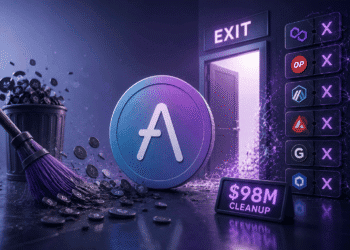

Virtuals Protocol, the AI agent platform with one of the largest token ecosystems in DeFi, announced it is migrating over $700 million in VIRTUAL tokens from LayerZero’s cross-chain bridge to Chainlink’s Cross-Chain Interoperability Protocol (CCIP).
The move brings the total value of assets that have abandoned LayerZero since April to approximately $4.7 billion. Virtuals joins Kelp DAO, Solv Protocol, Kraken, Lombard, and Re.xyz in what has become the largest infrastructure migration in DeFi history.


Every single one of these migrations traces back to the same event: a $292 million exploit in April that drained 116,500 rsETH from Kelp DAO’s LayerZero-powered bridge. That single exploit exposed a design flaw in how LayerZero’s verification network could be configured, and the consequences have been cascading through DeFi ever since.
Johann Eid, Chainlink Labs’ chief business officer, summed up the dynamic. “We are witnessing a continued flight to safety across the industry,” he said.
The flight isn’t slowing down. It’s picking up speed.
The Exploit That Started Everything
In April 2026, an attacker exploited Kelp DAO’s bridge infrastructure, which was powered by LayerZero’s messaging protocol. The attack drained 116,500 rsETH, worth approximately $292 million, making it the largest DeFi exploit of the year.
The root cause was a configuration that used a single Decentralised Verifier Network (DVN) node to validate cross-chain messages. In that setup, compromising one verifier was enough to approve fraudulent transactions. There was no redundancy. No second check. One point of failure, and the attacker found it.
What followed was a public blame war that damaged both parties. LayerZero said Kelp used a “1-of-1” DVN configuration despite recommendations to adopt a multi-verifier model. Kelp fired back that LayerZero personnel had reviewed and approved the exact configuration they later blamed for the attack. Internal communications surfaced suggesting that the single-verifier setup wasn’t an edge case but a common deployment pattern across multiple LayerZero-powered bridges.
LayerZero eventually acknowledged it “made a mistake” by allowing its own verifier network to secure high-value assets in that configuration. The company has since removed support for 1-of-1 DVN setups and announced plans to move most routes toward stricter 5-of-5 verifier arrangements.
But the damage was done. When a $292 million exploit can happen because of a configuration that the bridge provider’s own staff allegedly approved, trust in the entire infrastructure collapses. And trust, once lost in DeFi, doesn’t come back easily.
The Migration Timeline
The exodus from LayerZero has unfolded in waves, each one bigger than the last.
Kelp DAO moved first in early May, migrating its rsETH infrastructure to Chainlink CCIP while the dispute with LayerZero was still playing out publicly. Solv Protocol followed within days, shifting $700 million in tokenised Bitcoin (SolvBTC and xSolvBTC) away from LayerZero and deprecating bridge support across Corn, Berachain, Rootstock, and TAC.
Re.xyz, an on-chain reinsurance protocol with $475 million in total value locked, announced its migration on May 9. Kraken replaced LayerZero with Chainlink CCIP as the exclusive infrastructure for kBTC and all future wrapped assets on May 14. Lombard, which issues over $1 billion in Bitcoin-backed tokens (LBTC and BTC.b), joined the shift on May 15.
Now Virtuals Protocol adds another $700 million to the pile. The combined total exceeds $4.7 billion in assets that have either completed or initiated migration from LayerZero to Chainlink CCIP in less than two months.
LayerZero says more than $9 billion in bridged assets have still moved through its infrastructure since April 19. The protocol hasn’t collapsed. But losing $4.7 billion in committed TVL to a single competitor in eight weeks is the kind of exodus that reshapes competitive dynamics permanently.
Why Everyone Is Choosing Chainlink
The migration isn’t random. Every protocol that left LayerZero chose the same destination: Chainlink CCIP. Understanding why tells you what institutional-grade DeFi infrastructure looks like in 2026.
Chainlink CCIP completed a SOC 2 Type 2 examination by Deloitte & Touche LLP in April, validating the operating effectiveness of its security controls over an extended period. It also holds ISO 27001 certification. Chainlink is the only oracle and cross-chain platform to hold both of these enterprise compliance certifications.
For protocols managing hundreds of millions or billions in assets, those certifications matter enormously. They represent the same standards that banks, insurance companies, and financial institutions are required to meet. When a protocol like Kraken or Lombard needs to justify a bridge choice to its compliance team, pointing to Deloitte-audited security controls and ISO certification is a conversation-ender.
Beyond certifications, CCIP’s architecture differs from LayerZero’s in a fundamental way. Chainlink uses independent node operators running in a defence-in-depth configuration with built-in rate limits. Each cross-chain message is validated by multiple independent parties before execution. There is no configuration option that reduces verification to a single point of failure.
LayerZero’s architecture delegated verification configuration choices to the applications using it. That flexibility was a feature in theory and a vulnerability in practice. When Kelp deployed a single-verifier setup and $292 million was drained, the flexibility became the flaw.
Chainlink’s approach sacrifices some configurability for more consistent security. Protocols using CCIP don’t get to choose how many verifiers check their transactions. The security model is built into the infrastructure rather than left as an application-level decision. That rigidity is exactly what protocols managing billions in assets want.
What Virtuals’ Migration Means for AI Tokens
Virtuals Protocol isn’t a typical DeFi protocol. It’s the leading platform for AI agent creation and deployment in crypto, allowing users to build, launch, and monetise autonomous AI agents that operate on-chain.
The VIRTUAL token powers the entire ecosystem and has been one of the best-performing mid-cap tokens of 2026. Moving $700 million in token infrastructure from one bridge to another is an operationally complex undertaking that affects every user, every application, and every smart contract that interacts with VIRTUAL tokens across multiple chains.
The decision to migrate despite that complexity tells you how seriously the Virtuals team takes the security risk. For a protocol where AI agents autonomously execute financial transactions, a bridge vulnerability isn’t just a risk to user funds. It’s a risk to every autonomous agent operating across chains. An exploit that drains tokens mid-transaction could cascade through agent operations in ways that are difficult to predict or contain.
The migration also positions Chainlink as the default infrastructure layer for the AI agent economy. Virtuals joins a growing list of AI-adjacent protocols choosing CCIP. With Amazon’s Bedrock AgentCore Payments already using USDC for AI agent transactions and JPMorgan testing Chainlink for “agentic workflows” in trade settlement, the convergence between AI agents, cross-chain infrastructure, and Chainlink is becoming a defining theme of 2026.
What LayerZero Needs to Do to Survive
LayerZero isn’t dead. The protocol still processes billions in cross-chain volume and maintains significant market share in the bridge infrastructure space. But the reputational damage from the Kelp exploit and the subsequent exodus has been severe.
The company has taken concrete steps to address the security concerns. It removed support for single-verifier configurations. It announced plans to upgrade most routes to 5-of-5 verifier setups. And it has maintained that the exploit was an application-level configuration issue rather than a protocol-level vulnerability.
Those arguments are technically valid. LayerZero’s core protocol wasn’t hacked. The messaging layer worked as designed. The vulnerability existed in how Kelp configured its verification, not in LayerZero’s code itself.
But in DeFi, perception is reality. When protocols managing $4.7 billion collectively decide that your infrastructure is too risky and migrate to a competitor, the technical distinction between “our code was fine” and “our ecosystem lost $292 million” becomes irrelevant. The market has rendered its verdict.
LayerZero’s path back requires demonstrating over an extended period that its upgraded security configurations work at scale without incidents. That takes time. And every week that passes without a recovery in TVL makes the Chainlink migration look more permanent.
Disclaimer: This article is for informational purposes only and does not constitute financial advice. Cryptocurrency investments carry significant risk. Always conduct your own research before making any investment decisions.