For most of its existence, Uniswap embodied one of crypto’s most frustrating paradoxes. The protocol was a runaway success, processing trillions of dollars in cumulative trading volume and generating around $600 million a year in fees. Yet its token, UNI, captured none of it. Every cent of swap fees flowed to liquidity providers, and UNI holders were left with voting rights and a years-long promise that a “fee switch” might one day redirect some revenue to the token. That promise went unfulfilled for so long it became a running joke.
That era is now decisively ending, and the final pieces are being voted on this week.


Starting July 19, Uniswap holders begin binding on-chain votes on two proposals that would dramatically expand the protocol’s new fee-and-burn machine. One would activate protocol fees on selected Uniswap v4 pools for the first time, across seven chains. The other would extend fees to Robinhood Chain, the new blockchain that launched July 1. Both feed revenue into the UNI burn mechanism created under December’s “UNIfication” overhaul. Voting runs through July 26.
Founder Hayden Adams isn’t hiding his expectations. Citing current trading volumes, he wrote on X that “we expect the impact on UNI burn to be substantial.” And the single biggest reason for that optimism is an unlikely one: a memecoin frenzy on Robinhood Chain.
How the Burn Machine Works
To understand why this matters, it helps to understand the mechanism UNIfication created.
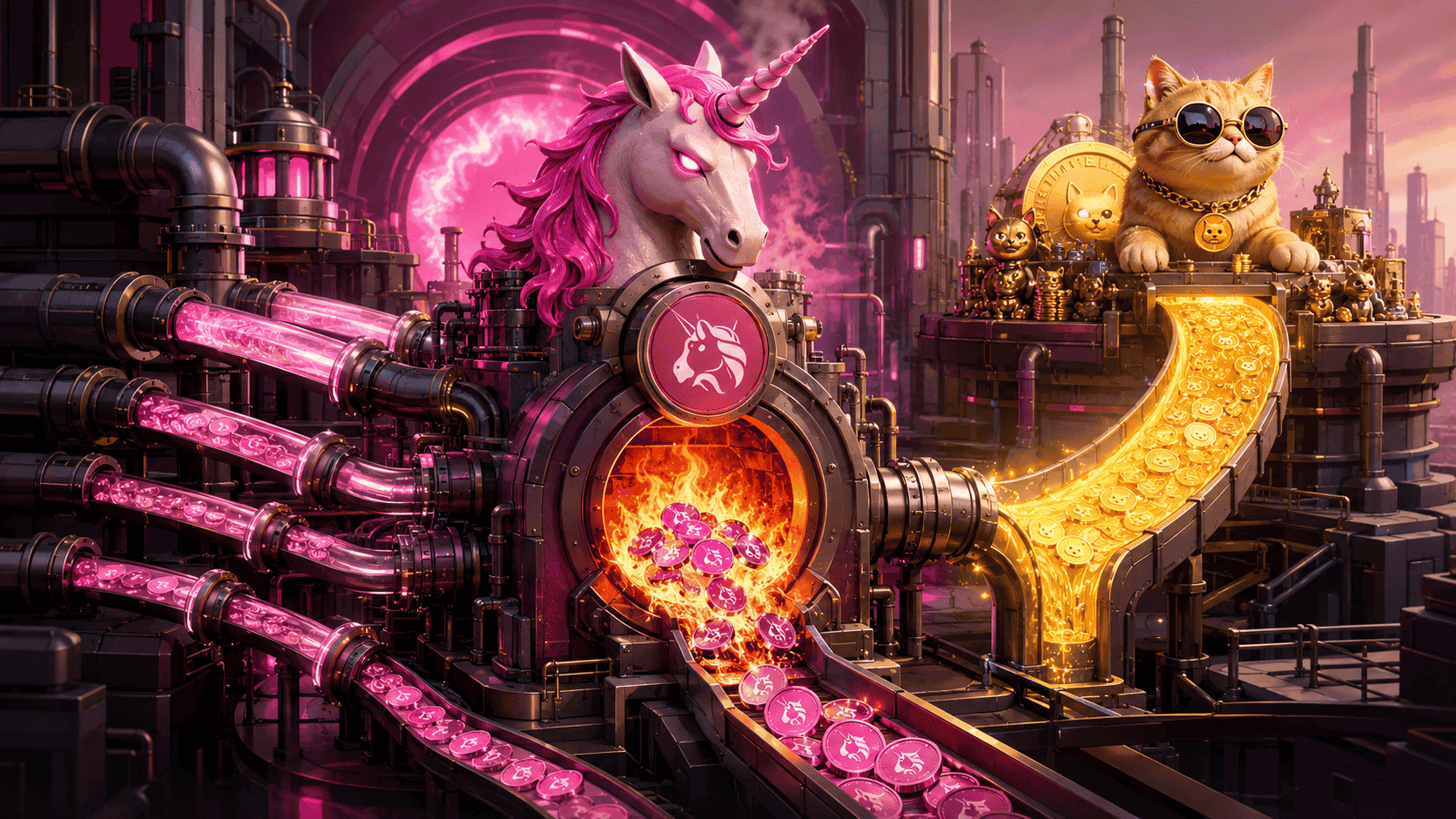
Before December 2025, UNI was a pure governance token with no economic link to Uniswap’s activity. The UNIfication proposal, passed with 99.9% support, changed that architecture fundamentally. Now, protocol fees collected on each supported chain flow into on-chain contracts, and crucially, those accumulated fees can only be claimed by burning UNI. Every strong trading day adds fees to the system, and burning UNI to claim them permanently removes tokens from supply. It’s a deflationary loop: more usage means more fees, which means more burning, which shrinks the supply.
The one-time launch of UNIfication also burned 100 million UNI from the treasury, a retroactive nod to fees the protocol never captured over the years. Since then, the burn has been rolling out chain by chain. To date, Uniswap has burned roughly 107 million UNI in total, and the burn rate recently tripled from around $51,000 to over $160,000 in a single week as activity picked up.
The two proposals now up for a vote extend this machine to new territory. The v4 proposal is technically the more complex, because v4 uses a “hooks” system that lets pools change their fees block by block, requiring new machinery (a V4FeePolicy and V4FeeAdapter) to tax something so flexible. The Robinhood Chain proposal is simpler, extending the existing v2 and v3 fee model to the new network. Together, they aim to plug the loudest new sources of trading volume directly into the supply-destruction engine.
The Memecoin Fueling It All
Here’s where the story takes an unexpected turn. The volume making Adams so optimistic is coming, in large part, from a cat-themed memecoin.
When Robinhood Chain launched on July 1 as an Ethereum Layer 2 built on Arbitrum’s technology, it was pitched as serious infrastructure for tokenized stocks and real-world assets. Instead, its breakout hit was CASHCAT, a memecoin named after the name Robinhood’s founders nearly gave the company. On July 8, Uniswap’s volume on Robinhood Chain hit $563.9 million, roughly ten times the previous day’s figure, with CASHCAT as the main catalyst. Adams marveled on X that “Robinhood chain is going absolutely crazy,” noting the volume was more than any chain other than Ethereum mainnet.
The numbers add up fast. Uniswap’s deployments on Robinhood Chain passed $6 billion in cumulative swap volume by July 10, having pulled roughly $3.1 billion in its first week alone, with early trading dominated by memecoins. On July 12, Adams posted that Uniswap was generating $5.2 million in daily fees, more than any crypto protocol except the two giant stablecoin issuers.
The market responded enthusiastically. UNI surged more than 40% in July, climbing from around $2.70 to $3.80, as traders front-ran the expected burn impact. The token confirmed a technical breakout above a long-term downtrend, though it has since stalled below its 200-day moving average.
The Honest Caveats
Before treating this as a straightforward win, two important caveats deserve attention, because they’re easy to miss in the excitement.
First, that headline $5.2 million daily fee figure isn’t what actually flows to UNI burns. That number represents total fees, the vast majority of which still go to liquidity providers, not the protocol. According to DefiLlama data, Uniswap’s genuine 24-hour protocol revenue, the portion that actually funds burns, was closer to $73,000. Protocol revenue is only a slice of total fees, taken after a governance vote, so the real burn impact is meaningful but far smaller than the eye-catching $5.2 million suggests. Governance estimates put the burn at roughly $26 million worth of UNI over 30 days at recent activity levels, still significant, but grounded rather than explosive.
Second, this pits token holders against liquidity providers. Because protocol fees are carved out of the fees that previously went entirely to LPs, activating them directly reduces what liquidity providers earn. Some LPs, including Gamma Strategies, have opposed the v4 fee proposals for exactly this reason. The risk is real: if fees make providing liquidity less attractive, capital could migrate to competing exchanges, potentially thinning the very liquidity that makes Uniswap valuable. The fee switch, in other words, taxes the liquidity it depends on, and Uniswap has to balance that carefully.
There’s also the durability question. Much of the Robinhood Chain volume is memecoin speculation that may have been boosted by gas subsidies during the chain’s launch phase. Whether that volume persists once the novelty fades and subsidies expire is genuinely uncertain. A burn engine fueled by a memecoin frenzy is only as reliable as the frenzy itself.
What It Means
For UNI holders, the significance is that Uniswap has completed one of the most-watched transformations in DeFi: turning a purely speculative governance token into what its advocates call a “cash flow asset.” The token now has a direct, mechanical link between protocol usage and supply reduction. That’s exactly the “revenue and fundamentals” narrative that many expected to dominate DeFi in 2026, and it stands in sharp contrast to tokens still searching for a reason to hold them.
For the broader DeFi sector, Uniswap’s move is a template others are watching closely. If the largest decentralized exchange can successfully tie its token to real revenue without driving away the liquidity that powers it, it validates a model the entire industry has struggled with. If LP flight or fading volume undermines it, that’s an equally important cautionary lesson.
The irony sitting at the center of this story is worth appreciating. One of DeFi’s most serious, foundational protocols is seeing its long-awaited value-capture mechanism supercharged by a cat-themed memecoin trading on a Wall Street company’s blockchain. It’s a fitting snapshot of crypto in 2026, where genuine financial engineering and pure speculation are so intertwined that the memes end up funding the fundamentals. This week’s votes will lock in the next stage. Whether the burn proves substantial or the memecoin fever cools will determine if UNI’s transformation into a cash-flow asset is durable or just another well-timed rally.
Disclaimer: This article is for informational purposes only and does not constitute financial advice. Cryptocurrency investments carry significant risk. Always conduct your own research before making any investment decisions.