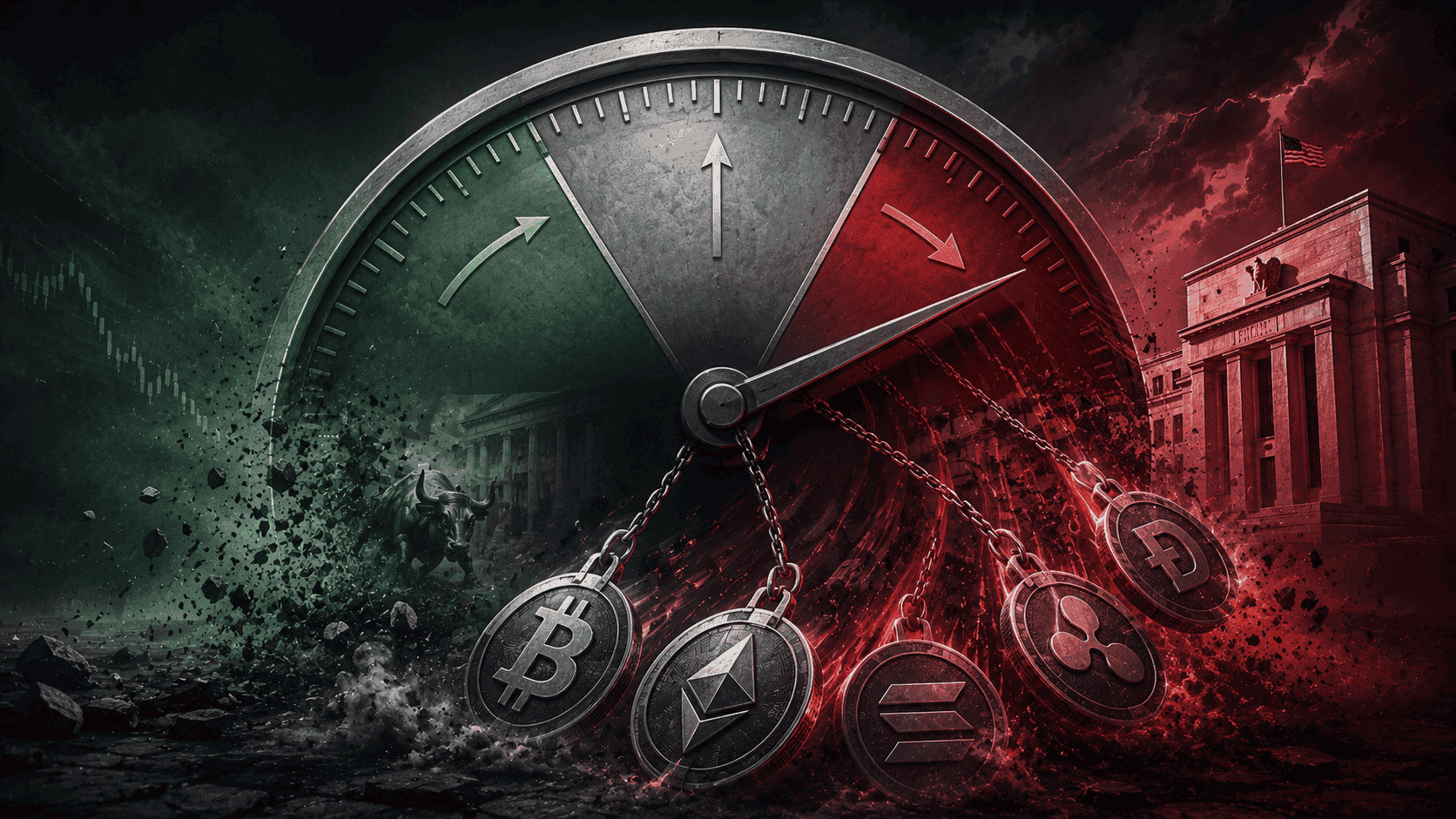
The most important number in crypto right now isn’t Bitcoin’s price. It’s the probability that the Federal Reserve cuts interest rates this year.
That probability has dropped to zero.


CME FedWatch data shows 95% to 98% odds that the Fed holds rates steady at all remaining meetings in 2026. The probability of a cut at the June 17 meeting stands at 3.6%. For July, the odds of no change sit at 84.4%. Prediction markets on Kalshi and Polymarket have more than $42 million staked on no rate change at the June meeting alone.
Meanwhile, the probability of a rate hike has surged to 46.9%. Not a hypothetical scenario that analysts discuss theoretically. Nearly a coin flip. BNP Paribas, one of Europe’s largest banks, abandoned its stable rate forecast entirely and now projects three Fed rate hikes beginning in December 2026.
Three months ago, in March, the market was pricing in two to three rate cuts by year-end. Bitcoin was above $80,000. Institutional capital was flowing into crypto ETFs. The thesis was simple: the Fed would ease, money would get cheaper, and risk assets would rally.
That thesis is gone. Completely. And its destruction explains almost everything that has happened to crypto since May.
How the Macro Thesis Collapsed
The bull case for crypto in 2026 rested on a three-step chain: inflation falls, the Fed cuts rates, and cheap money flows into risk assets including Bitcoin. Every link in that chain has broken.
Inflation hasn’t fallen. It’s risen. The April CPI came in at 3.8% year-over-year, the hottest reading since May 2023. Producer prices jumped 6%, the largest increase since December 2022. Energy prices are up 17.9% on the year. Gasoline is up 28.4%. Real wages turned negative for the first time since 2023.
The Iran conflict is the primary driver. US airstrikes, shipping disruptions in the Strait of Hormuz, and oil staying above $90 have created an energy price shock that feeds directly into consumer inflation. Every ceasefire announcement has been followed by renewed military action. The peace deal that was supposed to bring oil below $80 and ease inflation pressure remains unsigned.
The jobs market isn’t cooperating either. May’s nonfarm payrolls came in at 172,000 versus 85,000 expected. Unemployment held at 4.3%. A hot labour market means consumer spending stays firm, which keeps inflation elevated. The Fed can’t justify cutting rates when employment is this strong and inflation is this high.
The April FOMC vote was 8-4 to hold rates, the most dissents since 1992. May’s meeting minutes revealed that a majority of officials now see the possibility of raising rates if Iran-driven inflation persists. The Fed isn’t debating whether to cut anymore. It’s debating whether to hike.
What Zero Cuts Means for Crypto
The connection between Fed policy and crypto prices has never been tighter than in the current cycle.
Lower interest rates make borrowing cheaper, push investors out of safe-haven assets like Treasury bonds, and increase appetite for riskier investments including crypto. Every major Bitcoin rally in recent history has coincided with periods of loose monetary policy or expectations of easing.
Higher rates do the opposite. They make risk-free savings more attractive, increase borrowing costs for leveraged positions, and pull institutional capital away from speculative assets. When a Treasury bond pays 5% guaranteed, the opportunity cost of holding non-yielding Bitcoin increases significantly.
Bitcoin’s correlation with rate expectations has been running above 80% for most of 2026. When rate cut odds increased in March and April, Bitcoin rallied from $60,000 to $82,000. When cut odds collapsed in May and June, Bitcoin fell from $82,000 to $59,770.
The relationship is almost mechanical at this point. Institutional investors who allocate based on macro models increase crypto exposure when rate cuts are expected and reduce it when cuts are removed from the forecast. The $4.33 billion in Bitcoin ETF outflows over the past three weeks is largely a response to the rate cut thesis collapsing.
With cuts now at zero probability and hikes at 47%, the macro tailwind that crypto bulls were counting on has become a headwind. Risk assets perform poorly when rates are rising or expected to rise. Crypto, as the highest-beta risk asset in most institutional portfolios, gets hit the hardest.
The BNP Paribas Bombshell
BNP Paribas didn’t just remove rate cuts from its forecast. It went further than almost any major bank has gone.
The French bank now projects three Federal Reserve rate hikes beginning in December 2026, a complete reversal from its previous stable rate outlook. The bank’s note stated that the FOMC “will entertain hikes only in a world of bad choices: either to allow inflation to increase further and become further entrenched into the economy, or to accept the risk that a policy adjustment could prove macroeconomically destabilizing.”
That framing is extraordinary. BNP isn’t saying hikes are the right policy. It’s saying hikes are the least-bad option in a scenario where every choice carries significant risk. Raising rates while the economy is slowing could trigger a recession. Not raising rates while inflation accelerates could let prices spiral further out of control.
If BNP’s forecast proves correct and the Fed delivers three hikes starting in December, the impact on crypto would be severe. Higher rates would increase the attractiveness of bonds and savings relative to Bitcoin. Borrowing costs for leveraged crypto positions would rise. Institutional allocators would further reduce crypto exposure in favour of fixed income.
BNP’s forecast represents the extreme end of current expectations. Most analysts still expect rates to hold steady throughout 2026. But the fact that a major global bank considers three hikes plausible tells you how far the macro environment has shifted from the rate-cut consensus that prevailed three months ago.
The June 17-18 FOMC Meeting
Everything converges on Warsh’s first rate decision in 10 days.
The market is pricing a 96.4% probability that rates stay unchanged at 3.50% to 3.75%. That near-certainty means the rate decision itself is unlikely to move markets. What moves markets is the statement, the press conference, and the dot plot.
If Warsh’s statement signals that the Fed is genuinely considering hikes later in the year, the remaining 53% of the market that doesn’t yet believe hikes are coming will reprice immediately. Bitcoin would likely retest $55,000 or lower. Altcoins would face another round of double-digit declines.
If Warsh signals that the Fed is comfortable holding rates and sees inflation easing gradually, the relief rally could be significant. Bitcoin could recover toward $65,000 to $68,000 as the market pulls back from its most hawkish expectations. Crypto ETF outflows could slow or reverse.
If Warsh explicitly opens the door to cuts later in 2026, even conditionally, the reaction would be the most bullish event for crypto since the spot ETF approvals. Rate cut expectations would revive overnight. Institutional capital would rotate back toward risk assets. Bitcoin could target $75,000 within weeks.
The problem is that Friday’s jobs data gave Warsh almost no room for dovishness. Walking into his first meeting with 172,000 jobs and 3.8% inflation, any hint of easing would undermine his credibility before it’s established. The most likely outcome is a hold with hawkish language that keeps all options open, which would maintain the current status quo of zero cuts and rising hike probabilities.
What Crypto Investors Should Understand
The macro thesis that supported Bitcoin’s rally from $60,000 to $126,000 was built on three assumptions: inflation would fall, the Fed would cut, and institutional capital would flow into risk assets. All three assumptions were wrong.
Inflation rose. The Fed held. Institutional capital left through ETF redemptions and rotated into AI stocks and Treasury bonds. The result is a 52% drawdown from the all-time high and a market where the single most powerful catalyst that bulls were counting on has been removed from the forecast entirely.
That doesn’t mean crypto is finished. It means the recovery requires different catalysts than the ones the market was expecting. A resolution to the Iran conflict that crashes oil prices. A genuine economic slowdown that forces the Fed’s hand on cuts despite elevated inflation. A technological or regulatory development strong enough to attract institutional capital regardless of the rate environment.
Without one of those alternatives, crypto is fighting against the strongest macro headwind it has faced since the 2022 bear market. And unlike 2022, when rate hikes were already priced in and the worst was behind, the current environment hasn’t finished deteriorating. Hike odds are still rising. Inflation is still climbing. And the Fed hasn’t even had its first meeting under new leadership yet.
June 17 will tell us which direction the next chapter goes. Until then, the market trades on the assumption that cheap money isn’t coming. And for an asset class that has been fuelled by cheap money for most of its existence, that assumption changes everything.
FAQ
Why have rate cut expectations dropped to zero?
April CPI came in at 3.8%, well above the Fed’s 2% target. May jobs added 172,000 positions versus 85,000 expected. Energy prices are up 17.9% year-over-year due to the Iran conflict. The April FOMC vote was 8-4 to hold, the most dissents since 1992. Combined, these data points removed any justification for the Fed to ease monetary policy in 2026.
Could the Fed actually raise rates?
The probability has risen to 47% according to market pricing. BNP Paribas forecasts three hikes starting December 2026. May FOMC minutes showed a majority of officials see the possibility of raising rates if Iran-driven inflation persists. The scenario isn’t certain, but it has moved from theoretical to plausible.
What does this mean for Bitcoin and crypto?
Every major Bitcoin rally has coincided with rate cut expectations or actual easing. With cuts at zero probability and hikes at 47%, the macro tailwind that supported Bitcoin’s rise from $60,000 to $126,000 has reversed into a headwind. Institutional investors are rotating toward bonds and AI stocks that benefit from higher rates. Recovery requires either a rate cut surprise from Warsh on June 17 or alternative catalysts strong enough to overcome the macro environment.
Disclaimer: This article is for informational purposes only and does not constitute financial advice. Cryptocurrency investments carry significant risk. Always conduct your own research before making any investment decisions.