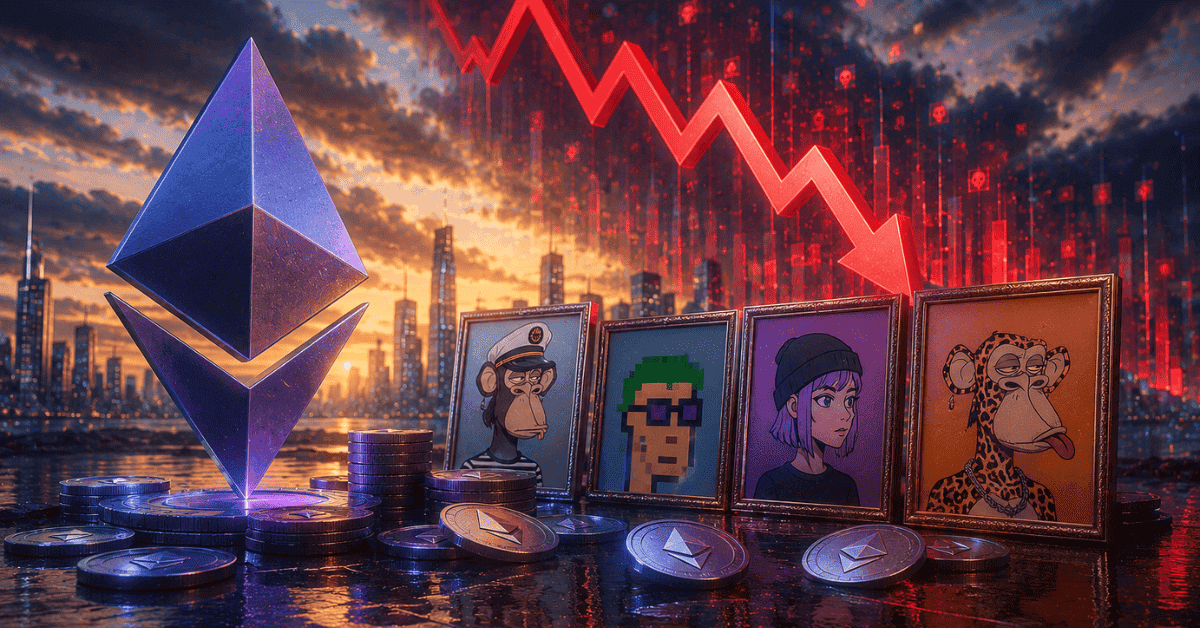
NFT market cap slump concerns are growing again as Ethereum’s weakness drags the dollar value of major collections back toward painful lows.
CoinGecko’s NFT dashboard shows the global NFT market cap sitting around $1.42 billion to $1.44 billion, with daily NFT sales volume below $3 million. That is a sharp reminder that the sector remains far smaller and less liquid than it was during the speculative boom.


The problem is not only that collectors are less active. It is that many of the best-known NFT collections are still priced in ETH, meaning their dollar value can fall even when their floor prices look more stable on an ETH basis.
Ethereum Is Still the Market’s Biggest Pressure Point
The NFT market has a simple structural issue: Ethereum remains its main pricing rail.
CryptoPunks, Bored Ape Yacht Club and Pudgy Penguins are all closely tied to ETH liquidity. When ETH falls, the dollar value of those collections can drop even if the floor price in ETH holds steady or rises slightly.
That creates a confusing market for holders.
A CryptoPunk can look stronger in ETH terms while still being worth less in dollars. A BAYC floor can decline modestly in ETH but much more sharply in dollar terms. For collectors who think in USD, that difference matters. For traders who borrowed against NFTs or track portfolio value in dollars, it matters even more.
This is the hidden risk in blue-chip NFTs. They are not only bets on collection demand. They are also indirect bets on Ethereum.
Blue-Chip NFTs Are Not Immune
The current downturn is especially uncomfortable because it is hitting the collections that were supposed to be the safest part of the market.
CryptoPunks remain the anchor of the NFT sector and still represent a major share of total blue-chip value. Bored Ape Yacht Club remains one of the most recognizable brands from the 2021 NFT cycle. Pudgy Penguins has been one of the stronger comeback stories, helped by consumer branding and mainstream partnerships.
But even those names are not protected from falling ETH prices and thin liquidity.
The issue is market depth. A collection can have cultural value, brand recognition and loyal holders, but if very few buyers are active, prices become easier to move. Low trading volume makes floor prices fragile because one or two sales can reset expectations quickly.
Low Volume Makes the Market Look Fragile
The NFT market’s daily sales volume is now small compared with its peak years.
CoinGecko shows total NFT sales volume below $3 million in the past day across tracked collections. NFT Price Floor shows a larger total market cap figure, but also confirms the same broader issue: activity is thin and the sector is struggling to support the data infrastructure built during the boom.
NFT Price Floor itself says it will shut down on June 30, 2026 due to lack of funding.
That is symbolic. A key NFT data platform closing because the market could not support it shows how far the sector has moved from the days when NFT dashboards, floor trackers and rarity tools were treated as essential infrastructure.
When market data businesses struggle, it usually means the user base is smaller, less active or less willing to pay.
The Dollar Floor Problem
The biggest lesson from this downturn is that ETH floors can be misleading.
If a collection floor rises from 31 ETH to 32 ETH, that sounds positive. But if ETH falls sharply at the same time, the dollar value of the NFT can still decline. That is exactly the kind of mismatch now hitting blue-chip NFTs.
This makes NFT performance harder to understand than simple token charts.
A token’s price is usually quoted directly in dollars. An NFT collection has at least two layers: the floor price in ETH and the ETH price in dollars. Both need to cooperate for holders to see real dollar gains.
When ETH is weak, even collections with stable native demand can look like they are falling apart in USD terms.
Why This Matters for Collectors
For collectors, the current market is forcing a more serious conversation about what NFTs are actually worth.
During the boom, floor prices were often treated like liquid market prices. In reality, NFTs are thinly traded, unique assets with uneven demand. The floor price shows the cheapest listed item, not necessarily what a holder can sell a specific NFT for quickly.
That difference becomes more important in a weak market.
If buyers are scarce, sellers may need to accept deeper discounts. If ETH is falling, waiting can also reduce dollar value even if the NFT floor stays steady. That creates pressure on holders who bought during stronger market conditions.
The result is a market where patience may matter, but liquidity matters more.
Pudgy Penguins Shows the New Playbook
Pudgy Penguins remains one of the more interesting examples because it has tried to move beyond pure NFT speculation.
The project has leaned into consumer products, brand partnerships and mainstream visibility. That strategy may not fully protect the floor price during an ETH downturn, but it gives the collection a clearer story than simple price appreciation.
That may be the direction stronger NFT projects need to take.
Collections that depend only on floor-price speculation may keep struggling. Collections that can build communities, products, IP, events or cultural relevance may have a better chance of surviving long market downturns.
The NFT market is not rewarding hype the way it once did. It is asking which projects can still matter when prices are weak.
NFT Market Cap May Need ETH to Stabilize First
A recovery in NFTs may depend heavily on Ethereum.
If ETH stabilizes, blue-chip NFT dollar floors could stop falling even without a major surge in collection demand. If ETH rebounds strongly, NFT valuations may improve faster because floors are still priced in ETH.
But if ETH keeps weakening, the NFT market may struggle to build confidence.
That is the uncomfortable truth. Many NFT collections can do everything right on branding, community and development, but their dollar valuations still depend heavily on the asset used to price them.
For now, NFTs are not only fighting weak sentiment. They are fighting Ethereum’s drawdown.
A Smaller, More Selective NFT Market
The NFT market is not finished, but it is clearly smaller and more selective.
CryptoPunks, BAYC and Pudgy Penguins still matter. They still have communities, history and liquidity compared with most collections. But the broader market has lost the easy speculative demand that once lifted almost everything.
That may ultimately be healthy.
A smaller NFT market could become more focused on durable brands, real collector demand and better infrastructure. But the transition is painful, especially for holders who bought during the boom and are now watching ETH weakness erase dollar value.
The latest NFT market cap slump is a reminder that blue-chip status does not remove market risk. In today’s NFT market, even the strongest collections still need buyers, liquidity and a stable Ethereum backdrop.
Until those return, the sector may remain stuck near its lows.
Disclaimer: This article is for informational purposes only and does not constitute financial, investment, or legal advice. Always conduct your own research before making any investment decisions.