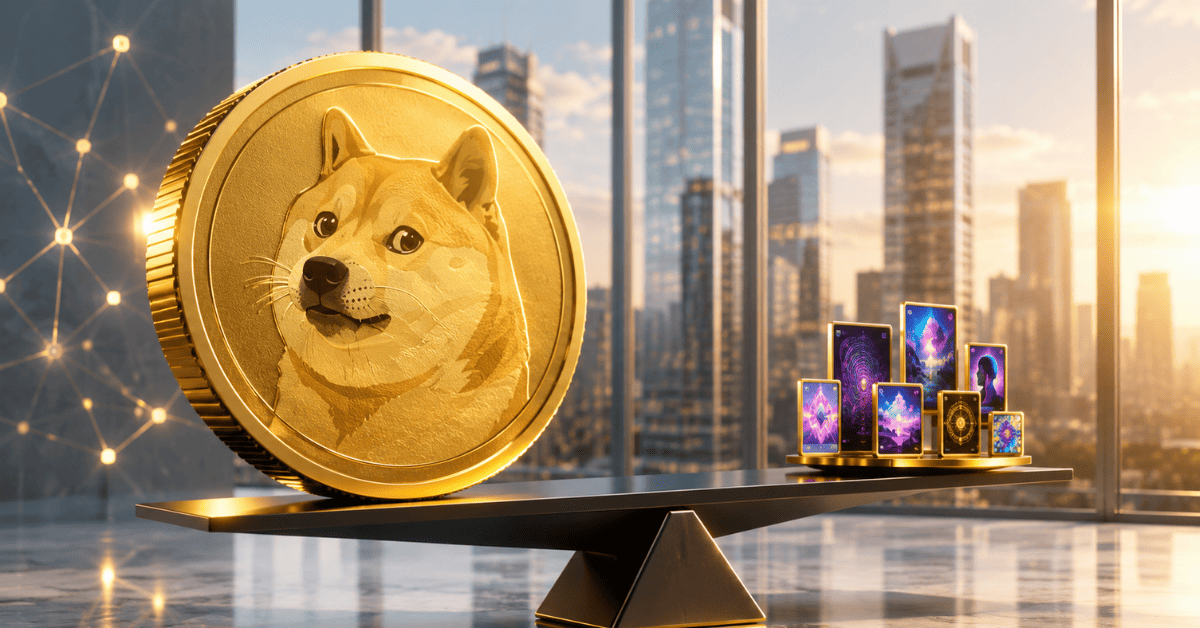
Dogecoin market cap is now more than eight times larger than the entire NFT market, which says a lot about where crypto attention has moved.
According to recent market commentary, DOGE is sitting around the top ten cryptocurrencies by market value, with a market cap near $16.5 billion.


Fun Fact: $DOGE has over 8x the entire NFT market cap 🐶 pic.twitter.com/ktRjPXjei4
— CoinGecko (@coingecko) May 8, 2026
The broader NFT market, by comparison, was estimated at around $1.97 billion. That means one meme coin inspired by a Shiba Inu is worth more than eight times the entire NFT sector.
That is a brutal comparison for NFTs.
At the peak of the last cycle, NFTs looked like the future of digital culture. Celebrities were buying profile pictures. Brands were launching collections. Marketplaces were doing huge volume. Now, Dogecoin, the original joke coin, is bigger than the whole category by a massive margin.
The Meme Coin Outlived the JPEG Boom
Dogecoin was never supposed to become a serious market heavyweight.
It started as a joke in 2013, built around internet meme culture and a friendly Shiba Inu logo. But more than a decade later, DOGE is still trading, still liquid and still widely recognized. It has survived multiple market cycles, exchange listings, celebrity-driven hype, brutal drawdowns and endless claims that meme coins are finished.
NFTs, meanwhile, had a much sharper boom-and-bust cycle.
The NFT market exploded in 2021 and 2022 as traders chased digital art, profile pictures, gaming assets and speculative communities. But when liquidity dried up, many collections lost most of their value. Marketplaces shrank. Trading volume fell. Casual buyers disappeared.
The result is strange but revealing: Dogecoin’s meme stayed liquid, while much of the NFT market became illiquid.
Why Dogecoin Still Commands a Huge Valuation
Dogecoin’s strength is simple: everyone knows what it is.
It does not need a complicated pitch. It does not ask users to understand floor prices, metadata, rarity traits or collection roadmaps. DOGE is easy to recognize, easy to trade and available on major exchanges.
That accessibility matters. A trader can buy or sell DOGE in seconds on major platforms. Many NFTs require a wallet, marketplace access, collection research and a buyer willing to take the other side. That friction makes NFTs harder to trade, especially when sentiment is weak.
DOGE also benefits from being treated like a market symbol. When traders want meme coin exposure, Dogecoin is still the default. It may not have the wildest upside compared with tiny meme coins, but it has the deepest brand recognition.
NFTs have stronger cultural depth in some places, but DOGE has broader market simplicity.
The NFT Market Is Not Dead, but It Is Smaller
This comparison does not mean NFTs are worthless.
There are still valuable collections, serious digital artists, gaming assets, brand experiments and identity use cases. Some blue-chip NFT collections continue to trade. Some builders still believe NFTs will matter for tickets, memberships, credentials, AI identity and digital ownership.
But the market is no longer in its mania phase.
The key difference is liquidity. Dogecoin trades like a major crypto asset. NFTs trade like collectibles, and collectible markets can become very thin when buyers disappear. A collection may have a quoted floor price, but that does not always mean there is deep demand behind it.
That is why the total NFT market can look small compared with a single liquid meme coin.
The Comparison Is Also a Warning About Crypto Narratives
Crypto narratives can change fast.
In 2021, many people believed NFTs would become one of the main gateways into crypto. That was not a crazy view at the time. NFTs brought artists, musicians, celebrities, gamers and collectors into Web3. They made crypto feel cultural rather than purely financial.
But attention moved on. Meme coins became easier to trade. AI tokens emerged. Stablecoins grew. Real-world asset tokenization attracted institutions. Bitcoin ETFs changed the institutional conversation.
NFTs did not vanish, but they lost the main character role.
Dogecoin’s market cap being more than 8x the NFT sector is a snapshot of that rotation. The market is saying that liquid meme culture is worth more, at least right now, than the entire NFT collectible economy.
Why This Is Embarrassing for NFT Marketplaces
The comparison is especially painful for NFT marketplaces.
Platforms built around NFT trading once looked like core crypto infrastructure. Now many of them are shrinking, pivoting or shutting down. OpenSea has moved beyond NFTs with token swaps and multichain trading. Other marketplaces have closed or reduced operations.
That makes sense when the total NFT market is so much smaller than it used to be. A marketplace model built on trading fees needs active buyers and sellers. If the market becomes thin, the business model gets harder.
Dogecoin does not need a marketplace economy. It only needs exchange liquidity and community attention. That difference has helped DOGE stay relevant while NFT platforms fight for a smaller pool of users.
The Bottom Line
Dogecoin market cap being more than eight times larger than the entire NFT market is funny, but it is also meaningful.
It shows how much the NFT sector has cooled since its boom years. It also shows how durable Dogecoin has been as a simple, liquid and instantly recognizable meme asset.
NFTs may still have a future, especially in identity, gaming, tickets and digital ownership. But as a market category, they are no longer dominating crypto attention. Dogecoin, somehow, is still standing near the top.
The lesson is awkward but clear: in crypto, the joke coin can outlive the revolution narrative.
Disclaimer: This article is for informational purposes only and does not constitute financial, investment, or legal advice. Always conduct your own research before making any investment decisions.